Key Takeaways (or TL;DR)
- DoorDash started as PaloAltoDelivery.com in 2013 and has since grown into the largest food delivery platform in the U.S., with $4.04 billion in Q1 2026 revenue (up 33% YoY) along with 27% order growth YoY.
- The DoorDash business model is built around a three-sided marketplace strategy. It acts as an intermediary connecting customers, restaurants/stores, and delivery partners through a single platform and coordinates orders and deliveries between all three to ensure smooth operations.
- The DoorDash revenue model primarily includes restaurant commissions, delivery and service charges, in-app advertising, and subscription plans.
- Beyond food, DoorDash has expanded into grocery, retail, drone, and robot delivery, scaling into new categories without rebuilding its core infrastructure each time.
The US food delivery market is worth billions, and DoorDash’s growth from a standalone app to the category leader offers a useful blueprint for understanding it. Unlike competitors, the company focused on suburban expansion and secured exclusive restaurant partnerships at an early stage.
DoorDash’s business model is a marketplace approach that connects customers, restaurants/stores, and delivery partners through a single platform. The company has revenue channels, including commissions, delivery fees, and in-app advertising, which makes it less dependent on any single one.
This becomes inspirations many delivery businesses. In this article your will learn about DoorDash’s business strategy, how it works, its revenue model, and the growth strategies behind its expansion.
What is DoorDash?
DoorDash is a leading on-demand delivery and local commerce platform connecting customers with local restaurants, grocery stores, pharmacies, and other local retailers through a unified platform.
DoorDash Company Overview
- Founders: Tony Xu, Andy Fang, Stanley Tang, and Evan Moore
- Founded Year: January 2013
- Headquarters: San Francisco, California, United States
- Area Served: Australia, Canada, New Zealand, the United States, plus 37+ additional countries through Deliveroo and Wolt
- Subsidiaries: Deliveroo and Wolt
- Company Type: Public
- Funding Amount: $5.2 billion
DoorDash’s journey began with a simple observation from four Stanford University students: Tony Xu, Stanley Tang, Andy Fang, and Evan Moore. They noticed that food delivery services at the time simply listed restaurants and left them to handle deliveries themselves, which often resulted in delays and inconsistencies.
To fill this gap, they initially launched a pilot project with a website named PaloAltoDelivery.com, which accepted orders via phone and completed deliveries to validate whether a tech-driven delivery approach could better serve local businesses and customers.
Soon after its launch, the founders rebranded it as DoorDash. They expanded their operations across the United States and diversified offerings to include grocery, convenience, pharmacy, and other daily essential item deliveries. The company has also introduced merchant technology, white-label delivery solutions, and a business ordering platform.
Let’s cover its service categories in more detail:
Services Offered by DoorDash: Complete Listing
| Service Categories | Services | Role of DoorDash |
|---|---|---|
|
Marketplace |
DoorDash Marketplace | Let’s customers browse and order food, groceries, and other daily essentials from local restaurants and retailers online |
| Wolt Marketplace | Offers similar services across Europe and other international markets. | |
|
White-Label Delivery |
DoorDash Drive | Provides delivery logistics for orders placed through merchants’ own website or app |
| Wolt Drive | Offers the same white-label delivery services in Wolt’s markets. | |
|
Merchant Enablement |
DoorDash Storefront | Provides merchants with a branded ordering website to take and manage orders directly, without paying marketplace commissions |
| Bbot | Enables QR-code ordering and payment for on-site restaurant guests | |
|
Convenience & Retail |
DashMart | Utilizes its own fulfillment centers for rapid delivery of groceries and other essentials |
| Package Pickup | Let customers request on-demand pickup and delivery of packages from partner carriers | |
| Corporate Solution | DoorDash for Business | Designed to offer special meal delivery services to employees, accepts group orders, etc. |
Today, DoorDash operates across 40 countries, serving millions of customers and businesses through its integrated commerce and logistics network. DoorDash’s Q1 2026 financial results further reflect this growth, with revenue reaching $4.04 billion, up 33% year-over-year.
On the other hand, the company’s continued growth today has also been possible because of strategic decisions to secure funding to expand into new markets and build strategic partnerships. This is worth diving into for any business looking to build or scale an on-demand platform.
DoorDash Success Timeline, Growth & Funding Journey
- 2013: Founded as a pilot project as PaloAltoDelivery.com in Palo Alto, California. In the same year, the company raised $120,000 in seed money from Y Combinator. It rebranded as DoorDash in June.
- 2014-15: Raised $17 million in Series A funding in 2014 to begin expanding outside the San Francisco Bay Area. In 2015, the company launched its first international market expansion in Toronto, Canada, and other metropolitan areas of the U.S.
- 2016-17: Made first major fast-food delivery partnerships with CKE Restaurants & Wendy’s. Also launched its DashPass subscription model.
- 2018: Overtook Uber Eats in total sales in 2018.
- 2019: It surpassed Grubhub to become the leading food delivery platform in the U.S. Also acquired Caviar and opened its first ghost kitchen facility, DoorDash Kitchen.
- 2020: Launched DashMart (its own network of dark stores) and became public by introducing its first-ever IPO on the NYSE during COVID-19.
- 2021: Expanded internationally into Europe and Asia by acquiring Wolt.
- 2022-2023: Scaled beyond food delivery by partnering with major retailers (Target, Sephora, Home Depot), transferred its stock listing to Nasdaq, and joined the Nasdaq-100 index.
- 2024: Made its debut on the Fortune 500 list (#443) and captured over 56% market share in U.S. food delivery and 60% in convenience delivery.
- 2025: DoorDash Acquired Deliveroo, a UK-based food delivery platform, for $3.9 billion and generated its first full year of positive GAAP net income of $935 million.
- 2026: Surpassed 10 billion lifetime orders and launched its DoorDash Air drone delivery program.
How Does DoorDash Work? Let’s Understand Its Three-Sided Flow
DoorDash works in a straightforward way, with each user role – customers, merchants, and dashers playing a specific role in the order journey from placement to fulfillment.
Customer
- Customers can use the DoorDash app or web platform to browse menus and place orders from local restaurants or DashMarts.
- They can confirm their order by paying for it conveniently and can also track their order in real-time and receive an order status update live.
Restaurant or Merchants
- Once the customer places an order, the request is sent to nearby restaurants or merchants.
- They accept the order requests and start preparing the order.
- Restaurants or merchants use DoorDash’s platform to manage orders, track sales, and access its customer data.
Dasher
- Once the order is prepared, the restaurant/merchant assigns the delivery to available Dashers.
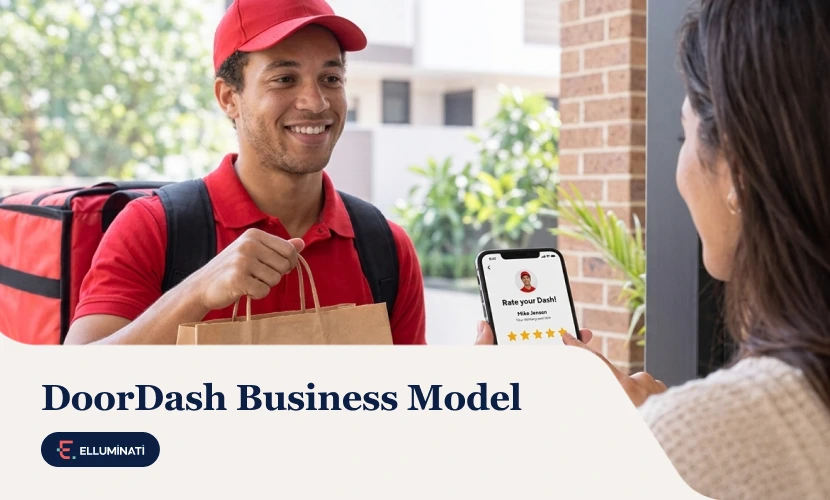
- Dashers use the DoorDash app to accept delivery requests, navigate to stores or restaurants, pick up the order, and deliver it to the customer’s address.
- Once the order is delivered, the customers and Dashers can share their reviews of each other based on their performance.
DoorDash Business Model Canvas Explained
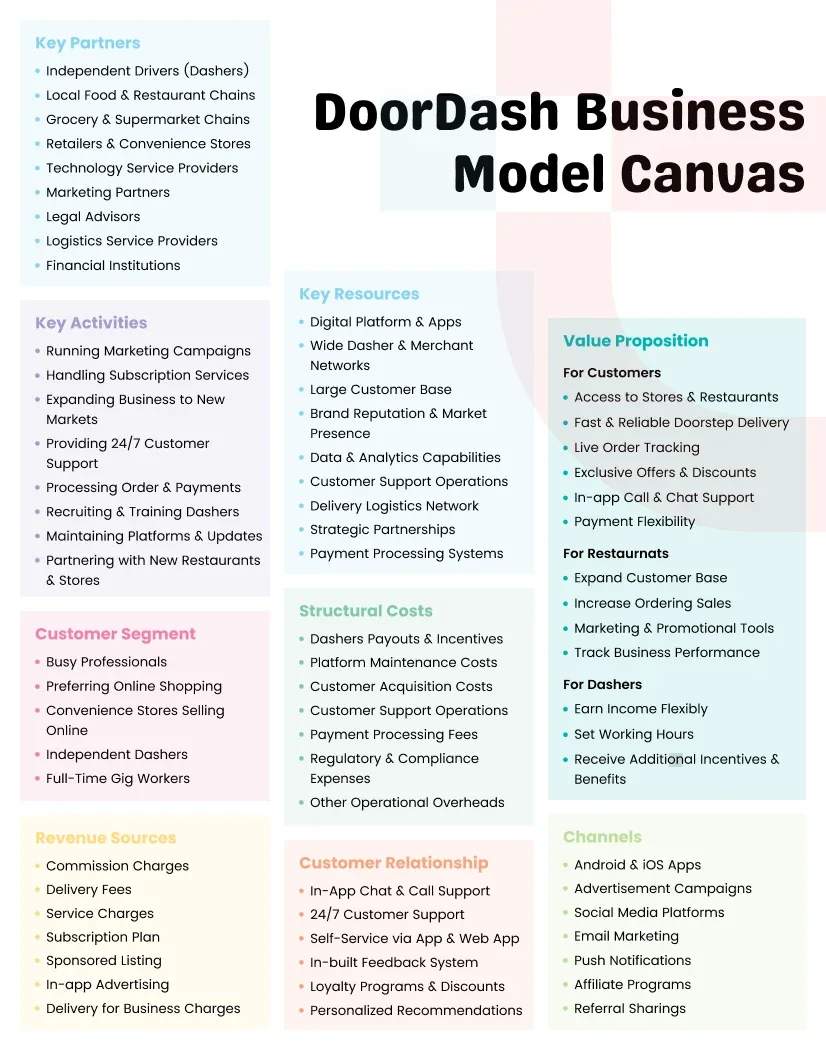
Since its launch, DoorDash has expanded well beyond food delivery. The DoorDash business model is flexible, and its elements can be adopted by any business segment, regardless of its size.
Let’s make it simple by breaking down the model into key factors.
Key Partners
DoorDash relies on several key partners to conduct smooth delivery operations.
- A huge network of dashers to deliver meals, groceries, and other essentials
- National and local restaurant chains like Wendy’s and The Keg will offer meal menus to customers for online ordering
- Grocery and retail brands like Kroger are to offer options for groceries and other retail items
- Reliable payment processors to enable secure online transactions
- Technology providers for app and web development
- Mapping and navigation services for route optimization and faster deliveries
- POS (Point-of-Sale) and middleware providers to help merchants sync their orders and menus with the platform
- Local community organizations to provide food delivery services to seniors and the underserved communities
Key Activities
The platform performs various activities to handle the platform and have effective coordination with customers, dashers, and merchants.
- Maintaining web and mobile applications to ensure efficient ordering and delivery operations
- Planning and launching marketing campaigns and referral programs to acquire and retain customers
- Partnering with new restaurants, grocery stores, and retailers to build a b supply network
- Managing real-time order routing and dasher dispatch to optimize delivery operations
- Maintaining compliance with regional regulations and data privacy standards
- Providing prompt support and solutions to user queries and issues
- Expanding into locations and service categories
Value Proposition
The multi-category delivery platform creates distinct value for its customers, merchants, and dashers.
For Customers
- Access to a wide range of local restaurants, grocery stores, and other retailers in a single app
- Can order meals, groceries, and other essentials from the comfort of their space
- Track order status in real time from the time it is placed to its delivery
- Exclusive benefits and discounts with DashPass subscription plans
- Get multiple payment options, including SNAP/EBT and Klarna BNPL (Buy Now, Pay Later)
For Merchants
- Extend customer reach without building their own technology platform
- The company’s large dashers network eliminates the need to set up its own delivery network
- Promote their products and services through DoorDash Ads
- POS system integration simplifies order management
- Data analytics tools help track customer preferences, order trends, and performance metrics
For Dashers
- Can operate flexibly at their preferred schedules
- A transparent pricing structure gives a clear idea about base pay and tips
- Hassle-free onboarding process with an in-app verification process
Key Resources
DoorDash depends on technology, customers, merchants, and dashers to keep the platform running.
- Maintaining the delivery platform and backend infrastructure over time.
- A wide Dashers network to deliver orders to customers’ doorsteps.
- Partnerships with thousands of restaurants, grocery stores, and retailers to provide a massive inventory variety to users
- A support team to respond promptly to user queries and issues
- Data analytics tools to gather users’ data and order history and optimize recommendations, pricing, and routing.
Customer Relationships
The delivery platform builds b relations with customers by offering digital convenience, prompt support, and loyalty programs.
- A self-service app and website let customers explore and order items from the comfort of their space
- 24/7 customer support provides instant solutions to user queries and issues
- Personalized recommendations suggest items based on users’ order history, location, and preferences.
- Exclusive discounts and offers through DashPass and Wolt+ subscription plans.
- A feedback system that collects dashers’ ratings to evaluate overall business performance.
- A dedicated corporate DoorDash to let companies manage group orders for their employees.
- Push notifications keep customers updated regarding their order status, platform updates, and new offers
Enter the U.S. Delivery Market with Elluminati’s Ready-Made App Like DoorDash, Built to Launch Faster, Streamline Operations, and Scale with Confidence
How Does DoorDash Make Money? Exploring Its 7 Diversified Revenue Channels
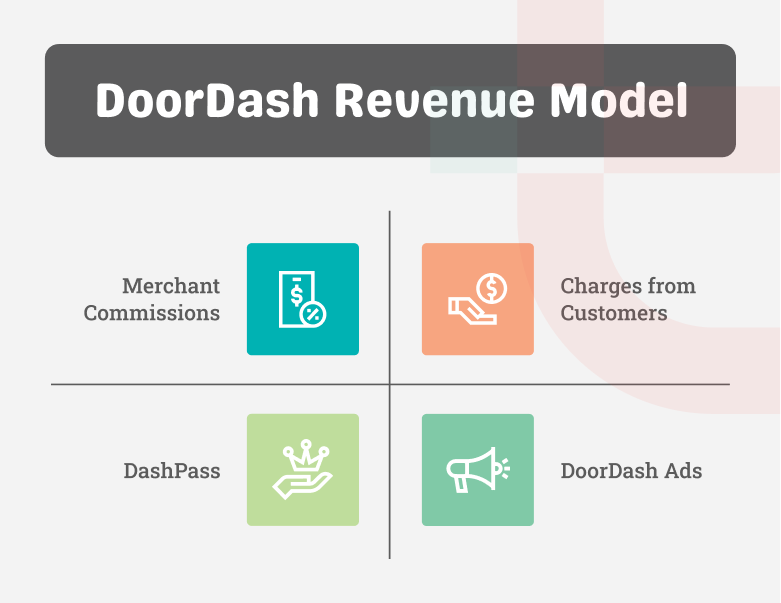
Commission from Merchants and Restaurants
DoorDash adopts a unique process to charge commission from merchants and restaurants. Instead of taking monthly charges, sign-up costs, or fixed commission costs, merchant and restaurant partners have to pay a commission when an order comes in.
Charges from Customers
Delivery Fees
The company charges customers delivery fees that range from $1.99 to $5.99. However, there are factors like distance, peak hours, and bad weather that impact overall delivery charges.
Service Charges
The company charges customers a standard service fee of around 15% of the order subtotal. Moreover, they may apply a minimum service fee on small orders. They also charge a 5% service fee on eligible DashPass restaurant orders.
DashPass (Subscription Plan)
DashPass is a well-designed subscription plan that gives its members $0 delivery fees while also giving them the benefit of minimizing service charges on eligible orders.
Its plans are mainly categorized into two tiers:
- Monthly – It costs approximately $9.99 per month, excluding taxes.
- Annually – It costs $96/ year ($8/month, plus tax)
Also, DoorDash offers a discounted DashPass for Students membership plan.
DoorDash Ads (In-App Advertising)
One of the effective revenue streams of DoorDash is through its DoorDash Ads. It follows a pay-per-order, auction-based advertising model.
Pay-Per-Order (Sponsored Listings)
Merchants only pay when an ad actually converts into an order, with merchants bidding an amount per order placed, plus a daily budget cap.
Sponsored Products (Retailer or for CPG Brands)
Auction-based pricing model using Cost-Per-Click (CPC) with individual bids settable per placement type (search, category pages, DoubleDash, etc.)
Merchants Premium Plan
Premium merchants get automatic ads baked into their higher commission rate, rather than paying separately. This means the ad value is captured indirectly through the commission tier itself, and no additional charges are required.
Also, the leftover merchants’ ad budget runs on partner platforms like Facebook and Instagram, with DoorDash directly taking a part of the income from them.
How Strategic Diversification Fueled Growth in the DoorDash Model?
International Expansion
One of the effective marketing strategies of DoorDash is that, instead of building a presence in the international market from the ground up, they acquired two well-established players, Deliveroo in the UK and Wolt across Europe.
These acquisitions gave the company instant access to Deliveroo and Wolt’s existing user base, restaurant partnerships, and delivery infrastructure, which made international expansion much easier.
Autonomous and Robot Deliveries
DoorDash launched its robot, called “Dot,” in Phoenix in September 2025 to test a delivery without a human driver. It can drive up to 20 mph and is built to handle bike lanes, parking lots, and sidewalks.
In fact, DoorDash announced its own in-house drone delivery program on 29th July, 2026. It is the 8th company to earn the FAA Part 135 air carrier certificate. This is a major regulatory milestone that legally authorizes the company to operate as a commercial air carrier for drone delivery.
Grocery and Retail Expansion
Beyond food, DoorDash has diversified into groceries, pharmacy, alcohol, and daily essentials-anchored by DashMart, its own network of mini-warehouses for fast grocery delivery, and partnerships with major retailers like Kroger and CVS – part of a broader shift toward integrating AI into grocery delivery apps.
AI-Powered Capabilities
The company is increasingly growing the adoption of AI in enhancing customer experience. They have redesigned most parts of their app and backend system with new global tech partners; it runs on the same modern infrastructure across countries.
For instance, on the advertiser side, it recently launched the Smart Campaigns tool for merchants, which automatically manages customer targeting, campaign limits, and discounts in real time. Helping advertisers run better ad campaigns automatically and for route optimizations.
Scaling of DashPass Subscription Plan
DashPass has become one of the most effective strategic growth factors for the company. It gives customers perks, including $0 free delivery, and had its best-ever year for new sign-ups in 2025.
In addition to this, the company also added two other similar programs from Wolt, Wolt+, and Deliveroo, Deliveroo Plus. Through this, the company now has over 35 million paying members across all its platforms worldwide.
Lessons Entrepreneurs Must Learn From the DoorDash Business Model
- Dominate an underserved market first, as capturing a specific market is easier when there is a lack of or lower competition. DoorDash first launched its solution in the suburban Palo Alto region, instead of directly competing with key industry players.
- Build an exclusive partnership with local restaurants and stores. The company strategically connects local chains like Wendy’s and Taco Bell, eliminating the risk of competitors.
- Focuses on operational efficiency and not just on growth. DoorDash adopted AI capabilities that work on smart dispatching and route optimization.
- Prioritizes customer retention over acquisition costs. Here, DoorDash becomes a significant example that offers a subscription and other loyalty programs to boost repeat orders and connect with a larger customer base.
- Build a platform that supports services and business expansion in the future. DoorDash started as a food ordering and delivery platform, expanded into international markets, and added multiple offerings like grocery, alcohol, and pharmacy without needing to rebuild its core delivery infrastructure.
How Can Elluminati Help You Build Your App Like DoorDash?
The success of the DoorDash business model proves how a simple idea of connecting customers with restaurants and local merchants can evolve into a leading on-demand delivery platform.
After understanding how it works, its diversified revenue streams, and the value proposition it has built for each user, it makes one thing pretty clear: a scalable delivery platform built on b infrastructure and smart execution. And that same kind of execution requires partnering with an experienced technology company.
That’s where Elluminati comes in. With 14+ years of experience, we have helped 850+ businesses across 100+ countries with our on-demand solutions. Our white-label DoorDash clone comes with a dedicated app and web panel ecosystem, real-time order tracking and management, an automated dispatch engine, and AI-powered capabilities.
FAQs
The DoorDash business model operates mainly on a three-sided marketplace strategy, connecting customers with local merchants, restaurants, and independent dashers. Customers can order meals and essentials online, merchants can extend their reach, and dashers enhance their earnings while working flexibly.
The DoorDash revenue model primarily includes:
- Merchant commissions
- Charges from customers
- DashPass subscription plans
- DoorDash Ads
DoorDash charges 15% to 30% commission from restaurants on each order placed by customers. The actual rate of commission varies based on order type, special order requirements, location, and other factors.
The following are the benefits that DoorDash offers to its registered restaurants, including:
- In-App table reservations
- Integration of the POS System
- Direct order confirmation via Email
According to the first quarter (Q1 2026) results, the company is making a profit on both the GAAP net income and Adjusted EBITDA basis. It shows that the revenue of the company is growing by 33% Year-over-Year. While the GAAP gross profit was $1.944 billion, up 6.2% YoY.
The following are the future growth strategies of DoorDash:
- Autonomous Delivery
- Grocery & Retail Business Expansion
- AI-Powered Personalization & Merchant Tools
- Growing In-App Advertising Network
The key competitors of DoorDash include Uber Eats, Grubhub, and Instacart.