Key Takeaways (or TL;DR)
- Yango first began as a ride-hailing app and expanded into a multi-service platform.
- It offers multiple services, including ride-hailing, delivery, advertising, and entertainment solutions.
- The company’s growth is driven by its hyperlocal strategy, in which it adapts its platform and strategies to local market conditions.
- The platform generates revenue from multiple sources, including driver and merchant commissions, in-app advertisements, subscription plans, delivery fees, and more.
- Expansion into multiple service segments like food and grocery delivery and entertainment, has helped Yango become an integral part of customers’ daily routine.
The Yango business model is an asset-light, platform-based strategy that connects customers with local transport, delivery, and digital services through regional partnerships rather than owning vehicle fleets or directly employing drivers.
For entrepreneurs looking to start a similar business, understanding this business model is beneficial as it highlights how a mere ride-hailing platform can expand into multiple service and diversify its revenue streams. This article will give a detailed overview of how Yango works, its business model, and monetization strategies.
What is Yango?
Yango is a multi-service platform that offers ride-hailing, food and grocery delivery, logistics, mapping, and other digital services through a single platform. While it is widely popular for its hyperlocal ride-hailing approach, it has expanded into several other verticals, including food and grocery delivery.
Detailed Overview: How Yango Transformed from a Ride-Hailing App to a Multi-Service Platform
Yandex, the Russian technology company often known as “Google of Russia,” launched “Yandex Taxi” in 2011. Further, in 2018, the company introduced Yango as an international brand and an expansion of that service, starting with a beta launch in Abidjan, Ivory Coast.
Company Overview
Founded in: October 2011
Founded by: The team of Yandex Taxi
Headquarters: Dubai
Key People: Roman Karlash (CEO)
Services: Ride-hailing, food delivery, e-grocery, advertising, mapping, and entertainment
Today, the company operates in 30+ countries across the Middle East, Latin America, Africa, Europe, and South Asia. Yango stands out through its hyperlocal approach, where it customizes its technology and services to fit local habits, languages, and communities globally.
Now let’s have a look at Yango’s success journey from its launch till today.
Yango’s Success Timeline
2011:
- Yandex launched “Yandex Taxi” in Moscow
2013:
- The service processed 3.5 million orders during the year, cementing its position as Russia’s largest taxi-booking platform.
2017:
- Yandex Taxi acquired Foodfox, a food delivery service in Moscow
2018:
- Launched its beta app in Abidjan, Ivory Coast
- Later, it expanded its operations to Finland and Israel
2019:
- Started expanding to the African market by launching in Ghana
2022:
- Launched its first delivery service in Africa, starting with parcel delivery in the Ivory Coast
2023:
- Launched “Yango Deli,” its combined food and grocery delivery app in Abidjan
- Yango Deli was launched in Lusaka, Zambia
- Also launched its operations in Pakistan
2024:
- Launched “Yango Play” (the entertainment app) in different MENA countries
- Launched its ride-hailing operations in Abu Dhabi and Dubai
2025:
- Launched its food delivery operations in Senegal
- It also launched a $20 million venture fund, Yango Ventures, to support startups in Africa, MENA, and Latin
America
2026:
- Yango committed $150 million to enter 10 new African countries.
Types of Services Offered by Yango
Yango Ride
It is Yango’s core business, which allows riders to book cabs through the mobile application. The nearest available drivers is assigned through automated dispatch systems.
Being the most frequently used service, ride-hailing helps Yango attract users to its other services and generate recurring revenue from driver commissions.
Yango Deli
In this service type, the platform allows customers to order meals or groceries from local restaurants and retail stores. This vertical creates an additional income opportunity for Yango while allowing it to create a loyal customer base through everyday
essentials delivery.
Yango Tech
It operates differently from Yango Deli. Rather than providing delivery services, the platform sells its logistics and fulfillment technology to retailers and e-commerce businesses. This service helps Yango generate revenue from its digital ecosystem.
Yango Play
This service category allows Yango to offer streaming content in select regions of the Middle East and North Africa markets.
Although the entertainment segment is disconnected from the ride-hailing and delivery segments, it helps Yango become an integral part of customers’ daily routine. With subscription plans, Yango Play allows the company to earn even on days with
low or no demand for rides or deliveries.
Yango Ads
The company allows local restaurants and retailers to promote their products and services through in-app banner ads. The businesses can extend their reach while Yango creates an additional monetization stream.
Yango Maps
It is built on the mapping and navigation technology developed by Yandex, which powers ride-hailing and delivery operations.
By having its own mapping technology, the company saves licensing costs by removing dependency on third-party providers like Google Maps. Moreover, it also helps its delivery partners and drivers navigate the routes more efficiently and ensure on-time
service delivery.
A Look into Yango’s Services by Regions
| Market | Services Offered | Countries Served |
|---|---|---|
| Africa | Ride-hailing, food delivery, courier delivery, buy&sell, Yango Pay | Angola, Cameroon, Congo, Cote d’Ivoire, DRC, Ghana, Morocco, Mozambique, Namibia, Senegal, Ethiopia |
| Asia | Ride-hailing, Yango Ventures for businesses, Yango Ads | China, Indonesia, Nepal, Singapore, South Korea, Thailand, Vietnam, Srilanka |
| MENAP | Ride-hailing, delivery, transport | Azerbaijan, Bahrain, Egypt, Pakistan, Qatar, Jordan, Kuwait, Turkiye, UAE, Oman |
| Central Asia and South Caucasus | Ride-hailing, delivery, navigation and mapping, entertainment, transport, education, and Yango Ventures for businesses | Armenia, Georgia, Qazaqstan, Kyrgyzstan, Uzbekistan |
| LATAM | Ride-hailing, food delivery, delivery, transport, and buy&sell | Bolivia, Brazil, Colombia, Guatemala, Peru, Venezuela |
| Europe | Ride-hailing, delivery, mapping, and navigation | Moldova, Serbia |
How Does Yango Work?
Yango works in a simple way where customers request the service they need, the platform matches them with the nearest providers, and fulfills the service. Let’s see in detail how Yango works.
- The customer logs into the app, enters their location, and chooses from the available service options, including ride, food order, or grocery delivery.
- Yango’s smart matching algorithm matches the customer’s request with the nearest available driver or the merchant based on the location and availability.
- The assigned driver or merchant can accept or reject the request based on their availability.
- After accepting the request, drivers navigate the route to reach the customer’s pickup point by using Yango Maps. At the same time, the restaurant or grocery store starts preparing the order after accepting
the request. - By the time the merchant prepares the order, the platform finds the nearest available delivery partner for assignment.
- As soon as the order is prepared, the merchant marks the order as “prepared,” and the platform sends the request to the delivery partner.
- The delivery partner is allowed to accept or reject the request according to their preferences.
- The delivery partner then reaches the customer’s location with the help of Yango’s maps and fulfills the delivery service.
- Customers can rate their overall experience in the app.
Understanding the Yango Business Model
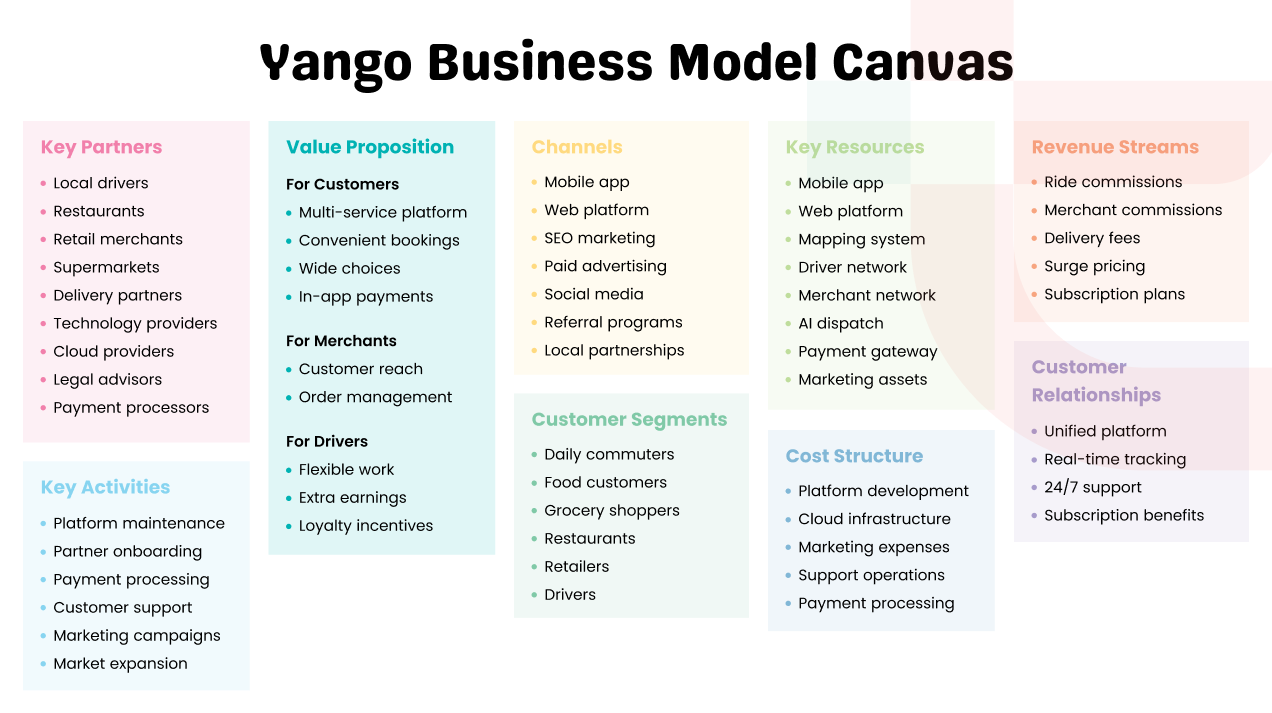
Yango business model acts as a multi-service ecosystem that connects customers with nearby drivers or merchants for ride-hailing or delivery services. Here is the detailed overview of the key aspects of the model.
Key Partners
The platform collaborates with different partners to deliver its services.
- Drivers who are well-versed in the local routes to offer ride-hailing services
- Restaurants, retail merchants, and supermarkets to provide food and grocery delivery services
- Delivery partners to fulfill deliveries of food, groceries, and parcels
- Technology providers to build and maintain a multi-service platform
- Cloud partners to have a scalable architecture of the platform for easy expansion
- Legal advisors to conduct compliant operations in different markets
- Reliable payment processors to ensure secure online transactions within the platform
Key Resources
The multi-service platform requires several key aspects to support operations, which include:
- Mobile and web applications to reach customers
- Mapping and navigation systems to help drivers and delivery partners navigate the routes
- A strong network of drivers, merchants, and delivery partners
- Payment processors to enable in-app transactions
- AI-powered dispatch system for instant assignment of drivers, merchants, and delivery partners
- Marketing campaigns to build a strong brand presence
Customer Segments
The company serves different types of users for both ride-hailing and delivery services:
- Individuals who want convenient transportation solutions for commuting
- Customers who want to order meals or groceries from the comfort of their own space
- Restaurants and retailers who want to provide online delivery services without investing in technology development
- Drivers looking for flexible and additional earning opportunities
Key Activities
Yango performs different activities to perform everyday operations efficiently:
- Maintaining the technology platform to ensure smooth operations
- Onboarding reliable drivers, restaurants, retailers, and delivery partners
- Processing payments
- Providing 24/7 support to customers for prompt resolution of queries
- Conducting marketing campaigns to build a strong brand presence
- Expanding to new markets and service categories
Value Proposition
The platform creates value for each of its stakeholders.
For Customers:
- Get access to different on-demand services through a single platform
- Can book rides or order meals and groceries from the comfort of their space
- Get a wide range of options for restaurants and grocery stores
- Can make payments directly from the app
For Restaurants and Grocery Partners:
- Reach more customers without building their own delivery infrastructure
- Manage online orders through a dedicated dashboard
For Drivers and Delivery Partners:
- Work flexibly at their preferred time
- Create an additional income source
- Increase earnings through incentives and loyalty programs
Customer Relationships
Yango builds strong customer relationships through:
- Offering multiple services through a single platform
- Allowing for tracking rides and deliveries in real time
- Providing customer support for instant resolutions
- Offering subscription plans for special discounts
Cost Structure
The company has to make several investments to conduct multi-service operations.
- Building and maintaining mobile and web applications
- Cloud infrastructure to ensure smooth scalability
- Launching marketing campaigns to extend the user reach
- Customer support team
- Fees for in-app payment processing and transactions
Channels
The multi-service platform reaches its users by promoting its services through different channels, which include:
- Mobile and web applications
- Digital marketing methods like SEO and paid ads
- Social media marketing campaigns
- Referral programs
- Co-marketing with local restaurants and retailers
Want to Launch a Multi-Service Platform? Connect with Elluminati for a White-Label Yango Clone, Flexible For Your Business Strategy
Yango Revenue Model: How it Makes Money from Diverse Sources
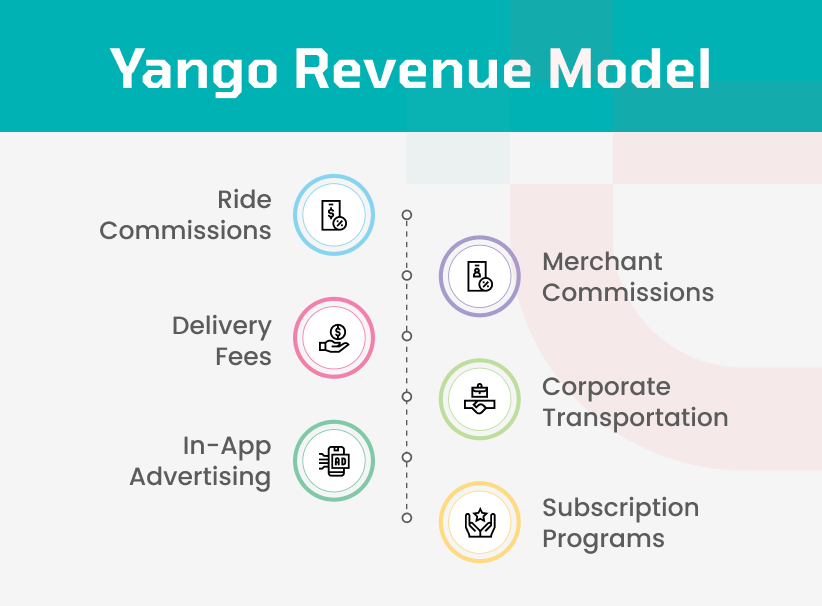
Rather than relying solely on commission structures, the company generates revenue from multiple sources like corporate transport, advertisements, and a subscription model. Let’s see in detail how Yango makes money.
Ride Commissions
Yango charges a 15%-20% commission to drivers for every ride booking received through the platform. This allows it to earn from every ride. Also, since the company does not own any vehicles, the commission model allows it to scale revenue as the ride
volume increases.
Delivery Fees
The customers have to pay a set amount of delivery fee to get ordered meals or groceries delivered to their doorstep. The delivery fees are calculated based on distance, demand, and order size. Although the amount is small, it allows the company to cover
expenses related to logistics operations.
Merchant Commissions
Restaurants and retail businesses pay a set percentage of commission to Yango for every food or grocery delivery order received through the platform. This allows the company to generate revenue from each order without managing product inventory. As more
merchants join the platform and order volume increases, this stream grows.
Corporate Transportation
The platform partners with local corporate companies to provide transportation solutions for their employees and clients.
These services are billed monthly or annually through a centralized invoicing system. This gives Yango a steady and predictable income source compared to individual rides, which fluctuate with demand and time of day.
In-App Advertising
The company allows restaurants, retailers, and other local businesses to promote their offerings through in-app banner ads. This creates an extra revenue source for businesses that work independently of their ride-hailing and delivery services.
Subscription Programs
Customers pay a set amount on a monthly or annual basis to get exclusive benefits on different services, like special discounts or priority dispatch. This helps the platform build long-term loyalty among users while creating a recurring income source.
What Can Entrepreneurs Learn from the Yango Business Model?
Yango’s growth is not only the result of the multiple services it offers, but it is also because of the different strategies implemented by it. Below are the important lessons that aspiring entrepreneurs can learn from the Yango business model.
Strongly Focus on Localization
Rather than offering the same set of services in every market, Yango follows a localized approach. It tailors its offerings and pricing strategies to the local market needs. This allows the company to attract users quickly.
Entrepreneurs should also follow a similar strategy for market acceptance rather than simply implementing the same model in every market they enter.
Build a Multi-Service Platform
Yango initially started as a ride-hailing platform. Then later it expanded to other service segments, including delivery, entertainment, and advertising, after it built a strong network of customers and drivers.
This allows the company to serve different user needs from a single platform, build long-term loyalty, and also create additional revenue opportunities.
Aspiring entrepreneurs can also begin with one service and then gradually expand to other segments as the business scales.
Invest in Intelligent Dispatch
Yango uses smart dispatch technology to match customers with nearby drivers or delivery partners, which helps it ensure on-time service fulfillment and reduce wait times for customers. This teaches how investing in the right technology is important from
the beginning, as it helps enhance user experience.
Prioritize Driver Satisfaction
Yango understands clearly that drivers play an integral role in conducting successful operations. That’s why they take several measures across different markets to build long-term loyalty among the partners.
For instance, in Peru, Yango has alliances with mechanics, gas stations, and more to benefit their drivers. These collaborations allow partnered drivers to save considerably on vehicle maintenance and repairs. Moreover, drivers also get exclusive discounts at local gas stations.
Such driver retention strategies encourage drivers to stay longer and are important for businesses to ensure service availability, so operations continue without
any disruption.
Scale Through Partnerships
Instead of building every operational capability from scratch, the platform partners with local taxi operators, technology providers, and merchants in every market they enter.
This simplifies entrance to new markets, as local partners are already familiar with the regulatory environment and the customer needs. Aspiring entrepreneurs should also follow a similar strategy for expansion without increasing operational complexity.
How Elluminati Can Help You Build a Multi-Service App Like Yango?
The Yango business model highlights how a mere ride-hailing company can transition to a multi-service ecosystem by combining technology, strategic partnerships, and a localized approach. Instead of relying on a single service, the platform generates revenue
from diverse offerings, including delivery, entertainment, and advertising.
If you are planning to build a similar platform, having the right technology partner is essential. Elluminati helps entrepreneurs launch faster with a ready-made white-label Yango clone app.
With 14+ years of experience in building on-demand solutions, our white-label, market-tested platform enables faster market entry while ensuring smooth scalability when needed.
FAQs
The Yango business model operates as a multi-service ecosystem that connects customers with local transport, delivery, and digital services through regional partnerships.
The Yango revenue model generates income from multiple sources, including:
- Ride commissions
- Delivery fees
- Merchant commissions
- Corporate transportation
- In-app advertising
- Subscription programs
A ready-made app like Yango costs between $5,000 and $25,000. It may vary depending on the level of customization and feature integrations you may need.