Key Takeaways (or TL;DR)
- The growing demand for affordable transport solutions makes it a strong opportunity to start a carpool business like Uber in 2026.
- The right type of business model helps you create a sustainable revenue strategy.
- Launching a carpool business like Uber requires careful planning for market research, business model selection, legal compliance, and app development.
- By implementing multiple monetization strategies like subscriptions, commissions, in-app advertising, and corporate partnerships, you can make money from your business.
Urban commuting is becoming more expensive and time-consuming due to rising fuel costs and traffic congestion. Due to this, more people are looking for shared mobility solutions as they can split fares and make daily mobility affordable.
If you want to start a carpool business like Uber, it is important to first understand how this model works and what it needs to build a digital platform.
This article will take you through the step-by-step process for launching, types of business models, legal requirements, marketing strategies, monetization ways, and common challenges and mistakes, so you can plan the business effectively.
Why Start a Carpool Business Like Uber in 2026
According to Market Research Future, the global carpooling market is projected to reach USD 33.52 billion in 2035 at a CAGR of 10.13%. This makes it the right time to enter this expanding market. Besides, there are several other benefits to starting the business.
Low Asset Model
The foremost advantage is that you do not have to own any fleet to get started. Drivers use their own vehicles to provide services. This asset-light approach reduces initial investment and also lets you focus on core operations.
Expandable Business Model
The business operates on a scalable model. This means you can expand operations gradually without rebuilding everything from scratch. You can start in one city, validate the model, and replicate the same strategy in other locations. This approach minimizes failure risks and enables long-term growth.
High Demand for Affordable Mobility
Rising fuel prices, increasing environmental awareness, and daily commuting needs are pushing more people towards using shared mobility solutions. Ride-sharing allows riders to split fares, which makes the trips affordable for them. This ensures consistent demand and gives you access to a growing user base.
Types of Carpool Business Models You Can Launch
Before planning for launch, it is essential to understand different types of business models. Each model is meant for a different rider segment. The right approach helps you plan your operations and revenue strategies effectively.
Daily Commute
This is the high-volume model serving office employees and students. Since these riders need to travel every day, it creates consistent booking opportunities. This consistency helps you build driver loyalty while generating a steady income.
Subscription-Based Platforms
Instead of paying per ride, users pay a fixed monthly or annual fee to access different benefits like exclusive discounts and priority services. This works well for frequent commuters. And for your business, this approach creates recurring revenue.
Intercity Ride-Sharing
The intercity ride-sharing model focuses on travel between cities or towns. Riders heading towards the same location split fares, making it an affordable alternative to buses or trains. Because it covers longer distances, this model helps you earn more compared to basic trips.
Women-Only
Safety remains a major concern for women while traveling. The women-only model addresses this concern by connecting multiple female riders with verified female drivers. It helps you build trust and long-term loyalty among a specific segment.
Corporate
This model connects employees of the same company who live in the same area and have similar working schedules. Corporates partner with you to fulfill their employees’ daily travel needs by paying a set amount on a monthly or annual basis. With bulk contracts, this segment creates a stable and predictable revenue stream.
How to Start a Carpool Business Like Uber: A Step-by-Step Process
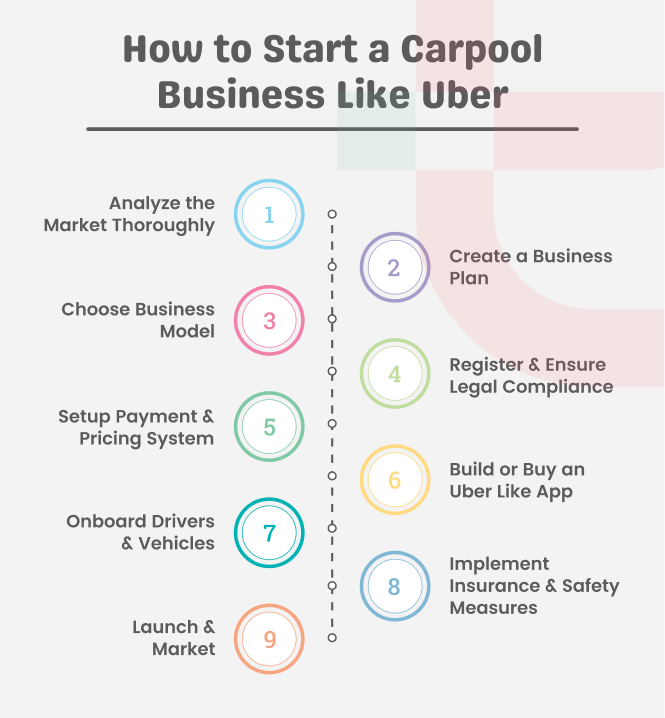
Starting a business requires thorough planning and execution. Here is the complete step-by-step process to help you start a carpool business like Uber effectively.
Step 1: Conduct Market Research
Study the target market and analyze your competitors before you decide on your business model. Ask yourself questions like:
- How large is the shared mobility market in your target city?
- Are there any underserved routes with no carpool options?
- Who will be your target riders in the region – corporate professionals, women, or intercity travelers?
- Is there an adequate driver supply available to fulfill demand?
- What are the current earnings of drivers, and how would you attract them?
Answering such questions will help you identify different kinds of risks early and create strategies accordingly.
Step 2: Create an Effective Business Plan
A business plan is a strategic roadmap that tells you how to structure, run, and grow your business.
For this,
- Define how you plan to acquire riders and drivers.
- What pricing strategies will you follow?
- What possible expenses will you have to incur for app maintenance, marketing, and daily operations?
A well-structured business plan will help you make the right decisions and also convince investors to provide funding.
Step 3: Choose the Appropriate Business Model
Now, you need to choose the business model. It involves determining how your business will work and make money.
There are various types of models available, like commission-based, subscriptions, ads, and corporate contracts. You can choose the one that best fits your business needs and goals. Today’s modern businesses opt for a hybrid approach as it creates revenue opportunities from multiple sources.
Step 4: Register and Ensure Legal Compliance
Complying with legal regulations early saves you from costly issues and penalties. It also helps you build a reliable brand position among people.
Register your company under the appropriate legal structure, like sole proprietorship, LLC, or private limited, depending on the target country. Also, research about the local regulations for transportation permits and shared mobility.
Step 5: Build from Scratch or Purchase a White Label Solution
The technology platform will be the core part of your carpool business, which will help you connect riders and drivers. For this, you can choose between custom development or a ready-made solution.
The selection will depend on different factors like budget, time to market, and long-term goals. A custom app requires developing everything from scratch, leading to significant investment and a longer timeline. At the same time, a pre-built solution is designed with tested features that enable faster launch without breaking the bank.
Step 6: Configure Payment and Pricing System
Once your platform is ready to launch, the next step is to implement the payment system. Make sure to include multiple payment methods like cards, digital wallets, and cash to cater to all rider preferences.
Besides, set up a dynamic pricing system that calculates fares based on distance, time, and the number of riders sharing the trip in real time. A well-structured system helps improve user experience and also maintain transparency.
Expert Tips:
- Instead of delaying the launch by building a fully feature-rich app, start with an MVP designed with essential features.
- Expanding city-by-city gradually will allow you to understand the legal regulations of each region more effectively than launching at once.
Step 7: Build a Network of Drivers and Vehicles
Drivers are the backbone of your ride-sharing business. Without enough drivers, you won’t be able to fulfill demand effectively. However, it is essential to build a strong network of reliable drivers instead of focusing on quantity only.
Implement a structured onboarding process with document verification, background checks, and vehicle verification. This ensures consistent service quality from day one.
Step 8: Implement Safety Measures and Insurance
Since riders will be sharing trips with strangers, ensuring rider safety is essential.
Make sure your app is embedded with safety features like an SOS button and real-time location sharing with their friends and family. Also, ensure the business has insurance coverage for both riders and drivers to safeguard it from liability.
Step 9: Launch and Market
The final stage is to deploy the carpooling platform. But instead of launching it everywhere at once, it will be better to start in one city. Gather feedback from the riders and drivers, iterate accordingly, and improve the experience.
Once your app starts running smoothly in the first region, you can replicate the approach in other markets. A validated expansion is far better than scaling too quickly without checking product fit in the market.
Begin Your Carpool Business Journey with Elluminati’s Expert Launch Strategies and White Label Uber Clone
Legal Requirements You Must Fulfill to Launch a Carpool Business like Uber
Now, let’s understand the legal regulations that you must follow to launch a ride-sharing business like Uber.
Business Registration & Licensing
To operate legally, you will be required to register your business entity.
- Choose the proper legal structure from Private Limited Company, LLC, or Corporation, depending on the country you desire to operate in.
- Have a general business operating license from the particular state where you are going to operate your company.
- Acquire a Transportation Network Company (TNC) license to operate the business via a digital network.
- Many cities require a separate business permit to conduct commercial operations. Check with your city’s licensing requirements before launch to ensure compliance.
- Get an Employer Identification Number (EIN) issued by the IRS (Internal Revenue Service) for tax filing and reporting.
Insurance & Liability Coverage
This is a mandatory need of any carpool business as it protects both riders and drivers during accidents and damage.
- TNC Insurance Period 1 covers the driver from the moment they log into your app and wait for a trip request.
- Contingent collision and comprehensive coverage cover physical damage caused to the driver’s vehicle during an active ride.
- Cyber Liability insurance protects your business in the event of a data breach or cyberattack.
- General liability insurance safeguards your business from third-party claims related to bodily injuries or property damage arising from the platform’s operations.
Driver Background Checks & Compliance
Driver verification is an essential legal requirement to ensure rider safety and maintain quality standards.
- Screen every driver for criminal records at the federal, state, and county levels.
- Verify driver’s licenses issued by the state.
- Make sure every vehicle passes safety inspection checks for brakes, lights, seatbelts, and overall road-readiness.
- Drivers must meet minimum age requirements as mandated by the federal and state authorities.
Data Privacy & App Regulations
As the app will store and process users’ sensitive information like contact details, location, and payment data, it is essential to comply with data protection rules.
- Depending on the region, you will have to adhere to data privacy norms like CCPA (California) or GDPR (Europe).
- It is mandatory for the app to publish a privacy policy, declare all data types it collects, and follow the guidelines of both the Apple App Store and Google Play Store.
- PCI DSS (Payment Card Industry Data Security Standard) adherence is a must, since it will process card payments and handle sensitive information of cards.
Expert Tips:
- Think of legal compliance as something they can deal with later, which results in costly penalties.
- Many founders believe that the same business license will work in every city and state.
- Most businesses do not verify drivers’ personal insurance during onboarding, which puts the entire company in serious legal liability.
Key Features Your Uber-Like Carpool App Must Have
The success of the carpool app depends on the experience it delivers to drivers and riders, and also on how it simplifies the management of daily operations. We have listed here the core features your platform must have.
Rider App
A rider-facing app designed to allow them to book shared rides, make payments, and track trips in real time.
- Booking rides based on routes and timing
- Seat selection as per their preferences
- Schedule rides
- Split fare calculation in real time
- Live ride tracking
- Details of co-passengers for transparency
Driver App
It allows drivers to receive trip requests, handle earnings, and optimize routes while increasing operational efficiency.
- Accept/reject ride request based on availability
- Online/offline toggle
- Dashboard for earnings overview
- In-app navigation system and route optimization
- Digital wallet integration
- Masked communication with riders
Admin Panel
A centralized dashboard allowing you to manage operations, monitor performance, and make decisions effectively.
- Monitor rides in real time
- Smart ride-matching
- Split fare calculation and management
- Revenue tracking and analytics
- Zone configuration and management
- Promotions and discounts handling
Monetization Strategies for Carpool Business like Uber
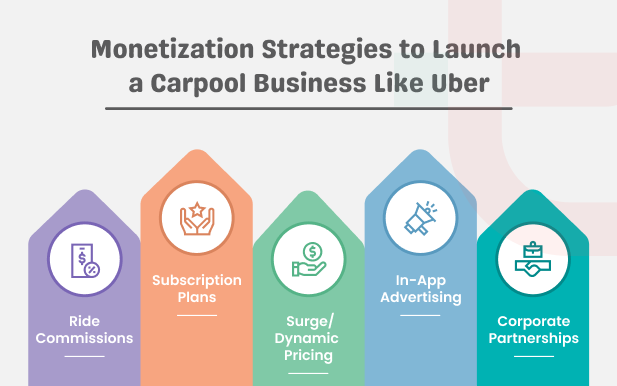
The monetization strategy determines how your platform will make money. Relying solely on ride commissions limits revenue potential. Combining multiple revenue strategies helps improve profitability.
Ride Commissions
Charge a 10% – 20% commission to drivers for each ride-sharing booking received through the platform. Allows to earn from each ride and is suitable for startups that are building their user base.
Surge/Dynamic Pricing
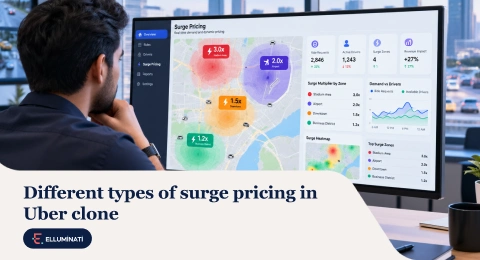
Automatically increases fares during peak times, bad weather conditions, special events, and in busy areas. Higher pricing encourages drivers to serve when demand is at its peak. This strategy is best suited for businesses operating in high-demand urban markets.
Subscription Plans for Drivers and Riders
Drivers and riders pay a set recurring amount on a monthly or annual basis to access exclusive perks like prioritized services and special discounts. It helps in generating predictable revenue. Businesses with a larger user base can implement this strategy.
In-App Advertising
Local businesses like restaurants and retail stores pay a set amount to promote their services through in-app banner ads. This helps them extend their reach and even allows you to create an additional source of income beyond basic rides. This model suits well the businesses serving a large number of users daily.
Corporate Partnerships
Partner with local corporate companies to help them manage the commuting needs of their employees and clients. It helps in generating high-value and stable revenue. Applications specifically designed to handle corporates can implement this strategy.
How Much Does it Cost to Start a Carpool Business Like Uber?
The cost to start a carpool business like Uber ranges from $25,000 to $250,000+, which includes app development, essential licensing, insurance claims, launching, and marketing. Here is the complete cost breakdown.
| Cost Component | Estimated Cost Range | What is it for? |
|---|---|---|
| App Development (MVP) | $30,000 – $70,000 | Dedicated apps for riders, drivers, and admins with core ride-sharing features like smart ride-matching and dynamic pricing |
| White-Label Solution | $1,000 – $7,000+ | Ready-made Uber clone embedded with core ride-sharing features, with complete customization options |
| Licensing & Permits | $5,000 – $10,000/year | Includes legal registrations and acquiring the Transportation Network Company (TNC) licenses |
| Insurance | $6,000 – $12,000/year | Covers vehicle damages in road accidents and the liability of drivers and riders |
| Marketing & Launch | $5,000 – $50,000+ | Launching and marketing through digital ads, SEO, and on social media platforms |
Launch Your Ride-Sharing Business Quickly and Affordably with Elluminati’s Uber Clone
Marketing Strategies to Start a Ride-Sharing Business Like Uber
Having a ride-sharing app like Uber alone will not help you achieve success in the competitive space. The right marketing strategies will help you attract riders and scale efficiently. Here are the marketing strategies that you should apply to your business.
Attract with Offers and Referral Programs
Offer exclusive discounts, cashbacks, and free rides to first-time riders. You can even reward existing users for referring your carpooling platform to their friends and family. This is the most cost-effective way to attract users when the brand is new in the market.
Collaborate with Local Businesses
Instead of reaching individual riders one by one, you can partner with local businesses, colleges, and corporate companies to access a larger user base at once. These collaborations create consistent ride demand while reducing customer acquisition costs.
Retain Riders with Loyalty Programs
Implementing retention strategies is as important as the launch of marketing methods. With loyalty programs and subscription plans, you can increase customer lifetime value and generate a predictable income.
Promote with Digital Marketing
You can promote your services digitally without spending heavily on traditional advertising. Implement SEO (Search Engine Optimization) to appear at the top of search engine results. Paid ads generate instant visibility. These strategies help in enhancing local brand presence.
Challenges You Face in Starting a Carpool Business like Uber
While the carpool business offers a strong opportunity, it also involves several operational and growth challenges.
Having Enough Driver Network
Maintaining a sufficient number of drivers is the hardest problem to solve. If driver availability is low, it directly impacts service fulfillment and rider satisfaction.
Solution: Ensuring guaranteed earnings, low commissions, and incentives can help you build a strong driver network.
Tough Competition from Uber and Other Players
Entering a market where several established players like Uber already operate is a significant challenge.
Solution: Create a unique brand presence by identifying a specific niche or underserved locations where leading platforms are falling short.
Regulatory Challenges
Legal compliance is essential to establish a trusted brand position. This includes licensing, insurance, and adhering to data privacy regulations. However, regulations vary by each city, state, and country, making compliance challenging.
Solution: Understand the legal regulations of each region before planning operations. It will help you adhere to each rule.
Balancing Demand and Supply
Even with sufficient driver supply, balancing rider demand and driver supply is very challenging.
Solution: Dynamic pricing and data-based demand forecasting can help you maintain the balance effectively.
Common Mistakes to Avoid When You Start a Ride-Sharing Business Like Uber
Many entrepreneurs make costly mistakes while rushing into the launch phase, which slows down growth. We have a breakdown of 4 common mistakes that businesses make.
Starting Without Proper Research
If you launch without understanding the target market, users, and competitors, the platform can struggle to gain traction during the initial days, which includes the risk of failure. Thorough research allows you to validate demand and launch confidently.
Ignoring Drivers
Many businesses just focus on acquiring riders and enhancing their experience. However, drivers are the backbone of your platform, so take measures to attract and retain them through low commissions, incentives, and continuous support.
Depending Solely on Commission Revenue
Although commissions allow you to earn from each ride, sole dependency on them can limit your revenue potential. Implement multiple revenue strategies like surge pricing, advertisements, and user subscription plans to ensure financial stability and create room to grow even during slow periods.
Overbuilding Before Launch
Building a fully loaded app with all features before launch can waste resources and even delay speed-to-market. Instead, start with an MVP (Minimum Viable Product) embedded with core features like trip booking, payments, and real-time updates. You can iterate later based on real user feedback.
Expert Insights:
- Instead of building a feature-heavy app, these businesses have focused strongly on building trust among riders and drivers from day one.
- Rather than launching in every possible region, they own one underserved segment and area, which helps them compete with established players like Uber.
How Elluminati Can Help You Start a Carpool Business Like Uber?
To start a carpool business like Uber, you need proper planning and execution, from choosing the appropriate business model to understanding the market and ensuring compliance. Every step plays a crucial role in driving success. However, a reliable technology platform is essential to manage ride-sharing operations and connect drivers and riders.
This is where Elluminati comes in. With an experience of 14+ years, we have helped 450+ mobility businesses across the globe with our Uber clone app. Besides ready-made solutions, we also offer strategic consultation to help you launch in different regions, adapt to local regulations, and scale your carpool business effectively with the right approach.
FAQs
The cost to launch a carpool business like Uber ranges from $20,000 to $150,000+, including app development, licensing, insurance, marketing, and launching.
To start a carpool business like Uber, you need to follow a step-by-step approach:
Step 1: Analyze the market thoroughly
Step 2: Create a business plan
Step 3: Choose the appropriate business model
Step 4: Register your company and acquire licenses
Step 5: Build or buy an Uber like ride-sharing platform
Step 6: Set up payment systems
Step 7: Onboard drivers
Step 8: Implement insurance measures
Step 9: Launch and scale strategically
Licenses like a personal driver’s license, business license, TNC driver permit, vehicle registration, and background check clearance are essential to start a ride-sharing business like Uber.
The launch timeline depends on the type of development approach you choose. It takes around 4 to 6 weeks for custom development, while a ready-made Uber clone solution takes around 2 to 3 weeks for launch, depending on the customization level required.
The best business model for a carpool business depends on the target market it is aimed at operating in. However, combining a commission-based peer-to-peer (P2P) model with corporate partnerships is considered to be the most sustainable approach. Besides, other best models include subscription plans and in-app advertising.
Yes, it is possible to start a carpool business like Uber without any prior experience. But it requires substantial research, legal compliance, and implementing insurance measures rather than just having an app. You can partner with an experienced technology company like Elluminati to launch the business with strategic guidance.
You can start a carpool business even without having any technology expertise by opting for a pre-built white label platform.