Key Takeaways (or TL;DR)
- Major Uber clone myths circulating in the market are related to legality, scalability, and customization.
- The Uber clone app misconceptions exist mainly due to technology vendors setting unrealistic expectations during sales, skeptics, and outdated blogs available online.
- The reality is that an Uber clone is scalable and fully customizable, which is built on an already tested business model.
- With the ride-hailing market growing rapidly, a white label solution allows you to enter the market quickly.
- The success of your ride-hailing business does not depend on the technology platform alone. It also relies on how well you onboard drivers and implement marketing strategies.
Many founders consider entering the growing ride-hailing industry with an app like Uber. However, they stop midway. Not because the market is too competitive to enter or the idea will not work. It’s because somewhere along the way, they heard some Uber clone myths, which made them believe that the whole process is risky and illegal.
But reality hits completely differently. Choosing a pre-built solution is about stepping into the market quickly with a proven formula rather than wasting time building everything from scratch on mere assumptions.
This article will clear all the common myths circulating in the industry and give you actual facts so you can make a confident decision based on reality.
Why Do So Many Uber Clone Myths Exist?
Uber clone app misconceptions have been spreading across the market for years. These false claims mislead and confuse the founders who are considering entering the ride-hailing industry with an Uber clone. That’s why it becomes essential to understand where these originate. These myths usually exist because:
- Most technology vendors set unrealistic expectations for entrepreneurs to close deals faster
- Blogs created 5+ years ago provide outdated information about technology.
- Skeptics misinterpret the word “clone” as a copy of someone else’s app.
Such things together give rise to myths, making the apps appear riskier and less reliable than they really are.
Debunking The Common Uber Clone Myths: Actual Facts to Know
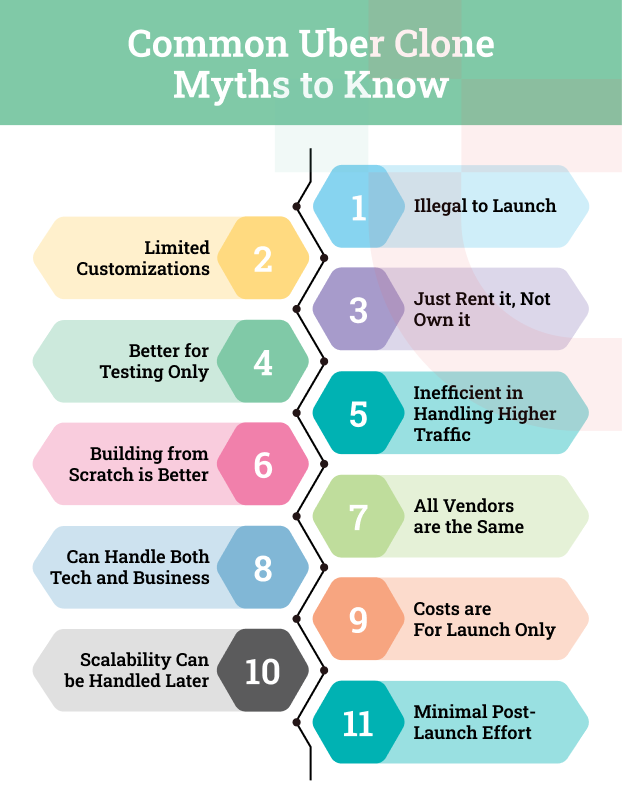
Now that you have understood where such misconceptions originate, it’s time to break down all Uber clone myths and see the real facts hidden behind them.
Myth #1 – An Uber Clone is Illegal to Launch
It is believed that clone apps are a copy of Uber’s system and are therefore illegal to use.
Reality Check: White label apps are built on original code. So, you are not copying Uber’s brand or proprietary systems. You are just using a business model that is already tested and has remained successful in the market.
Just as any e-commerce business can start an online store without copying Amazon, similarly, any ride-hailing business can build an app without infringing on Uber. Because the business model is not owned by Uber.
You just need your own original code, branding, app store compliance, and local transport permits to operate legally.
Myth #2 – An Uber Clone Allows Limited Customizations
A common belief is that an Uber clone app looks and functions the same. That’s why you can not differentiate your brand from competitors.
Reality Check: White label platforms are fully customizable. You can modify branding, service categories, fare logic, and even driver workflows according to your business needs.
Customization levels completely depend on the technology partner you work with and not the technology itself.
Myth #3 – You do Not Get Full Ownership
Buying an Uber clone means you are renting someone else’s software. You do not get full ownership and control of the app.
Reality Check: Ownership depends on the model you choose. Some vendors offer full source code ownership, where the entire codebase is transferred to you. Others operate on a subscription basis, where you pay a set amount to access the platform.
That’s why it is recommended to always confirm the model before signing the agreement. Check for ownership clauses, NDA, and IP transfer documentation. Proper agreements early prevent surprises later.
Myth #4 – Clone Scripts are for Testing Only
These apps are basic prototypes that are meant for testing ideas and not for running the actual ride-hailing business.
Reality Check: Today’s ready-made apps are embedded with all essential and tested features like GPS tracking, dynamic pricing, SOS safety features, and multi-lingual support.
So, pre-built solutions like Uber are built on proven technology that guarantees success in the market.
Myth #5 – An Uber Clone Falls Back in Handling Higher Traffic
As your user base grows, the clone will either crash or slow down as it is unable to handle higher traffic.
Reality Check: Scalability has nothing to do with the app being a clone. It depends on the architecture it is designed for. Modern solutions are designed with cloud infrastructure that ensures smooth scalability when needed.
If your platform struggles to scale, it points towards poor development and not the clone’s scaling capabilities.
Myth #6 – Custom Development Wins Over White Label Solutions
Building a ride-hailing app from scratch is always better than having a ready-made solution.
Reality Check: Modern ready-made solutions are built on a market-tested business model. But a custom build is way riskier as it requires building everything from scratch, which adds uncertainties for budget, time-to-market, and technical stability.
The real advantage lies in entering the competitive market quickly with a pre-tested solution.
Here is the practical comparison to show you the difference between a clone and a custom app.
| Factor | Custom Development | Uber Clone App |
|---|---|---|
|
Cost |
Significant investment is needed |
Lower upfront cost |
|
Time to Launch |
Needs several months |
Can go live in a few days or weeks |
|
Risk |
Mostly higher as the idea is not tested |
Lower as it operates on a tested model |
|
Maintenance |
Requires a dedicated technical team |
Supported by the vendor |
By understanding the difference clearly, you can easily make a better choice based on your needs and goals.
Myth #7 – All White Label Taxi Vendors Offer the Same Product
It does not matter which clone provider you pick. Everyone delivers a similar product.
Reality Check: Vendor quality varies a lot in terms of technical expertise, post-launch support, and app updates.
Some vendors only focus on making sales. But others believe in building long-term relations with customers by providing continuous support even after the app goes live.
It will be better to ask the following questions before committing to anything:
- Do you provide source code ownership?
- How does your customization process work?
- How do you provide post-launch support?
- How often do you release updates and security patches?
- Can you show any live platforms that you have built?
Answers to these questions help you choose the right and reliable technology partner.
Myth #8 – Both Tech and Business Can Be Handled Simultaneously
Founders can handle technical operations while keeping a better focus on core business operations.
Reality Check: Technology management is a full-time responsibility that needs dedicated attention. You have to perform several operations regularly, like maintaining the app and checking for updates, which require significant time. These operations can easily distract you from focusing on your business operations.
A well-built platform handles the technology in the background, so you can easily concentrate on crucial operations like marketing, driver onboarding, and customer retention.
Myth #9 – Expenses Occur During Launch Phase Only
Once the app is launched, you will not have to incur any major expenses.
Reality Check: Launch costs are just the beginning. Real expenses arise post-launch for server hosting, bug fixes, security audits, and OS updates.
Many founders overlook these ongoing expenses while planning the budget, resulting in financial surprises later. That’s why it is always recommended to have a better understanding of Uber clone development cost in the beginning.
Myth #10 – Scalability Issues Can be Tackled Later
You can address the scalability problem after launch. It does not need attention from day one.
Reality Check: Scalability is one of the most important growth factors for any ride-hailing business. And that’s why it has to be designed into the platform from the beginning.
A non-scalable system can easily slow down or delay responses when the user base suddenly increases. But an Uber clone involves a scalable cloud architecture, which allows it to handle the spikes smoothly and efficiently.
Myth #11 – App Will Run Smoothly Post-Launch by Itself
The platform will not require any maintenance effort from your end after going live. It will run smoothly on its own.
Reality Check: Every digital platform requires regular maintenance for updates, even after launch, to stay reliable and competitive.
Without regular updates, apps can degrade in performance, which negatively impacts the user experience. On the contrary, platforms with regular update cycles, continuous improvements, and bug monitoring help you ensure a consistent performance.
Want to Enter the Ride-Hailing Market with a Tested Solution? Connect with Elluminati for Expert Strategies and Solutions
Facts of Uber Like App – What Founders Actually Need to Know
After clearing the myths, it’s important to understand the actual truth. Below are the real facts about Uber clones that businesses should know.
The Ride-Hailing Market Is Growing, and This is the Right Time
According to Statista, the number of ride-hailing app users is expected to reach 2.34 billion by 2030. So, the numbers speak for themselves. This is not a saturated market.
It is expanding rapidly, and the opportunity is wide open for businesses that are ready to enter the market quickly. In such scenarios, white label clones help entrepreneurs enter at the right time without spending months or years building from scratch.
Success is Actually Driven Post-Launch
Many entrepreneurs believe that launching an app will be enough to build a successful taxi business. However, app launch is just the beginning. The actual success depends on how well you operate the business after launch. It mainly includes:
- How quickly you are able to build supply in the city where you have launched your business
- How well does your pricing strategy match the local market expectations
- What kind of user retention strategies, like referral programs and loyalty incentives, have you planned
- What marketing strategies are you implementing to attract users
- How quickly are you able to resolve user queries and disputes
None of these operations is technology-related. These are the business strategies and decisions. Your success will be determined by how effectively you implement them in your target market.
White Label Uber Clone is a Strategic Business Decision
Even after the myths are cleared, one common question will still be running through your mind: Will opting for a white label taxi app be the right decision for your business? According to a recent study, the global ride-hailing market is projected to reach USD 412.7 billion by 2035.
This growth clearly shows how competitive the market is going to be in the coming years. In such scenarios, businesses need to choose a quicker way to step into the market. And so choosing a pre-built Uber like app over custom development proves to be a strategic decision and not a shortcut.
Practical Tips for Entrepreneurs to Succeed with Uber Clone
Once you understand the actual facts of an Uber like app, the next step involves implementing those insights in your business decisions. Here are some practical tips to help you avoid costly mistakes and drive growth faster.
Start With One City Initially
Instead of launching your operations everywhere at once, start from one city and strengthen your brand presence in that one region. A well-established local presence is far better than a weak foothold in multiple regions.
Build Supply First (Drivers), Then Demand
Before you focus on attracting riders, build a strong network of reliable drivers in your launch area. Having enough supply will ensure on-time dispatch, which will result in better customer experiences.
Don’t Overspend on Tech – Rather Save for Growth
Your app is, of course, an integral part of your ride-hailing business. But it’s not the only area where you should drain your entire budget.
Operations like marketing, a reliable network of drivers, and customer acquisition strategies will make a bigger impact on your growth. So, opt for a white label clone to fulfill your technical needs and allocate the rest of the resources to success-driving activities.
Validate Demand Before Investing Heavily
Before allocating significant investment, make sure that the people in your targeted market actually need your services. A small validation in the beginning will save you from making expensive mistakes later.
Choose a Tech Vendor Like a Partner, Not a Seller
The work of the vendor does not end at platform delivery. You will require their constant support and guidance even after launch for maintenance, updates, and growth strategies. So, choose the vendor who helps you with long-term success and not just the initial setup.
Stop Waiting and Enter the Market Quickly with Elluminati’s Market-Ready Uber Clone
How Elluminati Can Help You Build an App Like Uber?
Understanding the reality behind Uber clone myths helps you make the right decisions. Instead of getting confused by misconceptions, you can focus on what actually matters – entering the market quickly with a tested solution. In the end, success comes from choosing the right approach and implementing it effectively in your target market.
If you are considering stepping into the ride-hailing market, Elluminati becomes your reliable technology partner with its Uber clone app. With 14+ years of experience and having served 450+ global mobility businesses, our solution is designed to overcome the real operational challenges.
With scalable architecture, core features, dedicated panels and apps for every user, and advanced AI-powered add-ons, it helps you launch faster, manage operations efficiently, and focus on growing your business rather than solving the technical intricacies.
FAQs
The common Uber clone app misconceptions include:
- They are illegal to launch
- Custom builds are better than white label solutions
- They offer limited customizations
- The app cost is only till launch
- You can solve the scalability issue later
- Having a white label app is like renting it and not owning it
- The clone is only meant for testing and not for running the real business
- All white label vendors are the same
- A clone app cannot handle scalability
A white label clone app is built on original code and does not copy Uber’s trademarks, proprietary systems, or branding. So, it is legal to launch an Uber clone.
Most white label ride-hailing platforms allow flexibility in customizing for branding, fare logic, service categories, app design, and driver rules. However, the level of customization depends on the vendor and the pricing package you select.
An Uber clone is a pre-built white label platform that replicates the core features of the leading ride-hailing giant Uber. A custom-built taxi app, on the contrary, is built from scratch. Platforms built with both approaches can help you operate the ride-hailing business. However, the choice depends on your business needs and goals.
Yes, many reputable Uber clone app providers like Elluminati provide 100% source code ownership, allowing you to own the intellectual property (IP).
The launch timeline depends on the type of development approach you select. It typically takes around 7 days to 4 weeks to launch a ready-made white label solution. It takes around 4 to 12 months to build the app from scratch.
Running an Uber clone after launch costs between $1,000 and $10,000+ per month, depending on the user base size. These costs include post-launch expenses like server hosting, ongoing maintenance, customer support, and third-party integrations.