Key Takeaways (or TL;DR):
- AI has become a core strategic advantage in modern marketing, enabling businesses to optimize every stage of the customer journey.
- Hyper-personalization is now essential—AI analyzes customer behavior to deliver dynamic segments, tailored messages, and higher conversions.
- Automation eliminates repetitive tasks, allowing marketing teams to focus more on creativity, strategy, and innovation.
- Predictive analytics enhances decision-making, helping businesses forecast trends, score leads, and prioritize high-impact opportunities.
- AI maximizes ROI through real-time optimization, automatically reallocating budgets and improving cost efficiency.
- AI is transforming core marketing functions, including content creation, chatbots, SEO, programmatic ads, social media insights, lead scoring, dynamic pricing, and workflow automation.
- A structured implementation process—objective setting, data auditing, tool selection, team training, and continuous optimization—is essential for AI success.
- Key challenges include data privacy, algorithm bias, integration complexity, cost barriers, and the need for skilled teams.
- The future of marketing is hyper-personalized and predictive, driven by generative AI, real-time optimization, and immersive AR/VR/voice experiences.
- Elluminati helps brands build modern AI-powered marketing systems, offering solutions in machine learning, predictive analytics, generative AI, and automation.
The role of AI in marketing has become a core strategic advantage for modern businesses. Today, you can use AI to elevate every stage of the marketing process. You can analyze customer behavior, forecast trends, personalize campaigns, and automate complex workflows. AI can create hyper-personalized experiences that your customers love in their ideal service provider.
However, leveraging all these benefits comes with certain critical challenges that require careful consideration from the start. Let’s understand how AI-powered marketing will reshape in 2026 and beyond.
Key Benefits of AI in Marketing for Businesses
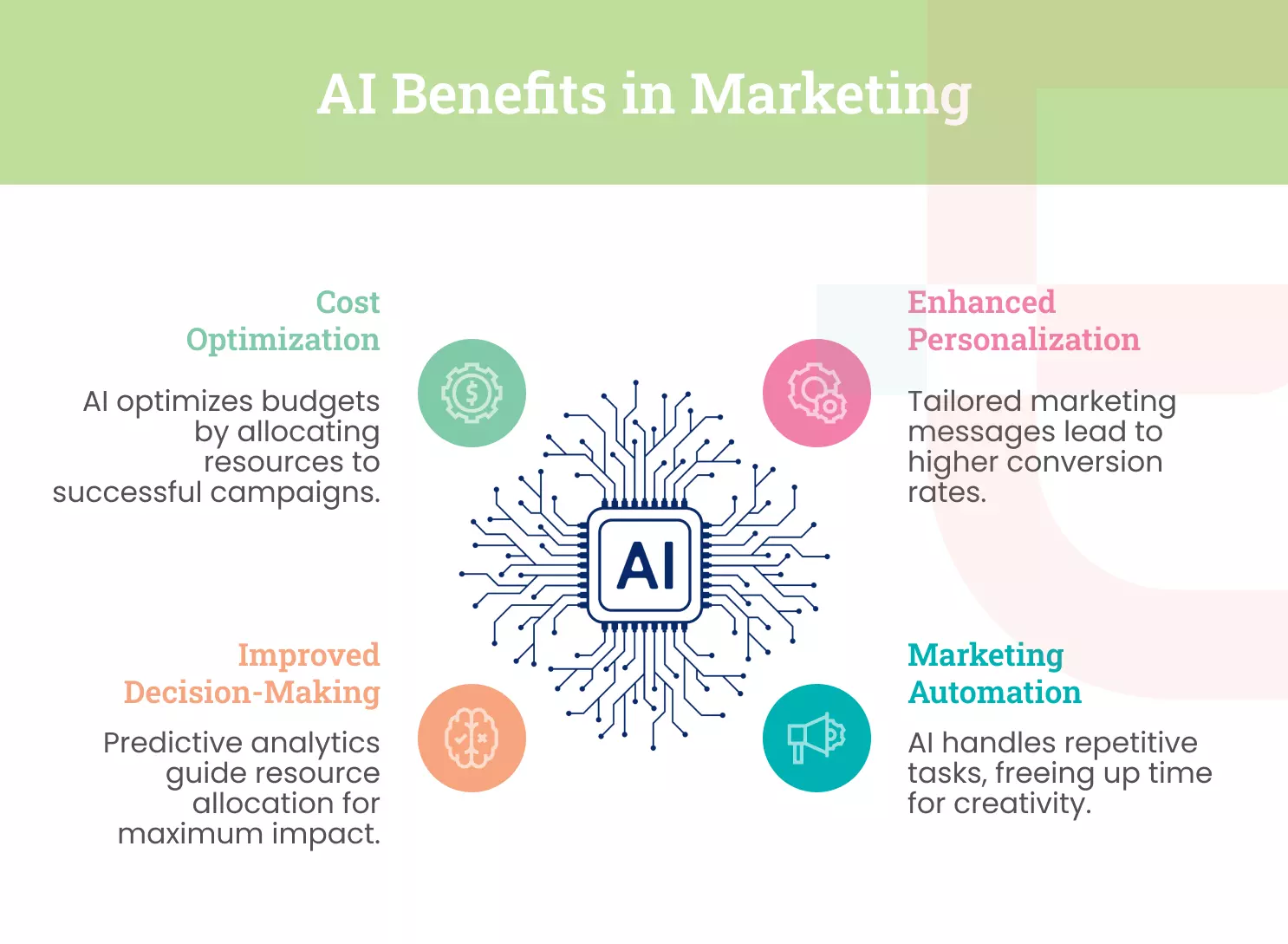
AI marketing is catalyzing business growth. For different purposes, different types of AI help businesses connect with their customers better, automate, offer personalized experiences, and provide many other benefits.
Enhanced Personalization and Customer Insights
Generic messages are no longer creating the desired impact in marketing. The message should touch upon the pain points of the customer. AI, along with machine learning, can analyze the browsing history and engagement behavior of your ideal customer to highlight those pain points with ease.
That means you get dynamic audience segments to do tailored marketing that yields the best results. Leads receive personalized emails and product suggestions, which increase the chances of conversion.
Marketing Automation and Time Efficiency
A lot of repetitive tasks in marketing slow down the workflow. Teams remain mostly occupied with manual execution rather than creativity. AI can take care of manual tasks, like scheduling campaigns and segmenting audiences, when trained well.
For instance, it can automatically distribute content across channels and run multi-variant testing with just one human executive by its side. This results in faster execution, reduced workload, and significantly improved productivity.
Improved Decision-Making with Predictive Analytics
When there is not enough data with the team, decisions are made on gut feelings. Later, it forces the team to make reactive adjustments to save campaigns from underperforming. AI can process a large dataset from different touchpoints and sources.
Then, with predictive analytics, AI can help the team understand which leads are most likely to convert. It can also analyze campaigns to show the probable churn rate. These insights become the base for prioritizing resources for maximum impact.
Cost Optimization and Improved ROI
It is a constant challenge for the marketing team to improve conversion at every stage of the customer journey. With AI-powered optimization engines, this issue can be easily addressed. AI constantly self-analyzes campaigns round the clock. Good-performing campaigns are automatically allocated extra budgets, while underperforming ones are paused.
Even if it’s your first time with AI, it takes a few trial-and-error experiments to optimize your marketing expenses with automation.
Real-World Use Cases of AI in Marketing Campaigns
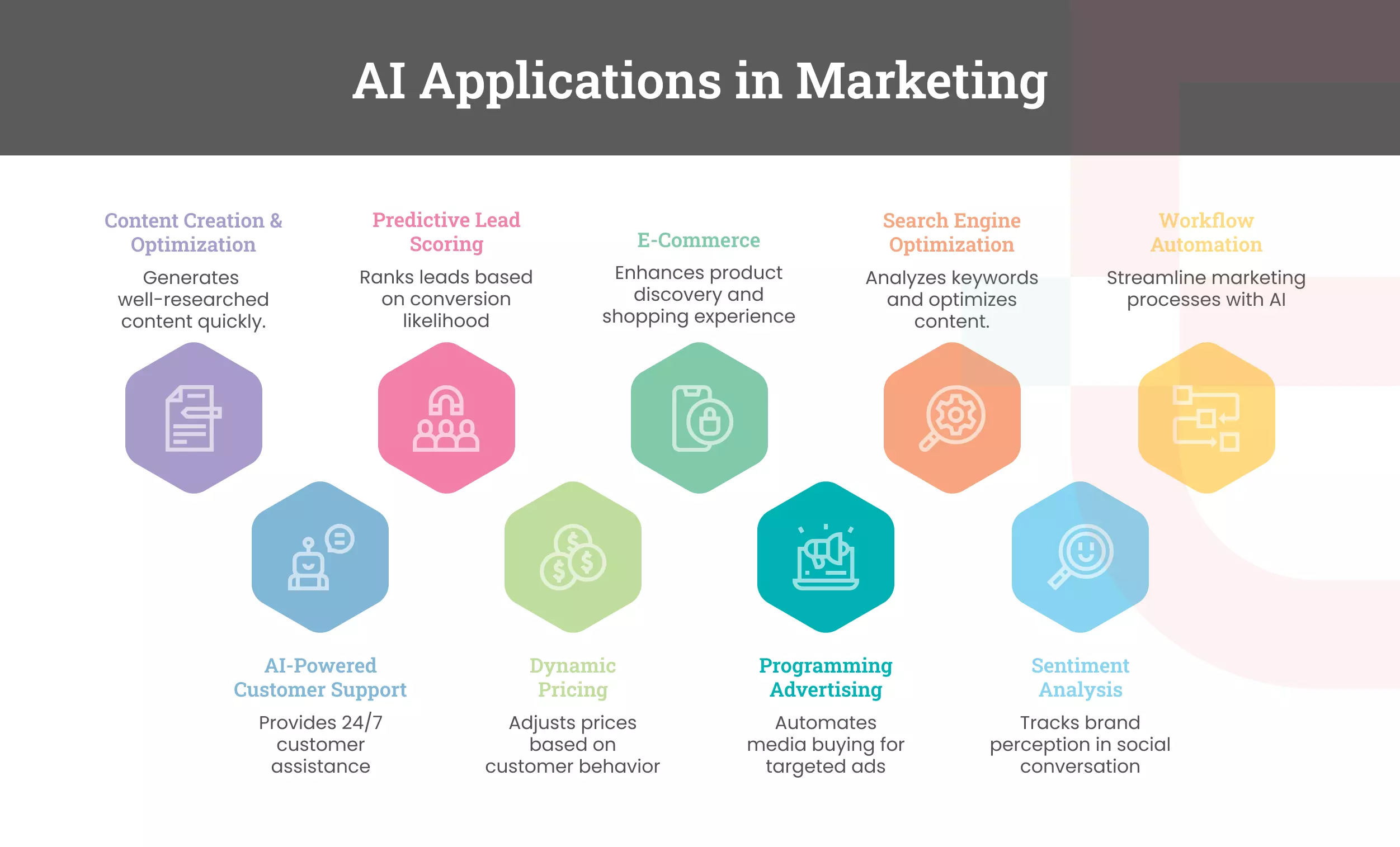
Let’s take a look at some real-world applications of AI-powered marketing campaigns across different levels.
Content Creation and Optimization
The immense capacity of AI to generate well-researched, meaningful content is a boon for the entire marketing community. With topics, target audience, and keywords, it can instantly produce blogs, ad copies, or social media posts in just seconds.
AI-Powered Customer Support and Chatbots
An AI chatbot can nurture leads when human agents are unavailable. With NLP, it can process customer queries, suggest products, and resolve any issues they have. If they are still not satisfied, AI can raise tickets for human intervention.
Before agents engage in a call, AI chatbots can provide them with all the previous chats and pain points. It helps agents get into the solution part right away.
Predictive Lead Scoring and Sales Forecasting
With AI, you can rank leads based on their likelihood of conversion. This is called predictive lead scoring. AI analyzes lead behavior on your website, email, demo requests, etc., to calculate the conversion potential.
AI can also estimate future pipeline revenue. An AI-powered predictive sales forecasting model is all you need. With a short training, these models can calculate the probable service/product demand to help you plan more accurately.
Dynamic Pricing and Personalized Product Recommendations
AI, along with machine learning, can give your customers a personalized shopping experience. They will see exactly the product they have been checking out on your competitor sites with a dynamic price. This increases conversion rates, average order value, and lifetime value.
E-commerce
E-commerce brands use AI to improve product discovery, increase conversions, and create personalized shopping experiences. AI analyzes browsing patterns, past purchases, and timing to predict what customers want and when they are ready to buy.
Programmatic advertising
When it comes to programmatic advertising, AI can automate media buying and ensure ads reach the right audience at the right time. AI assistants can study insights on user behavior, device type, location, and purchase interests to optimize bids and placements.
Search engine optimization (SEO)
AI assistants can act as your ideal SEO associate. Based on your business keywords, they can analyze SERPs, find untapped keywords, generate content, and suggest optimization guidelines. They can also map content clusters and suggest strategic topics.
Sentiment analysis
AI can track brand perception across millions of social conversations. It can help you identify trending sentiments and potential PR risks. Marketers can use sentiment analysis to analyze customer reviews and support tickets for emotional patterns.
Workflow automation
Nowadays, AI is getting good at automating email sequences, lead scoring, and CRM workflows. AI assistants can integrate with your existing legacy tools and build intelligent workflows with natural-language prompts. They can also predict task delays and suggest optimized work schedules.
How to Implement AI in Your Marketing Strategy
There has to be a structured approach to adopting AI in marketing. The following steps outline a practical roadmap to leverage AI for building high-converting sales funnels.
Step 1: Define Clear Marketing Objectives
When you have a clear marketing objective, you can choose the right AI features to strengthen your sales pipeline. For example, if the aim is to boost lead conversions, predictive lead scoring and marketing automation would be your ideal bet.
A clear marketing objective will also help you optimize the budget and choose the right KPIs. Defining measurable objectives ensures AI delivers strategic rather than superficial value.
Step 2: Audit Existing Data and Marketing Infrastructure
AI feeds on data. If the data is clean and complete, you can expect meaningful insights at the output. So, review data from all sources. There should be a data hygiene audit at CRM systems, analytics platforms, automation tools, and customer journey touchpoints.
Imagine a compromised sales funnel because the AI did a poor job at audience segmentation due to fragmented data. If you discover any fragmented data, fix it to avoid inaccurate forecasts.
Step 3: Choose the Right AI Marketing Tools
A perfect AI tool does not exist. You have to select tools that match your marketing goals and integrate well with existing platforms. Most businesses fail to check the ROI potential. That’s important as well.
Lastly, before you commit to any tool, also check if the subscription includes scalability and dedicated support. Otherwise, the overall budget will increase in the middle of the campaign.
Step 4: Train Teams and Integrate AI with Existing Systems
If your marketing and sales teams perceive AI as a threat, you can barely leverage its true benefits. So, educate teams on how to use AI insights to their advantage. They need to understand that AI has not evolved to be a replacement for human judgment yet.
A cross-team collaboration is equally important. If it is not fully used by CRM or customer support teams, you might not get unified customer data. There will be operational silos. When teams use AI collectively, decision-making becomes faster and more accurate.
Step 5: Monitor, Optimize, and Scale AI Implementation
AI is all about automation, but with constant monitoring under human supervision. Train your marketing team on how to check performance results with relevant KPIs. Performance metrics like cost per acquisition, conversion uplift, engagement rate, response time improvement, and customer satisfaction are highly useful.
AI automation also requires ongoing optimization. You may have to refine models, adjust audience segments, test variations, and improve AI recommendations based on the marketing requirements from time to time.
Once you experience measurable success in a small area of marketing, scale AI into the rest. This phased scaling reduces the chances of risk and maximizes return.
Ready To Unlock The Full Potential Of AI In Marketing? Partner With Our Experts To Build Intelligent Solutions That Accelerate Growth And ROI.
Best AI Marketing Tools for 2026
If you’ve just started to look for the best AI marketing tool, the number of options will overwhelm you. Below, we have categorized some of the best models as per their ideal domain of operation.
AI-Powered Analytics and Data Platforms
If you want to check the pulse of your marketing campaigns in real time, the following tools will be your ideal bet.
Google Cloud AI
- Processes large datasets
- Builds predictive models for live insights
- Forecasts conversions on the go
- Tracks real-time campaign performance
- Offers deeper audience segmentation
Acoustic Marketing Cloud
- Predicts customer behavior with machine learning
- Automates personalization to maximize conversion
- Comes with advanced audience analytics
- Good at understanding lead sentiment and purchase patterns
AI Marketing Automation and CRM Platforms
If you want AI to automatically manage your campaign workflows, the following tools will be highly useful.
HubSpot AI
- Automatically manage workflows
- Predicts the chances of converting leads to customers
- Recommends the best email templates for increasing CTR
Salesforce Einstein
- Offers advanced lead scoring
- Forecasts sales
- Good at personalized product/service recommendation
- Analyzes CRM activity and customer interactions
Marketo Engage
- Automates complex marketing campaigns
- Suggests funnel mapping for high conversion
- Offers AI-powered email optimization
Social Media and Ad Optimization Tools
The following AI marketing tools are best at optimizing your social media for ad campaigns for a healthy ROI.
Hootsuite Insights
- Guide trending social media content strategy for better conversions
- Measures sentiment and brand perception across platforms
- Tracks audience sentiment and demographics across various resources
Sprout Social
- Features AI-driven social listening
- Recommends ideas based on audience insights
- Tracks cross-platform performance
Albert AI
- Automatically tests audience targeting
- Adjusts bidding in real time for max ROI
- Eliminates paid digital silos
Challenges and Ethical Concerns for AI in Marketing
AI offers remarkable benefits in marketing. However, its use also comes with certain challenges that require ethical considerations.
Data Privacy and Compliance Issues
AI models heavily rely on customer data for generating marketing insights. However, it may contain personal information. A data breach can cause privacy and compliance issues. It is important to follow global data protection regulations, such as:
- GDPR (General Data Protection Regulation)
- CCPA (California Consumer Privacy Act)
- DPDP Act (Digital Personal Data Protection Act 2023)
- Other regional privacy frameworks
Key Concerns that You Must Address:
- Use consumer data only for explicitly stated purposes
- Protecting data with encrypted storage
- Providing users the right to view, correct, or delete their data
- Avoiding excessive or invasive tracking behaviors
Algorithm Bias and Transparency
AI models are trained based on historical data, and if that data has stereotypes, it may produce biased decisions. For example, a predictive lead scoring system may prioritize leads from specific income groups because past data was skewed in their favor.
In such situations, you may end up targeting the wrong audience or affecting the customer experience due to inaccurate predictions.
How Businesses Can Reduce Bias:
- Regularly audit training data to get rid of skewed or discriminatory patterns
- Maintain transparency in AI decision-making for your customers
- Combine AI decisions with human oversight instead of an automated judgment
Cost and Implementation Barriers
If you’re a small or mid-sized business, the high cost of AI setup and its ongoing maintenance can constantly overwhelm you.
Advanced AI tools require heavy investment in:
- Software subscriptions
- Data infrastructure
- Skilled professionals
Also, there may be technical complexity in terms of:
- Data preparation
- Integration across existing systems
- Staff training
How businesses can overcome these challenges:
- Start with scalable AI tools and expand as results grow
- Use no-code or low-code AI platforms that require less technical expertise
- Apply AI for one or two high-impact use cases first to reduce the risk
Partner with AI consultants or managed service providers to reduce internal workload and accelerate implementation.
Future of AI for Marketing and Business Growth
Let’s understand how AI marketing will move beyond automation into experience design with the following AI trends.
Generative AI for Hyper-Personalization
- 89% of companies say personalization is invaluable to their business success.
- Real-time personalization will expand from segmentation to true one-to-one engagement powered by generative models.
- AI will produce dynamic landing pages, emails, visuals, and offers tailored to unique customer journeys.
- Generative AI tools will create highly targeted content, product recommendations, and ad creatives customized to individual user behavior across channels.
Predictive Marketing and Real-Time Optimization
- AI will forecast customer intent and campaign results before decisions are made.
- Predictive analytics will adjust budgets, targeting, and messaging instantly.
- Marketing will shift to proactive and autonomous execution. Teams will focus on strategy instead of guesswork.
Integration of AR, VR, and Voice AI
- Nearly 157.1 million U.S. adults will use voice assistants for product research by 2026.
- Predictive analytics will adjust budgets, targeting, and messaging instantly.
- AI in virtual reality will enable immersive product interactions like virtual try-ons and 3D demos.
- Personalized experiences will adapt live using behavioral and contextual insights.
How Elluminati Helps You Build Future-Ready AI Marketing Solutions
If you want to integrate AI in marketing for exponential growth, Elluminati is the right development partner. We specialize in offering enterprise-grade AI development services spanning a diverse spectrum, including machine learning, generative AI, predictive analytics, and more. We focus on helping you boost customer engagement and campaign performance by building an AI-focused marketing platform.
We have been helping brands around the globe to adopt AI-driven tools with confidence for 13 years. Our approach is to build engineering-first solutions with a deep understanding of industry standards and deliver outcomes that scale for you.
Level up your marketing with intelligent AI systems designed to scale — partner with Elluminati to turn your vision into a high-performance reality.
FAQs
AI in marketing refers to the use of artificial intelligence, along with other technologies, to automate different aspects of marketing. It works by collecting and processing customer data to identify patterns key to delivering a personalized experience.
AI helps you give a personal touch to campaigns to experience higher ROI. Also, AI can take over a lot of mundane tasks to help marketers focus more on creative works. The technology is also capable of adjusting ad budgets in real time to reduce the overall costs.
Entry-level AI tools may cost between $50 to $300 per month. However, enterprise-level tools may cost from $100 to $10,000 per year. It all depends on the scale of implementation and your business requirements.
Data privacy is one of the major challenges in using AI-powered marketing, followed by algorithm bias that often leads to ethical issues. Many businesses also face internal skill gaps where teams need training to understand AI workflows.
AI marketing is heading towards hyper-personalization. AI will adjust campaigns in real time so that customer experiences feel uniquely human. The future will also witness AR/VR and voice-based experiences to bring new innovation in customer engagement.