Key Takeaways (or TL;DR):
- AI agents are autonomous intelligent systems capable of perceiving information, making decisions, & taking actions that help entrepreneurs scale their business faster without human interference.
- There are 7 key types of AI agents, each with distinct capabilities, including predictive analysis, autonomous planning, optimization, and problem-solving.
- Whether it’s to enhance customer experience through chatbots or prevent fraud through intelligent detection systems, AI-powered agents in real-world businesses deliver better business outcomes.
As AI technology evolves, AI agents are becoming increasingly pervasive across sectors like healthcare, logistics, transportation, and more. There is nothing wrong with saying it; it works as a strategic advantage for businesses by helping them manage workflows, evaluate risks, deliver personalized interactions, and more.
However, not all types of AI agents are created following the same objective. Every agent has varied capabilities, adaptability, and interactions. Therefore, businesses planning to integrate AI-powered agents can explore this article to understand the types of AI agents for clarification.
What is an AI Agent? Why Are Businesses Investing in It to Improve Their Operations?
An AI agent is an autonomous software entity capable of perceiving its environment, processing information, and taking actions to achieve specific goals with minimal human intervention. These agents are designed using advanced AI technologies, such as machine learning, decision models, and contextual understanding, to execute tasks more efficiently.
With rapid advancements in machine learning, NLP, automation frameworks, and multi-agent systems, the demand for AI agents is growing. According to the latest research report, the global AI agent market is also expected to reach USD 52.62bn by 2030.
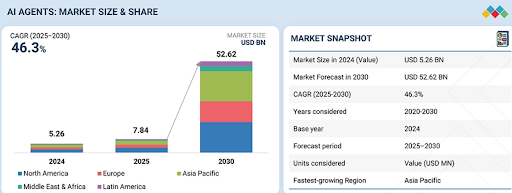
Source: marketsandmarkets
Alongside these significant market trends, several compelling factors encourage businesses to increase their investment in AI agents, which include;
Increased Efficiency
One of the key reasons businesses invest in AI agents is their ability to automate repetitive & time-consuming processes, allowing them to focus more on strategy and high-value tasks. It operates 24/7 & handles multistep processes without constant human input.
Enhanced Accuracy
An AI-powered agent helps businesses reduce errors. By using structured rules, real-time data & predictive algorithms, entrepreneurs can enhance decision-making quality and improve the overall customer experience.
Personalization
Businesses can enhance their customers’ experience by integrating AI-driven agents. It helps them analyze users’ behavior and preferences to suggest recommended products, delivering tailored support responses while driving higher engagement & conversion rates.
Learning & Adaptability
Through the help of machine learning & continuous feedback loops, AI agents improve adaptability over time. They easily adapt to new data patterns, refine their actions, and evolve their decision-making models through real-world interactions.
Informed Decision-Making
With the help of AI agents, businesses can process large volumes of data faster than humans, uncovering insights & patterns that support strategic choices. It also enables predictive analytics, empowering businesses to make data-backed decisions.
Exploring the 7 Key Types of AI Agents
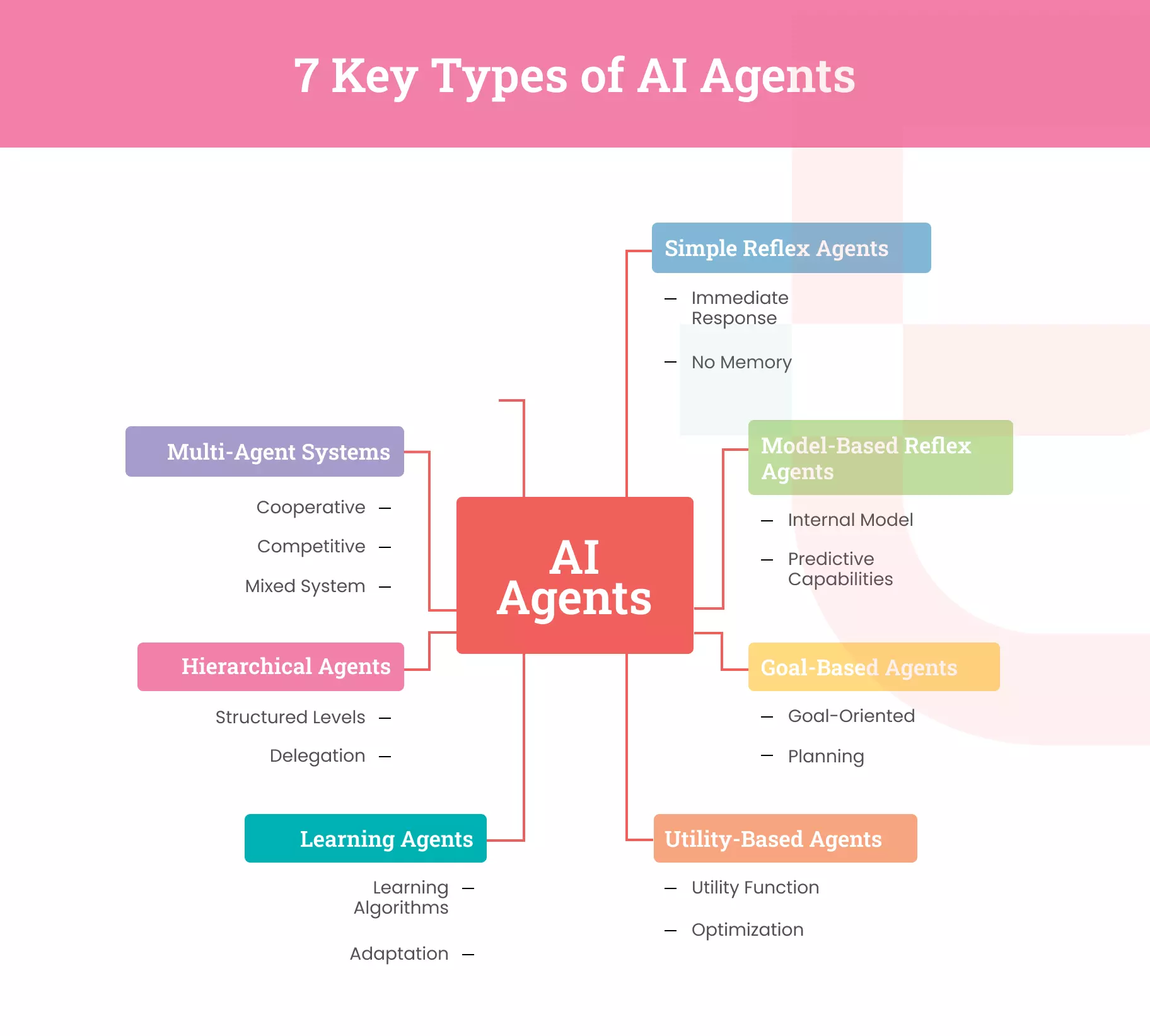
Businesses have a rich but complex landscape of AI agent options, ranging from simple task-specific automation tools to sophisticated multipurpose assistants that can transform entire workflows.
The choice or development of an AI agent depends on several factors, including technical complexity, implementation costs, and specific use cases, with some businesses opting for ready-to-use solutions. In contrast, others invest in custom agents tailored to their unique needs.
Simple Reflex Agents
Considered as one of the common agent types of artificial intelligence, a simple reflex agent operates with basic if-then rules. It makes decisions solely on its current sensory input, responding immediately to environmental stimuli without requiring memory or learning.
Example:
- Simple chatbots that provide predetermined responses to specific keywords.
- Traffic light control systems that change signals based on fixed timing.
Pros:
- Quick & efficient for straightforward tasks.
- Minimal computational resources required.
Cons:
- This type of agent in artificial intelligence is not able to handle complex scenarios.
- It requires a manual upgrade with every new task, making it less effective for dynamic environments.
Model-Based Reflex Agents
Model-based reflex agents are renowned as a more advanced form of intelligent agents designed to operate in partially observable environments. These intelligent agents maintain internal representations, such as filling in missing information, and act intelligently even when data is incomplete to predict business outcomes with greater accuracy.
Example:
- Network monitoring tools that detect issues in the IT infrastructure.
- Autonomous drones that navigate changing environments.
Pros:
- This type of agent easily predicts future states, making it more adaptable.
- It is the best match for dynamic environments.
Cons:
- Increased complexity and computational requirements.
- Limited by the accuracy and completeness of the internal mode.
Goal-Based Agents
Achieve a business-specific objective by integrating goal-based agents. Despite each stimulus being evaluated independently, it determines different actions based on how effectively they contribute to achieving a specific goal.
Example:
- Navigation systems that determine the fastest route to a destination.
- Task automation chatbots that sequence actions to complete multiple-step processes effectively.
Pros:
- Break down large goals into smaller, manageable sub-parts, making it easier to achieve complex objectives.
- It mainly focuses on achieving specific outcomes.
Cons:
- It is difficult to define clear, achievable goals, particularly when tasks involve multiple objectives.
- A less accurate goal can lead to inefficiency or incorrect outcomes.
Utility-Based Agents
Utility-based agents make decisions by evaluating the potential outcomes of their actions and choosing the one that maximizes overall utility. Rather than simply meeting goals, it considers trade-offs, risks, preferences & outcomes, making it the ideal choice for businesses that frequently need to make complex business decisions.
Example:
- Resource management systems in cloud computing environments.
- Stock trading algorithms weigh risk against potential returns.
Pros:
- Leverages complex reasoning algorithms to evaluate different scenarios, leading to more effective decision-making.
- It can operate in uncertain, variable environments.
Cons:
- Significant computational resources are required for continuous evaluation and optimizations.
- One key challenge for this agent is the need for a carefully designed utility function to perform tasks.
Learning Agents
By analyzing data and receiving real-time feedback, the learning agents help businesses continuously improve their performance. These agents include machine learning algorithms, reinforcement learning models, and adaptive intelligence systems, which become smarter over time, refining predictions, strategies, and actions with every evolving set of requirements.
Example:
- AI-powered chatbot solutions to deliver impressive customer services by refining the responses based on their user interactions.
- Autonomous vehicles that continually improve driving capabilities.
Pros:
- One key advantage of the learning agent is its ability to make highly informed, accurate decisions.
- It continuously improves their performance, leading to better outcomes over time.
Pros:
- One key advantage of the learning agent is its ability to make highly informed, accurate decisions.
- It continuously improves their performance, leading to better outcomes over time.
Cons:
- It requires large amounts of data and feedback to learn effectively.
- Also, the algorithms used for learning, such as neural networks and reinforcement learning, can be computationally demanding.
Hierarchical Agents
Recognized as one of the most effective types of AI agents, hierarchical agents are structured in a tiered system, with higher-level agents managing and directing the actions of lower-level agents. This architecture breaks complex tasks into manageable subtasks, enabling more organized control & decision-making.
Example:
- Manufacturing systems where supervisory AI agents manage the production line through robots.
- Autonomous vehicles where top-level plans routes and low-level controls steering.
Pros:
- It follows an organized structure, resulting in simplifying complex operations.
- Allows for better resource allocations and task divisions.
Cons:
- The key loophole in this AI agent is its reduced adaptability when strict hierarchies are enforced.
- Also, designing this type of agent requires careful planning and deep domain knowledge; if any steps are missed, then it leads to inefficiencies or system failures.
Multi-Agent Systems (MAS)
A multi-agent system (MAS) involves multiple autonomous agents that interact within a shared environment, working independently or cooperatively to achieve individual or collective goals. The multi-agents are further divided into three types, including:
- Cooperative Systems—Agents share information and resources to achieve common business goals.
- Competitive Systems—Agents compete for resources following defined rules
- Mixed Systems—Combine both cooperative & competitive behaviors, such as agents sharing some information while computing with limited resources.
Example:
- Supply chain networks where agents optimize logistics across suppliers.
- Robotic warehouse teams with specialized units handling different tasks.
Pros:
- Multi-agent systems help businesses scale to handle larger, more complex problems by adding more agents to specific tasks.
- Each agent added to the operations is specialized in performing their own tasks, resulting in higher efficiency and reduced manual errors.
Cons:
- Efficiently managing resources such as time, energy, and computational power across multiple agents is complex.
- As multiple agents work toward the ultimate goal, maintaining security becomes difficult.
Comparing AI Agents
As we explored above, AI agents come in several forms, each with its own approach to perceiving information, making decisions, and executing tasks. From simple reflexes to learning agents, each contributes differently to growing businesses across sectors.
Now, let’s take a closer look at this comparison table to get a quick overview of the most common types of artificial intelligence agents, along with their complexity levels and effective use cases.
| Types of AI Agents | Complexity Level | Functionality |
|---|---|---|
| Simple Reflex Agents | Low | It operates according to condition-action rules. |
| Model-Based Agents | Medium | Utilizes internal models to track environments that frequently change. |
| Goal-Based Agents | High | It considers future consequences to help entrepreneurs achieve business-specific goals. |
| Utility-Based Agents | Very High | Mainly optimize performance based on utility functions. |
| Learning Agents | Very High | Enhances operational performance by continually learning from changing demands and experiences. |
| Hierarchical Agents | High | They use a layered decision-making pattern in which high-level agents plan tasks and lower-level agents execute them. |
| Multi-Agents Systems | Varies (Medium to Very High) | Multiple agents work together to achieve a common business goal. |
Ready to Automate Your Business with AI? Let Us Help You Deploy AI-Powered Agents Tailored to Your Business Needs
Top 8 Effective Use Cases of Types of AI Agents Every Business Should Know in 2026
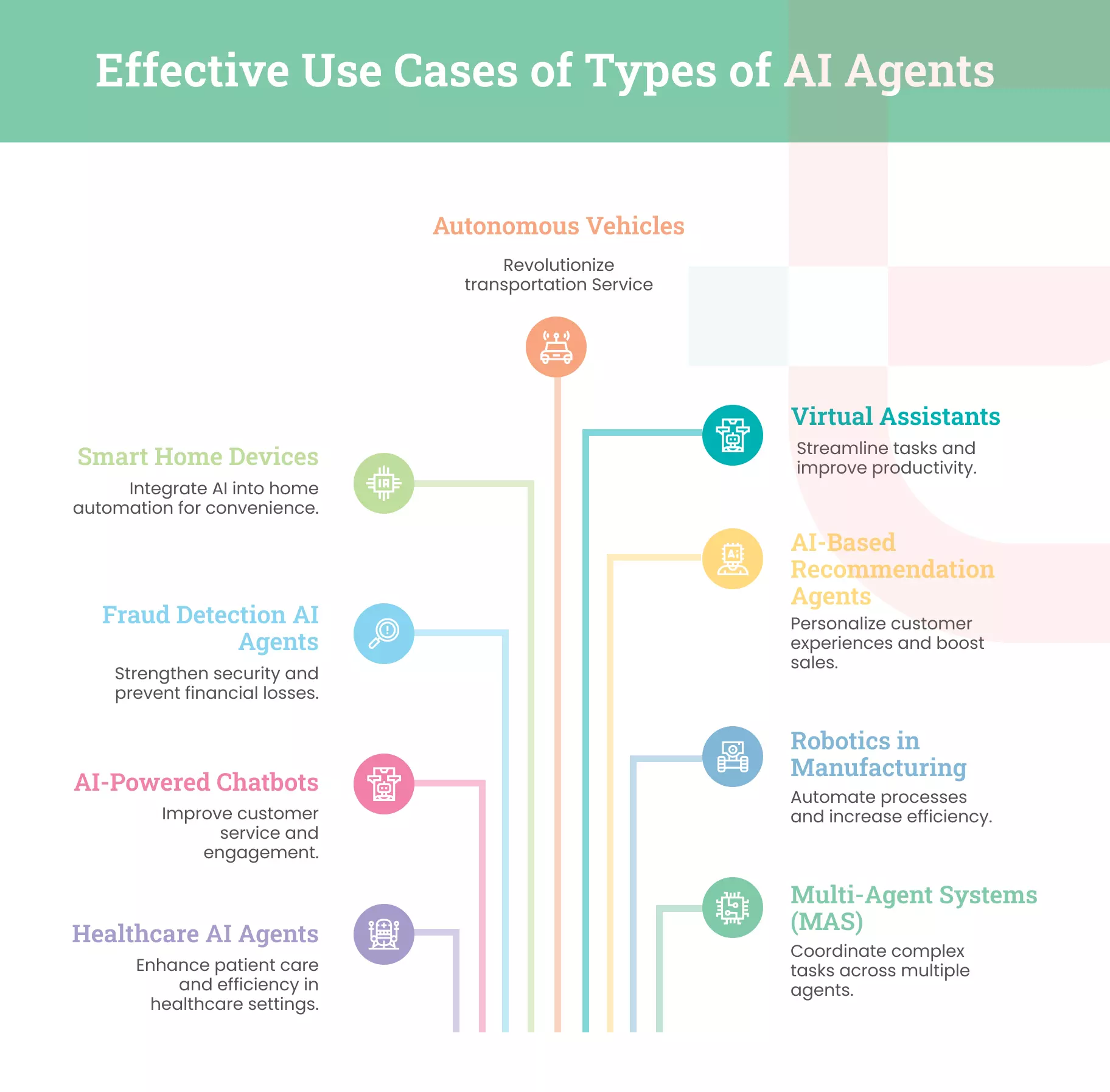
We all know that artificial intelligence agents have rapidly evolved from simple automation tools into a highly sophisticated system capable of making decisions, learning patterns, and optimizing complex business processes.
As AI technologies mature, businesses are increasingly demanding custom AI solutions to build specialized agents aligned with their strategic objectives. From automating customer service to predicting market trends, implementing AI-powered agents tailored to your use cases can deliver measurable outcomes and fundamentally transform the way your business processes.
Below are some of the most impactful applications of AI-powered agents that will help maximize ROI and maintain a competitive edge in the coming years.
Healthcare AI Agents
Healthcare AI agents are revolutionizing patient care by performing tasks such as diagnosing diseases, analyzing medical images, predicting health risks, and personalizing treatment plans. They break down complex medical data into actionable insights, enabling faster & more accurate diagnoses.
With machine learning algorithms and deep neural networks, healthcare agents interpret vast datasets with exceptional precision. This enhances decision-making and reduces human errors by delivering a more efficient, predictive, and personalized healthcare ecosystem.
AI-Powered Chatbots
Businesses are adopting AI-powered chatbots to improve communication with their customers. They handle inquiries, resolve issues, and automate repetitive support tasks, reducing the need for human agents while minimizing operational costs.
These systems rely heavily on goal-based agents, which use NLP and machine learning technologies to understand customer intent, respond accurately, and deliver personalized responses, while also elevating customer satisfaction.
Fraud Detections AI Agents
As the demand for digital payments & online transactions surges, fraud attempts are becoming more sophisticated. Fraud detection AI agents continuously monitor transactional data, assess user activity patterns, and identify anomalies to detect potential fraud before losses occur.
These agents combine machine learning & risk intelligence to flag suspicious behavior in real-time. One of the best examples to showcase here is businesses like PayPal that use AI agents to evaluate transaction authenticity and prevent unauthorized activity.
Smart Home Devices
Smart home devices use goal-based AI agents to create intelligent, responsive home environments. These agents support tasks such as adjusting lighting, regulating temperature, controlling appliances, and automating daily routines.
By analyzing usage patterns and environmental conditions, these AI agents provide personalized experiences. Apple HomeKit is a good-to-go example that uses voice commands and IoT connectivity to make home setups more adaptive and efficient, enhancing convenience and energy efficiency.
Autonomous Vehicle
Autonomous vehicles use a network of AI agents to process data from sensors, cameras, GPS systems, and real-time traffic inputs. These agents help self-driving cars navigate roads, detect obstacles, adjust to weather conditions, and ensure safe, accurate driving without human involvement.
Most autonomous vehicle systems use multi-layer hybrid agents, which continuously update internal environmental models & predict optimal actions. One of the key examples of this is the Waymo model, which already uses intelligent agents to interpret real-time data and make safe driving decisions. This results in enhanced customer safety and efficiency, and delivers them an exceptional experience.
Virtual Assistants
AI in virtual assistants has become indispensable for both personal & professional productivity. They perform tasks like scheduling, sending reminders, retrieving information, and navigating systems through natural conversations.
Generally, virtual assistance relies on a mix of AI agents, including goal-based, rule-based, and learning-based agents, to understand context, interpret voice commands, and execute the right actions. This enhances productivity while reducing manual effort for users across devices & ecosystems.
AI-Based Recommendation Agents
Recommendation agents analyze user behavior, preferences, and contextual signals to deliver tailored product or content suggestions. They are the backbone of personalization strategies in entertainment, retail, and service-based platforms.
Using utility-based agents, these systems evaluate which recommendations deliver the highest relevance and value to the user. Spotify’s playlists are one of the best examples that offer hyper-personalized experiences and help businesses increase conversions, engagement, and customer retention.
Robotics in Manufacturing
In manufacturing, robots powered by AI agents automate production lines, improve precision, reduce waste, and increase productivity. These systems perform repetitive & physically demanding tasks with high accuracy.
Robotics commonly uses model-based reflex agents, which process real-time inputs, adapt to workspace changes, and ensure consistent performance. One of the best examples of this is Tesla’s robotic assembly lines, which result in higher productivity, lower operational costs & improved product consistency.
Discover the Best Practices for Using Artificial Intelligence Agents
Implementing AI agents effectively requires more than choosing the right technology, right? It requires strategic planning, operational clarity, and long-term optimization.
Below are some of the best practices entrepreneurs should follow to ensure the successful adoption of AI solutions in businesses
- It is always better to begin with an AI use case that delivers the highest value with low complexity, helping in achieving quick results and easier scalability.
- Opt for the required types of AI agents from the list of reflex, goal-based, utility-based, or other types that align with your business requirements while also boosting efficiency & performance.
- Ensure your AI agents smoothly integrate with legacy systems, such as CRM or ERP, as proper integration keeps data consistent & workflow seamless.
- Strong data governance to maintain reliability is a must.
- Protect sensitive data with encryption and compliance frameworks that are essential to a business’s operations as data evolves.
- Let the AI handle repetitive & analytical tasks while humans focus on strategy & creativity. This collaboration maximizes productivity & smarter decision-making.
- Working with an expert AI development company helps you speed up deployment and ensure better customization, allowing businesses to use advanced AI without managing complex technical work in-house.
How Can Elluminati Help You Build AI-Powered Agents to Streamline Operational Tasks
The world of AI agents is vast, evolving, and full of potential to transform industries and everyday life. From simple reflex agents to goal-specific agents, each agent has various capabilities to automate complex tasks, improving decision-making and enhancing customer experience. Throughout this blog, we have already explored key types of AI agents and how they contribute to smarter, more efficient operations.
If you are ready to adopt AI-driven automation, intelligent workflows, or custom agent architecture into your operations, partnering with trusted AI agent development services like Elluminati can accelerate your transformation.
We help businesses like yours turn their raw ideas into powerful, revenue-driving solutions by designing fully tailored, manageable AI agents backed by an advanced tech stack and algorithms, including ML, NLP, and more. This enables you to build a future-ready system that enhances efficiency, accelerates growth, and supports long-term scalability.
FAQs
The cost of developing an AI agent for businesses typically ranges between $10,000 $200,000. However, several factors, including project complexity, integration & data requirements, types of AI agents needed, and other customized requirements, must be considered. To obtain an accurate quotation, we would like you to connect with our sales executives at sales@elluminatiinc.com.
The primary functions of an AI agent include;
- Perceiving an environment’s dynamic conditions,
- Adapting to changing marketing conditions,
- Interpreting its own perceptions,
- Solving complex problems, and
- Selecting the appropriate actions to achieve its goal.
AI agents mainly work with the three essential steps, that is:
- Perception, to gather the data from their environment
- Decision-making that processes information and determines appropriate actions
- Execution, to implement chosen responses through output interfaces.
Common types of AI agents include simple reflex agents, model-based reflex agents, goal-based agents, multi-agent systems, and more. However, each type serves a different purpose, from automation to predictive intelligence, optimization, & collaborative decision-making.
AI agents are autonomous programs that can observe their environments, make decisions, and take actions to achieve a specific goal without human intervention. At the same time, chatbots are basic interfaces designed primarily to respond promptly to users’ queries.