Key Takeaways ( or TL;DR ):
- AI is classified in various categories —by capabilities, functionality, purpose, and technology—and each category demonstrates a unique dimension of how AI works and where it can be applied.
- Capability-based AI (ANI, AGI, ASI) shows the evolution of intelligence in machines—from narrow task-specific AI to human-like intelligence to hypothetical superintelligent systems.
- Functionality-based AI (Reactive, Limited Memory, Theory of Mind, Self-Aware) explains how AI models process information, respond to environments, and potentially develop social and emotional intelligence.
- Purpose-based AI (Generative, Predictive, Assistive, Conversational) highlights how AI is used in real-world applications—from automating content creation to forecasting risks, assisting workflows, and enabling natural communication.
- Technology-based AI (ML, Deep Learning, NLP, Robotics, Expert Systems) shows the core technical methods powering modern AI innovations across industries—from automation and analytics to language understanding and autonomous machines.
Artificial Intelligence (AI) has evolved from a futuristic concept to a core driver of innovation across every industry. It is shaping the operational and decision-making capabilities of organizations across different industries.
Now, there are different types of AI models to solve your business problems. You can leverage machine learning, deep learning, generative AI, narrow AI, robotics, and more. It’s easy to get confused about what AI really is and how it’s classified.
In this article, we will understand the major AI classification approaches, including capabilities, functionality, purpose, and technology. Before that, let’s have a brief understanding of this revolutionary technology.
What is Artificial Intelligence?
Artificial Intelligence (AI) refers to the ability of machines to perform tasks that typically require human intelligence. AI enables computers to think, learn, and act like humans to do different types of tasks with ease.
Integrating AI can smoothly do the following three things:
- Understands information through data, images, audio, or text
- Processes that information through algorithms
- Take actions based on self-generated insights
This ability to analyze vast amounts of data makes AI handle repetitive tasks like:
- Understanding human language
- Recognizing complex data patterns
- Making decisions based on data analysis
- Learning from past experiences
- Generating creative content with custom requirements
Overview of Types of AI Classification Approaches
There are different types of AI based on what aspect of artificial intelligence we want to understand.
AI technology can be classified as:
- Capability-based AI models: intelligent and autonomous
- Functionality-based AI models: good at processing information
- Purpose-based AI models are categorized based on the goals they are designed to achieve
- Technology-based AI models: classification based on the technical methods and systems used
Each one highlights a different domain of AI. Let’s understand how each of these types of AI works, along with their pros, cons, and real-life applications.
Types of AI Based on Capabilities
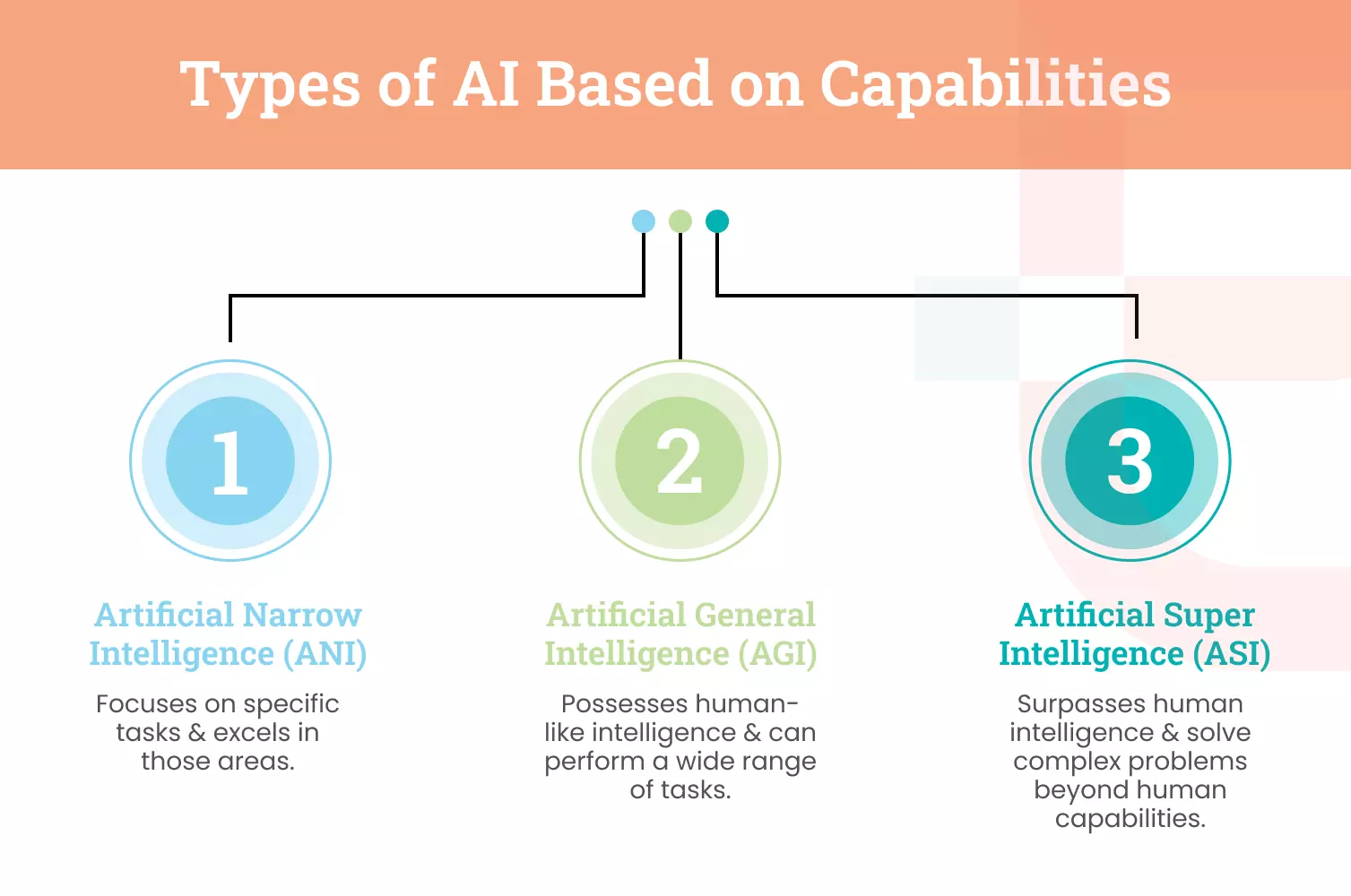
There are three different types of AI based on their capability to perform tasks, learn from data, and replicate human intelligence. Each of the following types represents a different stage of evolution.
Artificial Narrow Intelligence (ANI) / Weak AI
If artificial intelligence has been designed to perform a specific task, it is known as artificial narrow intelligence. They can’t operate beyond their defined boundaries. That’s why they are also known as Weak AI.
For example, the voice assistants we use, like Siri or Alexa, are designed for a specific purpose. They can’t identify faces or objects, like image recognition software, and vice versa. Even Netflix and Amazon fall under this category of AI.
Pros:
- Can process a vast amount of data
- Learn patterns from data
- Make good decisions within its domain
Cons:
- Limited intelligence to a particular domain
- Can not think or act outside of its programmed logic
Artificial General Intelligence (AGI) / Strong AI
Machines powered by Artificial General Intelligence can think, learn, and apply knowledge, just like humans. While ANI holds expertise in one particular domain, AGI can understand any intellectual task that humans can perform.
AGI machines do not rely on pre-programmed instructions. They are capable of independently learning and drawing connections between topics from experience. That’s why they are highly sought-after in fields where adaptive learning is necessary.
AGI is purely theoretical today. No system with true human-level intelligence has been created yet.
Pros:
- Human-level understanding
- Independent reasoning and decision-making
- Adaptive to new situations on its own
Cons:
- Largely theoretical at the present
- Raises ethical and existential concerns
Artificial Super Intelligence (ASI)
Artificial Super Intelligence is an advanced upgrade to AGI. This refers to a form of machine intelligence that will surpass human cognitive abilities in every aspect. Theoretically, the ideal form of this AI would be capable of innovations and insights that humans cannot possibly imagine.
ASI would have self-awareness, consciousness, and advanced emotional understanding. Just like humans, it can develop its own goals and motivations. However, experts like Stephen Hawking, Bill Gates, and Elon Musk have warned us about the potential threat of AI to human society. There is a possibility that ASI-powered machines may pose existential threats due to conflict with human interests.
Pros:
- Superlative human cognitive abilities
- Capable of decoding innovations that take decades
- Can provide insights beyond human comprehension
Cons:
- Can make decisions that conflict with human interests
- Requires strict safety measures and ethical frameworks
Trusted AI Needs a Human at the Wheel! Let’s Discuss What You Need and How We Can Make It AI-Proof!
Types of AI Based on Functionality
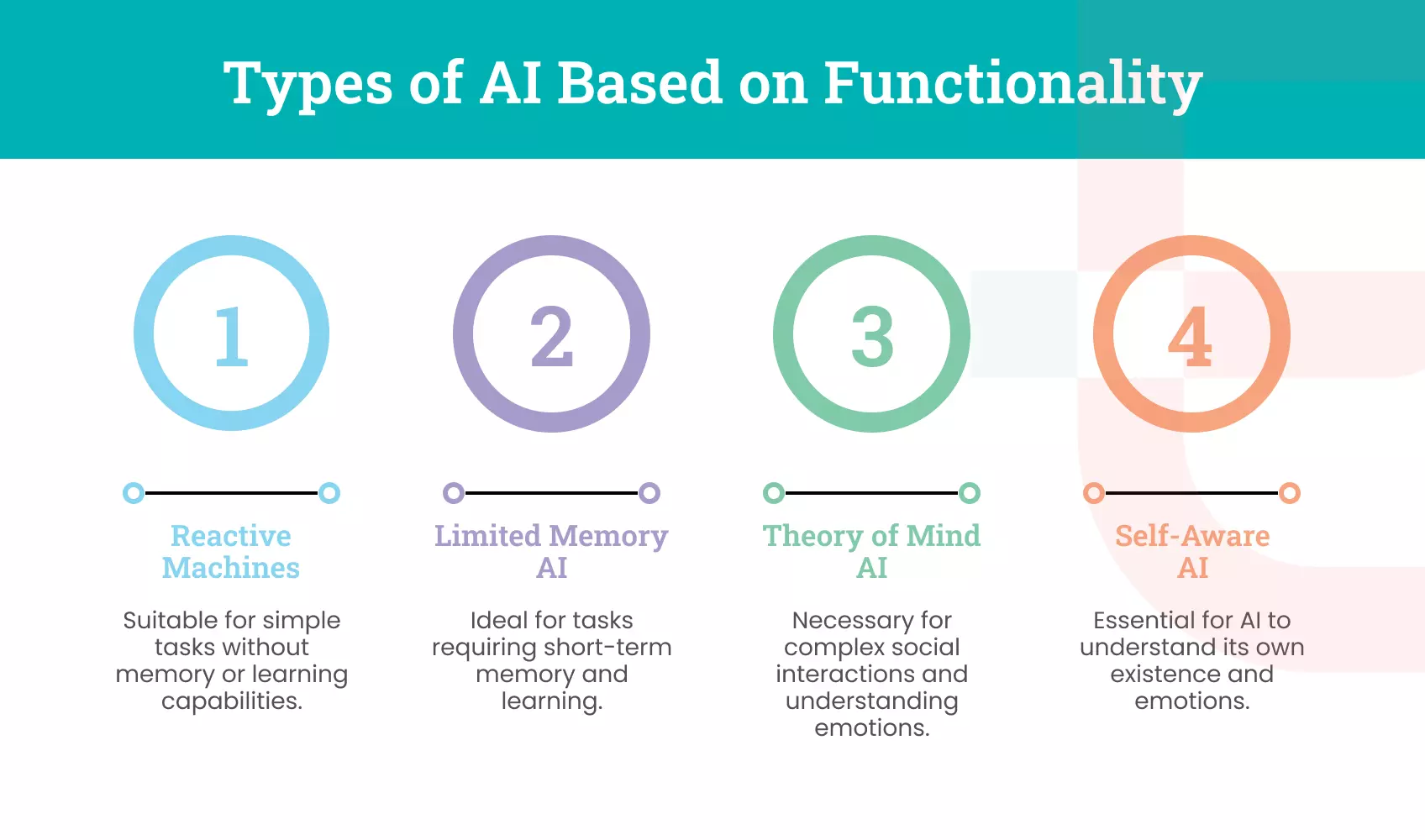
Depending on how AI operates and responds to the world around it, there are three types of AI. Each of the following caters to a different level of cognitive ability.
Reactive Machines
Reactive machines are one of the basic types of AI that generate predefined outputs based on certain inputs. They don’t have the ability to learn from past data. One of the best examples of reactive AI is IBM’s Deep Blue. It is the same supercomputer that defeated world champion Garry Kasparov in the 1990s.
Some other notable applications of reactive AI are spam filters, image classifiers, and AI-powered game opponents in video games.
Pros
- Good at repetitive and well-defined tasks
- Generates outputs at consistent accuracy
Cons:
- Lacks adaptability
- Can’t store information
- Can’t improve performance over time
Limited Memory AI
Limited memory AI models can learn from historical data. They can also make decisions based on past experiences, but for a short period. The most common applications of this type of AI are found in self-driving cars, virtual assistants, and chatbots.
These systems can analyze patterns and use the stored information to make better judgments. For instance, this model of AI in a self-driving car continuously reads sensor data, road conditions, and the movement of nearby vehicles in real-time. Based on that real-time analysis, it decides how to drive the car safely through even busy streets.
Pros:
- Learns from historical data
- Good at real-time judgement
- Can continuously analyze data
Cons:
- Temporary memory
- Lacks conceptual learning
Theory of Mind AI
Theory of Mind AI refers to the type of AI that is emotionally and socially intelligent. These models aim to understand and respond to human emotions through mimicking human psychology. It’s like interacting with an AI that not only understands your words but also your tone, mood, and body language.
These types of Artificial Intelligence can bring empathy, encouragement, and even disagreement into the conversation when needed. For instance, chatbots developed by this model can generate supportive replies based on patient emotions. Similarly, it could adjust tones in customer service, whether the user is satisfied or frustrated with the service.
Now, it’s in the beta stage. However, developers are still not sure how to draw the line between empathy and manipulation.
Pros:
- Can model human behavior
- Emotionally aware and empathetic
- They are intended to model human emotions and mental states, but no real Theory of Mind AI exists yet
Cons:
- Still in its research phase
- Could raise ethical questions
Self-Aware AI
Self-aware AI is a hypothetical form of artificial intelligence that has consciousness and self-awareness. It can understand human emotions but also has a sense of its own existence. It recognizes itself as an entity separate from humans.
The beauty of this type of AI model is that it even questions its purpose and existence, just like humans!
Given its ability to predict outcomes based on intuition, you can call it one of the most philosophically intriguing yet controversial frontiers of AI research.
However, it is still a theoretical concept. If it ever gets materialized, humans would be able to solve problems that they can’t even conceptualize.
Pros:
- Has self-awareness and independent thoughts
- Can predict outcomes based on intuition
- Can bring about unimaginable progress
Cons:
- May pose grave ethical and safety concerns
- Might not always align with human interests
Types of AI Based on Purpose
Depending on the purpose the AI is intended to solve, it can be divided into the following four types.
Generative AI
As the name suggests, generative AI represents the type of artificial intelligence that can create new content. It can be texts, images, music, video, or code. Through deep learning techniques and transformer models like GPT or DALL·E, it can produce realistic outputs.
Recently, generative AI has been extensively used in content creation, designing, software development, and education. For example, writing articles through ChatGPT could be the most relatable example to understand the widespread popularity of generative AI.
Pros:
- Automates content generation
- Reduces costs for content generation
- Can tailor content as per the instructions
Cons:
- Leads to biased outputs if not trained properly
- Raises concerns about originality and repeated content
Predictive AI
Predictive AI can help you anticipate probable future scenarios based on the current and past data. It is the integration of AI in predictive analytics. It anticipates probable outcomes by making use of statistical modeling, machine learning, and data analytics.
Many industries are using predictive AI models. For instance, finance companies use it for credit scoring, stock market analysis, and fraud detection. In the manufacturing industry, it helps avoid equipment failures by identifying breakdown signs early.
Pros:
- Highly reliable for data-driven forecasts
- Good at identifying problems and opportunities early
- Offers room for personalization with automation
Cons:
- Poor data leads to wrong forecasts
- Overreliance on its power can reduce human judgment and adaptability
Assistive AI
This type of artificial intelligence is best utilized as a support to enhance productivity. You can use it to automate routine tasks or simplify complex workflows for a boost in productivity. These systems use natural language processing, computer vision, and contextual learning to assist you better at work.
Assistive AI models have a wide application area. They are mainly used in healthcare, education, and customer service sectors to save time on manual chores. These types of AI models are also used in text-to-speech converter tools and mobility aids to support people with disabilities.
Pros:
- Good at doing repetitive tasks to improve work efficiency
- Offers intelligent recommendations to aid decision-making
- Improves accessibility and inclusivity for differently-abled users
Cons:
- May lead to a data breach without strong data protection policies
- Involves high initial implementation and training costs
Conversational AI
Conversational AI can interact with humans in a natural way. These types of AI models are useful for converting speech to text or generating contextual responses for customers. Apart from NLP and machine learning, speech recognition technology is also used here. It can even enable machines to communicate with each other in real time.
You can use them in everything from simple chatbots to advanced virtual assistants where you need an ongoing intelligent communication. For instance, it can be used as product-recommending bots in e-commerce, as virtual agents in customer support, and as AI tutors in the education industry.
Pros:
- Delivers personalized, instant responses
- Supports multilingual communication
- Reduces operational costs
Cons:
- Limited contextual understanding in emotional conversations
- Lack of training may produce inaccurate or generic responses
Types of AI Based on Technology
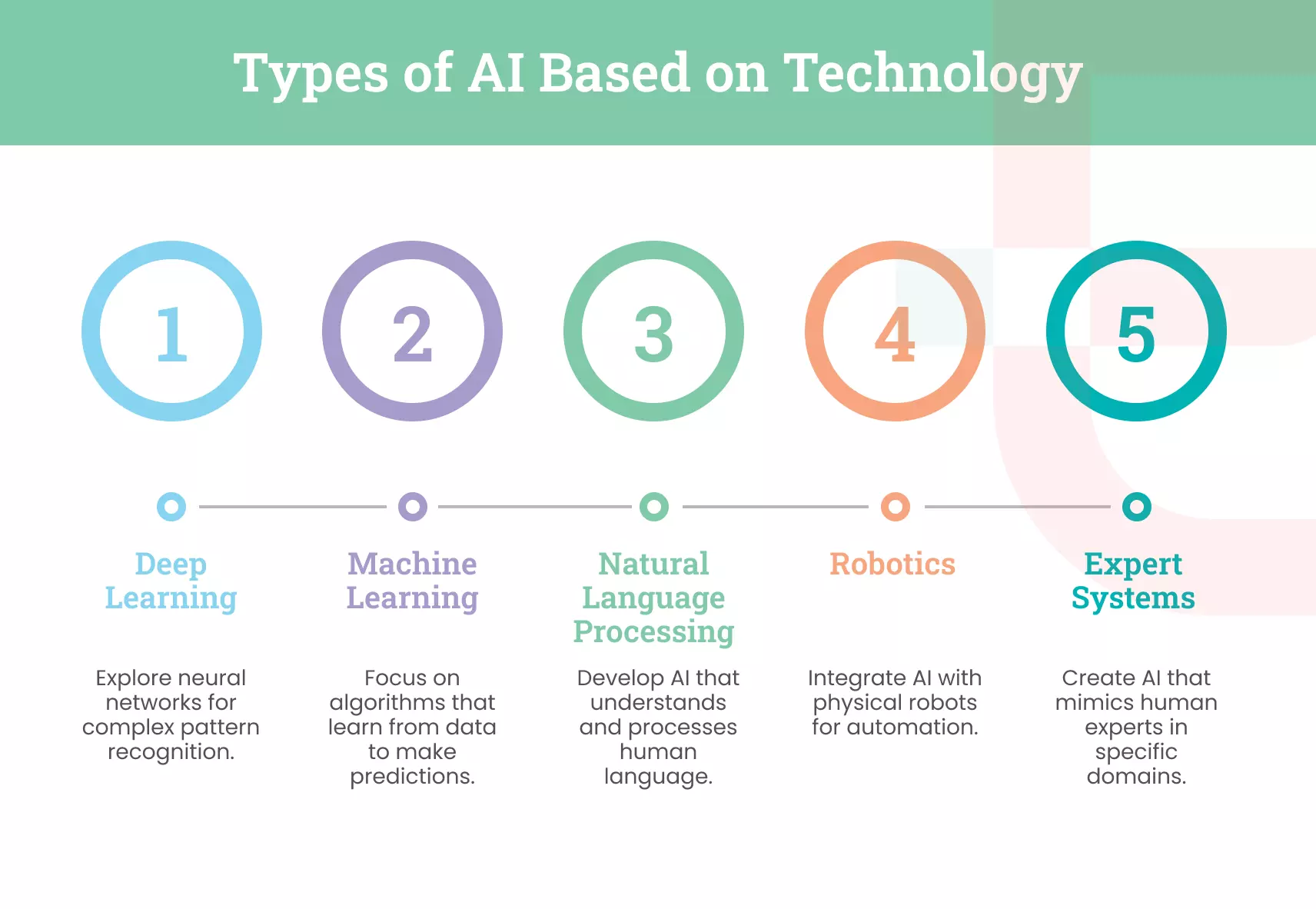
Here, we are going to look at different types of AI based on the technologies and methods they use for functions. So, the classification of AI based on the underlying mechanisms goes as follows:
Machine Learning (ML)
Machine learning is the foundation for most AI systems today. It gives computers the ability to learn and improve by historical data analysis without requiring explicit programming for every scenario.
Machine learning can be further divided into three categories:
1. Supervised learning: learns from labeled data (e.g., predicting house price based on its location, size, and price)
2. Unsupervised learning: creates patterns in unlabeled data (e.g., breaking down customer data into different segments)
3. Reinforcement learning: continues to learn from trial and error (e.g., teaching an AI to play chess or control robots)
Pros:
- Good at data-driven decision-making
- Continuously improves accuracy
- Can decode hidden patterns from large datasets
Cons:
- Requires quality data for accuracy
- Can inherit biases from training data
Deep Learning
Deep learning mimics the neurological brain structure of a human. It works through an artificial neural network to find meaningful patterns in complex data. The best part is that it can automatically find patterns without requiring any manual engineering.
Its working process is unique. The model processes data through its multiple layers of virtually interconnected neurons. Each layer forwards data to the next after processing. If it is used for image recognition, the early layers may detect colors while deeper layers identify shapes or objects.
Pros:
- Can beautifully handle complex and unstructured data
- High accuracy in identifying patterns
- Learns automatically without manual feature extraction
Cons:
- Requires massive computational power and data for training
- Can be resource-intensive and costly to implement
Natural Language Processing (NLP)
NLP-powered AI models can understand, interpret, or generate human languages through voice or text. It does so by analyzing language structure, meaning, and human sentiment. For that, NLP takes the help of computational linguistics, machine learning, and deep learning.
There are several processes involved in the background. For example, there is a process called tokenization, where each text is broken into words. Then there is sentiment analysis identify and categorizes opinions as positive, negative, or neutral. Modern NLP models, like GPT, BERT, and Gemini, extensively use these features.
Pros:
- Creates human-computer interaction through natural communication
- Automates language-based tasks like summarization or translation
- Fetches real-time insights from a massive pool of unstructured data
Cons:
- Struggles with language ambiguity and sarcasm
- Requires constant fine-tuning to stay current
Robotics
Robotics is the technology that combines AI with engineering to turn robots capable enough to function with little to no human intervention. AI-powered robots can automatically perceive elements in their surroundings and act consciously.
These robots function through a synchronized workflow between sensors, actuators, computer vision, and machine learning algorithms. Earlier, robots were used just to assemble products in the factories. Now, they are even becoming advanced enough to assist doctors with complex surgeries.
Pros:
- Highly efficient even in hazardous environments
- Can work 24/7 without fatigue or complaints
- Quick adaptability to external changes
Cons:
- High development and maintenance costs
- May lead to job displacement in certain industries
Expert Systems
Expert systems are AI programs that can mimic the judgment capability of human experts. They take facts and rules and combine them with an inference engine to derive logical reasoning to solve a problem.
Before machine learning, expert systems used to be the core driving system of AI in business, medicine, and engineering. Unlike other types of AI that depend on data, expert systems rely on if-then rules defined by domain experts to reach conclusions.
One of the most well-known examples of this type of AI is MYCIN, the expert system developed to diagnose infections.
Pros:
- Consistent and reliable decision-making within a specific domain
- Provides human-expert-level assistance for repetitive tasks
- Retains specialized knowledge for future model trainings
Cons:
- Lacks learning abilities like modern AI models
- Requires constant updates to maintain accuracy
Take A Step in the Future With Elluminati’s AI Expertise
AI has become one of the most powerful tools for modern businesses. Train it well, and it can help you create smarter, more efficient, and more human-like solutions. That also requires understanding AI classifications based on capability, functionality, purpose, and technology. Each type excels in some elements over other AI models.
All you need to know is that the real opportunity lies in how strategically you are leveraging it. If you’re planning to integrate AI into your business or build AI-driven products, partner with Elluminati for AI development services, turning ideas into innovative solutions.
Elluminati follows an engineering-first approach, forming solutions that are intelligent, adaptive, and data-driven. We make sure that your organizations elevate operations, decisions, and innovation.
AI is shaping the future. The next step is deciding how you want to shape yours.
FAQs
There can be different types of artificial intelligence depending on what aspect of the system we want to understand. However, based on the number of applications, the seven most popular AI types are as follows:
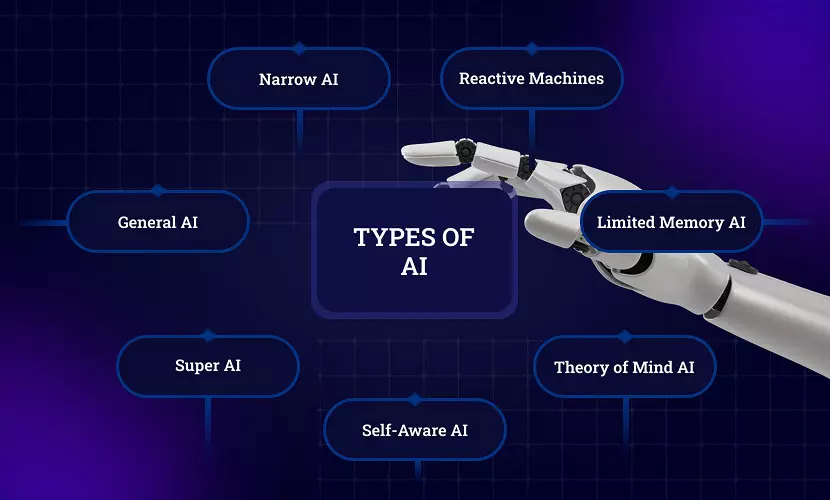
- Narrow AI
- Artificial General Intelligence
- Artificial Super-intelligence
- Reactive Machine
- Limited Memory AI
- Theory of Mind AI
- Self-Aware AI
Artificial Narrow Intelligence (ANI) is the most common type of AI with a wide range of applications across different industries. ANI models are designed to perform one specific task extremely well. Some popular applications of ANI include chatbots, virtual assistants, image recognition tools, and email spam filters.
ChatGPT can be categorized into three different types of artificial intelligence. Capability-wise, it fits into ANI AI classification. When it comes to purpose, it is a generative AI model. Technology-wise, it leverages deep learning to understand and follow human responses.
A majority of businesses use AI for data analysis and complete repetitive tasks. That’s why four common AI types used in business applications are predictive AI, generative AI, assistive AI, and conversational AI.