Key Takeaways (or TL;DR):
- AI sales agents serve as 24×7 virtual sales assistants, automating sales tasks like answering queries, qualifying leads, and following up to improve response speed and customer experience.
- There are five specialized types of AI agents—Conversational, Predictive, Autonomous, Assistive Co-pilots, and Analytical—each supporting different stages of the sales funnel.
- AI significantly boosts sales efficiency by reducing manual workload, automating repetitive tasks, and enabling teams to focus on high-value interactions.
- Personalized and data-driven selling becomes easier, as AI analyzes customer behavior, scores leads, provides insights, and tailors communication to increase conversions.
- The future of sales is moving toward autonomous, voice-enabled, and ethically guided AI agents, but human oversight remains crucial for empathy, negotiation, and trust.
Winning customers today is harder than ever. They expect instant replies at 2 am and a smooth experience across every touchpoint. At the same time, sales teams are struggling to make sense of countless customer interactions. An ideal sales environment demands speed and precision. This is where AI sales agents come in.
These intelligent systems can answer queries when human agents are occupied or follow up with prospects to increase conversions. However, adopting an AI sales agent is a costly investment. They can drain your budget if you don’t know how to program them to work better with your systems and workforce.
Let’s learn everything about AI sales agents in this article. From their types and benefits to implementation strategy, learning everything is important for transforming the sales process for faster growth.
What Is an AI Sales Agent?
An AI sales agent is an intelligent virtual assistant that can perform repetitive sales tasks with speed and accuracy. For example, an AI sales agent can address queries of potential buyers, recommend products, and even offer discounts to close deals.
It works through a combination of different technologies, such as:
- Natural Language Processing (NLP) to understand customer messages
- Generative AI to come up with persuasive responses
- Machine Learning to learn from sales conversations and improve over time
- Predictive analytics to identify high-intent leads and suggest next steps
- CRM integration to access customer data and personalize conversations
In short, a sales AI agent can be your 24×7 virtual salesman to keep potential customers engaged for maximum conversions.
Types of AI Sales Agents and Their Roles
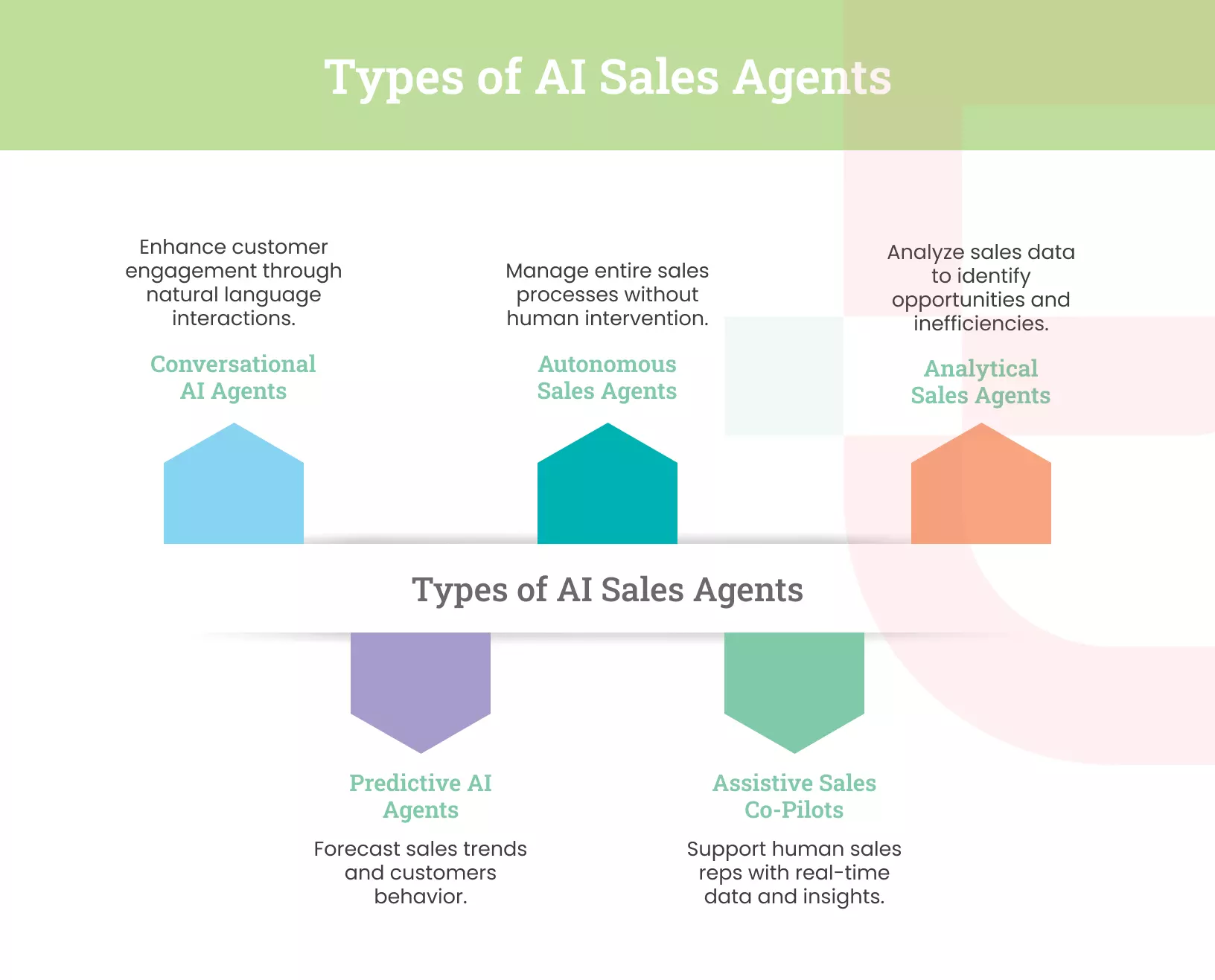
There are five different types of AI sales agents to solve specific challenges of the sales cycle. Let’s understand their roles, key capabilities, and areas of application.
Conversational AI Agents
The purpose of these AI agents is to keep your online visitors engaged. Until human agents are available, conversational AI agents can answer basic queries. They can also guide visitors towards the next step in the sales funnel.
Key Capabilities:
- Handle questions about products, pricing, features, or policies
- Qualify leads by asking structured questions
- Recommend solutions based on customer needs
- Schedule demos for customers with human representatives
- Provide round-the-clock assistance through chat, WhatsApp, SMS, and email
Example:
Consider a SaaS website leveraging a conversational AI agent. It can greet visitors, ask about their business challenges, and automatically book a demo with the right sales representative.
Areas of Application:
- Top-of-funnel interactions
- Initial lead qualification
- Customer support
Predictive AI Agents
These agents use machine learning models to analyze data and forecast sales outcomes. They don’t chat with customers but guide sales teams behind the scenes.
Key Capabilities:
- Score leads based on the likelihood of conversion
- Predict deal closures and expected revenue
- Identify the best time to contact a prospect
- Recommend the most promising leads to focus on
- Recognize patterns in buyer behavior
Example:
A B2B company uses a predictive AI agent that analyzes CRM data and tells the team, “These 50 leads have the highest chance of converting this week.”
Areas of Application:
- Sales planning
- Pipeline management
- Resource optimization
Autonomous Sales Agents
These are the next evolution of AI sales systems. They operate independently, take end-to-end actions, and sometimes even close smaller deals without human involvement.
Key Capabilities:
- Run multi-channel outreach (email, LinkedIn, chat, SMS)
- Conduct conversations without scripts
- Handle objections with contextual knowledge
- Follow up relentlessly until the lead responds
- Process smaller transactions or signups directly
Example:
An eCommerce brand uses an autonomous AI agent to contact cold leads, nurture them with personalized messages, and close purchases on special offers.
Areas of Application:
- SMBs with limited sales staff
- High-volume sales pipelines
- Repetitive outreach tasks
Assistive Sales Co-Pilots
These AI tools support human sales reps in real time. They don’t replace salespeople. Instead, they boost their performance during calls, demos, and negotiations.
Key Capabilities:
- Provide live suggestions during conversations
- Pull up customer data automatically
- Summarize calls and identify action items
- Recommend upsells or cross-sells
- Generate personalized responses or follow-up emails
Example:
Imagine during a sales call, the co-pilot listens in and instantly shows the message to the human agent:
“Prospect is concerned about implementation time. Share the 2-week onboarding success metric.”
Areas of Application:
- High-touch B2B sales
- Enterprise negotiations
- Rep productivity enhancement
Analytical Sales Agents
These agents act as data analysts for the sales team. They digest massive volumes of sales data and convert it into clear insights.
Key Capabilities:
- Track sales performance across teams
- Identify bottlenecks in the funnel
- Suggest next-best actions for stalled deals
- Monitor rep productivity and conversion rates
- Provide executive-level dashboards and forecasts
Example:
Imagine a growth team uses an analytical AI agent that reports:
“Your email follow-up rate dropped by 18% this month; leads are disengaging after stage 2.”
Areas of Application:
- Sales strategy
- Sales forecasting
- Leadership decision-making
Why Using AI to Increase Sales Makes Business Sense
AI has become one of the most strategic investments for sales-driven companies. Whether you’re a small business or a global enterprise, AI helps you sell smarter, faster, and more consistently. It not only cuts down on manual work but also improves the accuracy and efficiency of every step in the sales cycle.
Below are the key reasons why adopting AI for sales is no longer optional but essential.
Massive Efficiency Gains With Reduced Human Effort
When sales representatives spend more time managing work than selling, the business loses potential leads. A sales AI agent can take over mundane sales tasks so that human agents can focus on high-value interactions.
With AI agents, you can automate:
- Lead segmentation
- Repetitive follow-ups
- Periodic CRM updates
- Answering basic queries through chatbots
Benefits:
- Higher productivity with fewer manual tasks
- Faster lead response times
- More pipeline coverage without increasing team size
Increased Conversions Through Personalization and Speed
Sometimes businesses lose leads because follow-ups are either too late, generic, or inconsistent. It’s not even possible to follow dozens or hundreds of leads every day with the same energy.
Through AI agents, you can send personalized follow-ups based on their previous interactions. For example, AI will tailor the message for one lead based on price and for another based on time spent on sales pages.
Benefits:
- Higher engagement
- More conversions from the same traffic
- Personalized nurturing at scale
Data-Driven Sales Strategy for Actionable Insights
With inconsistent CRM data, it is difficult to identify high-potential leads for targeted marketing. This often leads to poor campaign performance. AI agents can analyze thousands of data points to help you identify such leads and suggest the right method to convert them with ease.
Benefits:
- More accurate forecasting
- Better prioritization of leads
- Faster decision-making backed by clear patterns
True 24/7 Sales Operations
With a sales AI agent, there is no question of task fatigue. They don’t need sleep, breaks, or limited working bandwidth. If you need them to handle thousands of conversations simultaneously, they can do it.
Benefits:
- No missed leads
- Immediate responses at any hour
- Continuous nurturing even during weekends
- Higher customer satisfaction
Discuss Your AI Sales Agent Strategy With Our Developers Today And Start Building A Smarter, Faster Customer Experience.
Key Use Cases of an AI Agent for Sale in the Sales Funnel
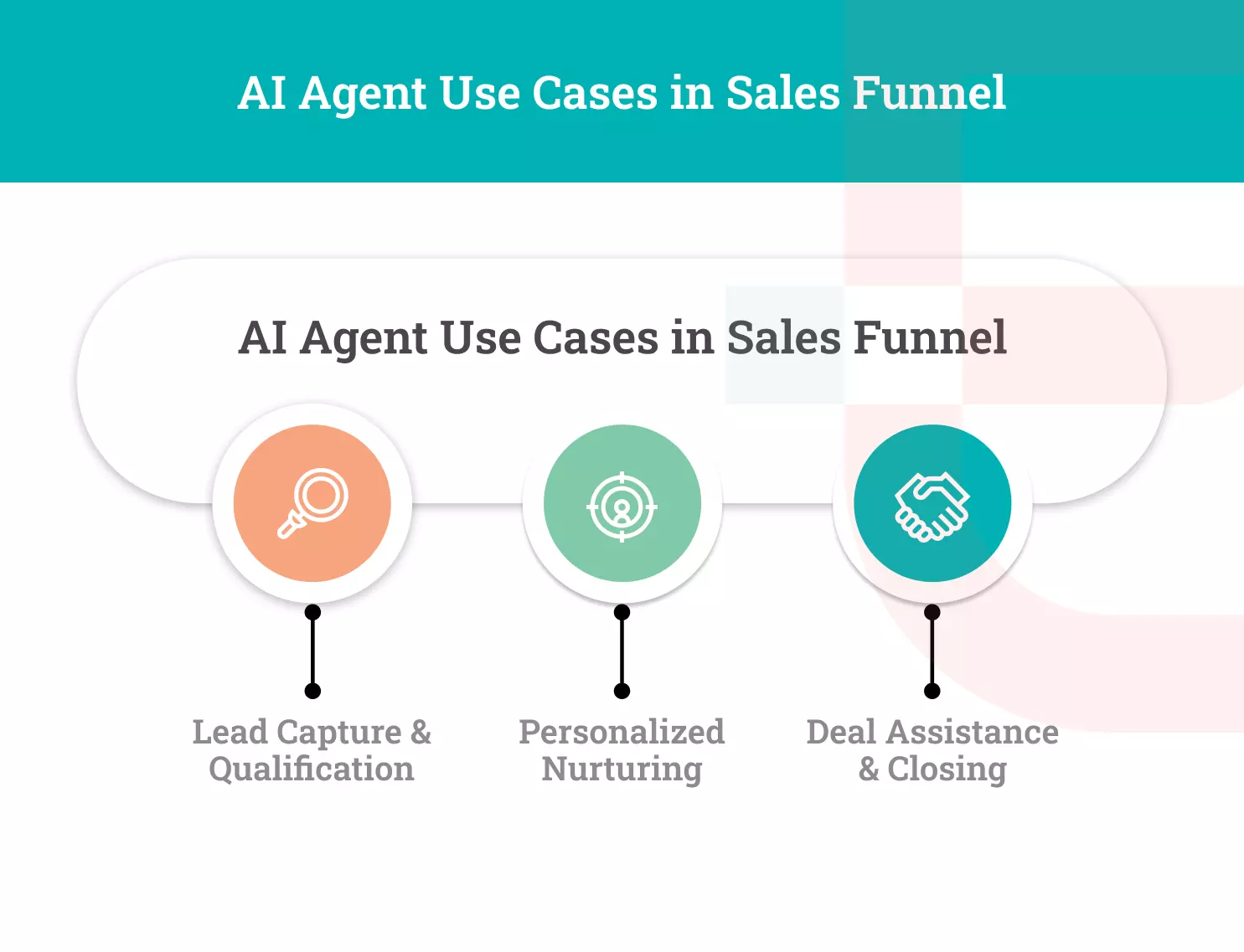
AI sales agents play different roles at each stage of the sales funnel. Let’s take three real industry scenarios to better understand.
TOFU Use Case: Lead Capture and Qualification (SaaS)
The top of the funnel is all about attracting potential leads by tapping into their pain points. However, either businesses experience a high churn rate or sales teams waste time on unqualified leads.
How AI helps:
Sales AI agents quickly interact with visitors to engage them through the funnel and extract contact details. They ask qualifying prompts to highlight high-potential leads for an immediate follow-up by human agents.
Industry Example:
A project management SaaS tool installs an AI agent on its pricing page. When visitors inquire about plans, the AI identifies usage needs, budget, and company size. Only qualified leads are pushed into the CRM with full context, while low-value leads receive automated guidance.
Result: +40% more qualified demo bookings without expanding the SDR team.
MOFU Use Case: Personalized Nurturing and Follow-Up (E-commerce)
In the middle of the funnel, prospects are in the semi-conversion stage. They compare your brand with competitors, abandon payment carts, or may exit the funnel.
How AI Helps:
AI agents keep nurturing sceptical leads with personalized promo codes, FOMO-driven emails, or one-to-one chat in real time. They retain leads within the funnel and signal human intervention for that little push required for the conversion.
Industry Example:
A fashion e-commerce brand uses a sales AI agent to recover abandoned carts. When a customer leaves without purchasing, the AI:
- Sends a personalized WhatsApp message
- Recommends alternative sizes or deals
- Answers queries about shipping or returns
If the lead is still not showing any positive move, the AI can issue a limited-time discount.
Result: 25-35% increase in cart recovery and repeat purchases.
BOFU Use Case: Deal Assistance and Closing Support (B2B)
At the bottom of the funnel, you either lose customers or close deals. It is nearly impossible to keep track of every single lead activity there and plan the next move.
How AI Helps:
An AI sales co-pilot can help human agents come up with better negotiations by:
- Highlighting buyer intent signals
- Summarizing previous conversations
- Suggesting the ideal course of action
- Drafting quick follow-up emails
- Providing competitive battlecards in real time
Industry Example:
A cybersecurity company equips its reps with an AI co-pilot during client demos. When a prospect wanted to know USPs over other brands, the AI instantly pulled out a side-by-side comparison for the human agent. After the call, it auto-generated a customized proposal based on the last conversation and triggered a follow-up.
Result: 30% faster deal velocity and reduced friction in final-stage negotiations.
Harness the Power of AI Sales Agents to Transform Your Workflow! Reach Out to Us and Share Your Loopholes!
How to Choose and Implement a Sales AI Agent in Your Organization
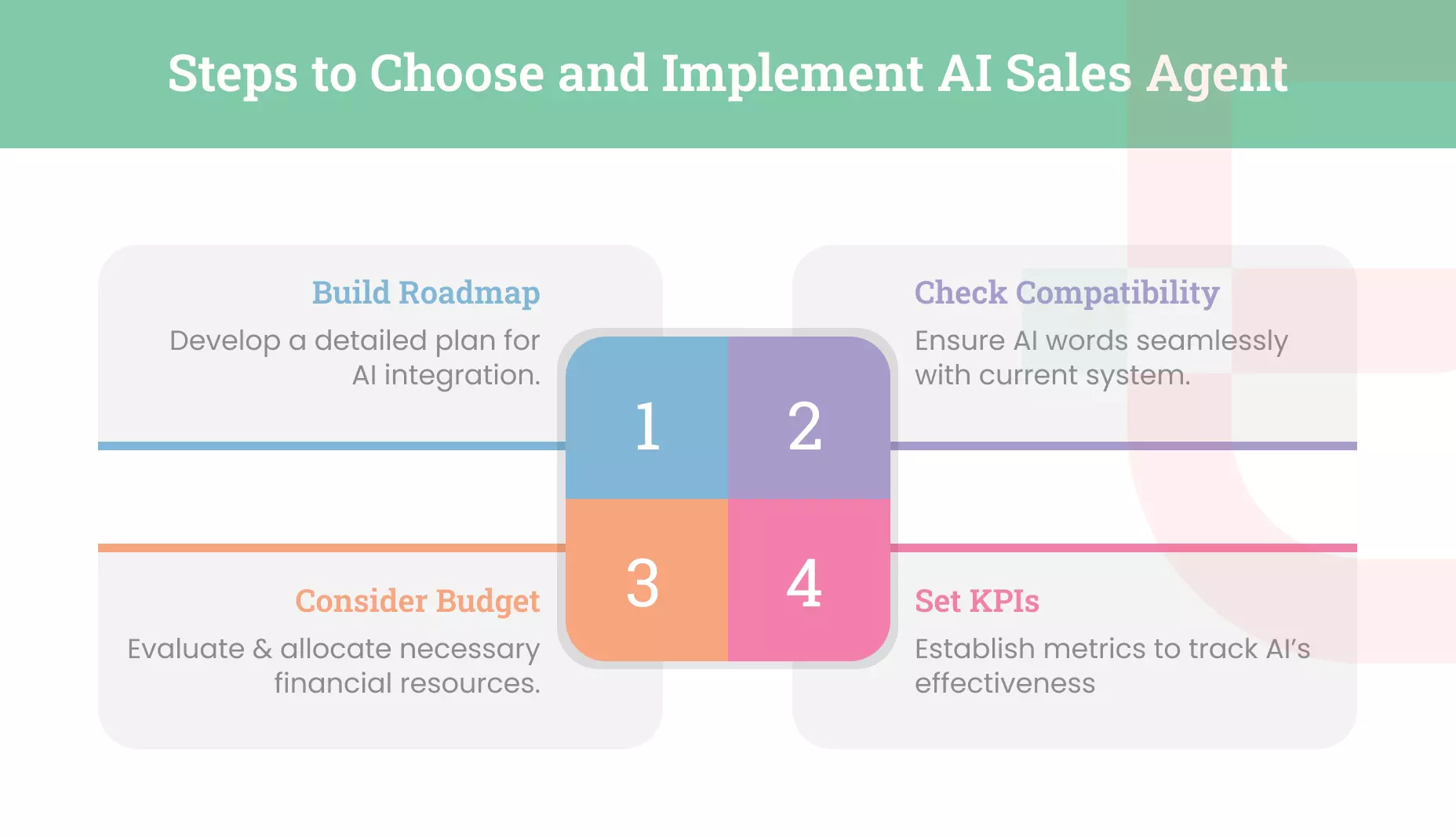
Choosing the right sales AI agent and correctly integrating it with your system for the desired output are two critical challenges on their own. Here is a simple step-by-step process that will help you start on the right foot.
Step 1: Build a Clear Implementation Roadmap
First, have absolute clarity about how you want to align AI agents with your sales processes to aid your team’s performance.
Ask yourself:
- Do we need faster lead qualification?
- Are we missing leads after office hours?
- Are human agents overloaded with follow-ups?
Based on your need, choose the right agent type as follows:
- Conversational AI for faster responses
- Predictive agent to predict conversions
- Autonomous agent to bring end-to-end automation
- Sales co-pilot agent to assist representatives during calls
- An analytical agent for an in-depth data analysis
Once your AI sales agent is finalized, map your sales workflow. Identify which tasks are to be completed by AI and which ones must stay in control of humans. For instance, lead capture and lead qualifications can be handled by AI agents. However, leads would prefer to see a demo and negotiate a contract only with human agents.
Next, decide which systems to integrate with AI for faster workflows. For example, you can connect an AI agent inside HubSpot or WhatsApp, depending on your requirement.
Step 2: Check Technical Compatibility With Your Existing Sales Stack
It is one of the critical challenges for businesses to seamlessly integrate AI into their legacy systems.
Here’s how to evaluate it:
Confirm CRM Compatibility
Check if the AI agent integrates with your CRM through:
- Direct native integration
- API connections
- Webhooks
If the AI can’t read or update customer records, it can’t make accurate decisions.
Ensure Compatibility with Communication Tools
Your AI should plug into the channels your customers use:
- Website chat widgets
- WhatsApp Business
- SMS
- Phone systems
- Social DMs (Instagram, Facebook)
Step 3: Consider Budget and Cost
It is important to invest in AI sales agents that improve revenue without creating unnecessary overhead. That can be best realized by correctly estimating how much time your sales team spends on repetitive tasks. For example, if they spend one-fourth of their day on admin work, your ROI should at least cover that.
AI sales agents usually follow one of these models:
- Subscription-based: fixed monthly fee
- Seat-based: pay per sales representative
- Usage-based: per lead, per conversation, or per message
- Hybrid: mix of subscription + usage
>
Also, check for hidden charges, like:
- Set-up or onboarding fees
- Additional channel integrations (like WhatsApp API fees)
- Customization charges
- CRM syncing limits
- Cost of adding more users in the future
Choose the model that fits your lead volume and sales cycle.
Step 4: Set KPIs to Measure Success
Once your AI sales agent is live, you need clear metrics to judge whether it’s actually delivering value. The right KPIs help you understand where the system excels and where it needs improvement.
Here are some key KPIs to track:
Conversion Rate Improvement
This metric shows if more people are showing interest and moving to the next step. An ideal AI sales agent should increase conversions by ensuring timely responses and personalized follow-ups.
Lead Response Time
AI should reduce the average response time from minutes/hours to a few seconds. For example, if AI can cut your first response time from 2 hours to under 5 seconds, this will increase qualified leads by 19%.
Time-to-Close Deals
Track how long it takes from initial interest to deal closure.
AI speeds this up by:
- Qualifying leads faster
- Assisting reps with real-time insights
- Keeping prospects engaged with follow-ups
For example, if you are a B2B SaaS company and your average sales cycle is 45 days. You have now implemented AI co-pilot in your workflow. It prepares summaries, follow-ups, and product recommendations instantly. Periodically check how it impacts your sales cycle. If it is less than 45 days every time, you’ve the right agent for your help.
Agent Productivity
Measure how many hours of admin work the AI eliminated. The number of hours per week AI saves each representative can be redirected to other productivity tasks.
What to measure:
- Hours of admin work saved per rep per week
- Number of automated follow-ups sent
- Number of emails drafted by AI instead of humans
- Reduction in time spent updating CRM fields
If your human agent spends only 2-3 hours on a task with an AI copilot that used to take 10-12 hrs, that’s almost 40 hours saved per week. This is equivalent to one full workweek that can be spent on some other high-value tasks requiring human intervention.
Customer Satisfaction
Customer satisfaction is one of the clearest indicators of whether your AI agent is improving experience or frustrating prospects. AI should improve the overall experience, not harm it.
Consider tracking:
- Chat satisfaction score
- Reduced ticket backlog
- After-hours engagement rate
- Resolution rates for routine questions
Certain customer issues still need empathy and human judgment. This is where evaluating AI vs. human chat support becomes crucial for shaping your engagement strategy.
The Future of Sales: Where AI Sales Agent Technology Is Heading
As AI continues to shift through new updates, it will bring new revolutions in sales and marketing. According to McKinsey, nearly 62% of survey respondents said they are experimenting with agent AI. Here is how the AI sales agents may surprise us by automating even more critical tasks for human agents.
Integration of Voice AI and Generative AI for Personalized Pitches
In the near future, there will be a technical integration between voice AI and generative AI. That means an AI agent will be able to generate the pitch for customers on the fly as they speak about their requirements over an automated voice call.
The sales team can leverage this feature to bring more customers inside the funnel without heavy model training. AI, on its own, will be able to decide whether to invite the lead for a demo or share customized pricing.
Agentic AI and Fully Autonomous Sales Systems
One of the interesting AI trends is Agentic AI. The next generation of AI agents may no longer require scripted automation. They will be autonomous collaborators. Meaning, everything involved in a complex sales strategy can be automated through AI agents.
For example, for a SaaS company, AI sales agents create outreach campaigns for the target audience, book calls, and negotiate custom pricing to close contracts. This will dramatically reduce human workload.
Ethical Sales AI: Balancing Automation with Human Empathy
As AI agents become more sophisticated, there will be an increasing concern about the ethics of automation in sales. Businesses have to maintain trust, transparency, and empathy when AI drives customer conversations.
As per IBM, now is the moment for responsible AI. For example, customers have to be informed that they are currently speaking with AI. Sometimes, AI may also generate wrong messages or interactions if it fails to read emotions, tone, or sensitivity of customers correctly. There is also a chance of AI favoring certain leads due to its training on biased data.
So, it is imperative to always involve a human in high-value deals and to train AI with ethics to mitigate these risks.
Transform Your Sales Process With Elluminati’s AI Sales Agent
AI sales agents are essential assets for any business to stay competitive, respond faster, and sell smarter in a digital-first world. They are changing the way sales teams operate and customers experience your brand, and that too in a positive way.
However, to experience the true benefits of this automation demands the right strategy, the right type of AI agent, seamless integration with your systems, and continuous optimization. Elluminati knows this well. We offer AI agent development services, preparing neatly coded solutions to offer efficiency, conversion rates, and customer satisfaction.
Our AI-powered solutions are built to support core business areas. We partner closely to understand business, operations, and challenges to build and implement AI solutions for innovation and automation to fit the goals.
If you’re ready to bring this future into your organization, the next step is partnering with Elluminati for AI agent development services that can build solutions tailored to your sales process, data, and goals.
Let AI support and accelerate your sales engine with the right partner.
FAQs
AI sales agents are automated tools developed for handling mundane, repetitive tasks of human agents for additional productivity. For example, AI agents can respond to queries, nurture leads with follow-up messages, and support sales teams by giving the right answers. The entire process is carried out with a combined effort of machine learning, natural language processing, and automation to address customer needs.
Based on the intent of operation, AI sales agents can be of five different types as follows:
- Conversational AI Agents: to engage in conversation with customers through chat or voice
- Predictive AI Agents: to forecast trends in sales or to identify potential clients for targeted marketing
- Autonomous AI Agents: to handle mundane tasks like outreach or follow-ups without human intervention
- Assistive Sales Co-Pilots: to support human sales agents during calls with real-time customer insights or intent
- Analytical Sales Agents: to analyze the current sales performance and suggest actions for pipeline growth
AI can handle automated, repetitive tasks, but it cannot replace human agents in critical situations. For example, in certain situations that require emotional intelligence, negotiation, or empathy, AI cannot deliver like humans.
AI sales agents work by following a systematic process. They collect and analyze data from different sources, like CRMs, web analytics, or past client chats. Then they interpret them with NLP to understand the intent. Depending on the context, they respond. It can be responding to a customer query or offering product suggestions.