Key Takeaways (or TL;DR)
- Careem initially began its journey as a premium transportation solution for business travel, and later it expanded its ecosystem to multiple services, including delivery, couriers, and home services.
- The platform turned out to be MENA’s leading super app due to its strong focus on localization.
- The Careem business model operates as a multi-service platform connecting customers, drivers, delivery partners, and merchants through a single ecosystem.
- The super app generates revenue from multiple streams, including commissions, service fees, surge pricing, subscriptions, and more.
The Careem business model shows how a ride-hailing startup can evolve into a super app by integrating multiple services in its ecosystem. The MENA region’s famous multi-service platform generates income from multiple sources, including subscriptions, commissions, service fees, and more.
Understanding the model helps you identify the strategies behind its growth and market leadership in the region. This article will give you detailed information about Careem’s revenue model, its business model, and ownership structure.
What is Careem?
Careem is a Dubai-headquartered super app that allows customers to book multiple services like ride-hailing, food and grocery delivery, home services, and payments from a single application. It was founded in 2012 by former management consultants of McKinsey & Company, Mudassir Sheikha and Magnus Olsson.
Later in 2013, a third co-founder, Abdullah Elyas, joined the company. Its primary purpose has always been to simplify and improve the lives of people and build an inspiring organization.
Careem initially began its operations as a corporate car booking website where professionals were able to pre-schedule transportation facilities. Then, starting in 2018, it began transforming into a multi-service app by adding other verticals like standard rides, deliveries, and payments to its platform.
The company gained immense popularity within a few years of its launch. The reason behind it was its strong focus on regional localization. It has designed its services around local language preferences, payment needs, and regulatory frameworks.
Moreover, it also gives importance to its drivers by branding them as Captains. This term gave drivers professional recognition and also helped the company change the perception of the profession in the region, which helped it build a strong network.
A Look into Careem’s Success Journey
Today, Careem operates in more than 70 cities across 10 countries of the MENA region, including Morocco and Pakistan. Besides, it has helped over 2.5 million captains to increase their earnings and has served more than 50 million customers since its launch. Here is a look at the growth journey of Careem.
2012
- Launched in Dubai by Mudassir Sheikha and Magnus Olsson as a corporate booking platform
2013
- Abdullah Elyas joined as the third co-founder.
- It transitioned into a ride-hailing platform
- Received seed funding of $1.7 million from STC Ventures
- Expanded its operations to other cities like Abu Dhabi and Riyadh
2014
- Received funding of $10 million from Al Tayyar Travel Group and STC Ventures
2015
- Expanded beyond the Gulf and Egypt by launching in Morocco and Pakistan
- Careem was Uber’s largest regional competitor as Uber entered the MENA market.
2016
- Raised a $350 million tranche led by Rakuten and Saudi Telecom Company, reaching unicorn status at a $1 billion valuation
2017
- China’s famous ride-hailing platform DiDi Chuxing partnered with Careem to expand its operations in the Middle East.
2018
- It launched an online food ordering and delivery app, Careem Now, in Dubai and Jeddah.
2019
- Expanded its food delivery operations in Riyadh and Amman
2020
- Uber acquired Careem for $3.1 billion.
2021
- Careem launched Careem Quik for rapid grocery delivery within 15 minutes.
2022
- Introduced Careem Pay, a digital wallet on its platform
2023
- A UAE-based telecom giant, Emirates Telecommunications Group(e&) took a $400 million majority stake in Careem.
2026
- e& to sell a 12.5% stake in Careem to Uber for $100 million
- Continues to expand its operations in the MENA market
Who Actually Owns Careem – Uber or e&?
In 2020, Uber acquired Careem completely. But in April 2023, the company spun out its non-mobility services, like delivery and payment, into a separate entity named Careem Technologies.
At that time, e& acquired a 50.03% majority stake in this company. e& not only provided support in terms of capital, but it also helped the multi-service platform strengthen its brand presence in the MENA market.
But recently, in June 2026, e& signed an agreement to sell a 12.5% stake in Careem to Uber for $100 million. This will reduce e&’s holding from 50.03% to 37.53% and give a controlling position to Uber in the super app unit.
The deal also carries reciprocal put and call options exercisable between December 2031 and January 2032, which will let Uber buy out e&’s remaining stake entirely. So, Uber owns 100% of Careem’s ride-hailing operations and a controlling stake in Careem Technologies.
Despite these structural changes, Mudassir Sheikha continues as the CEO of the company. And customers continue using the app, completely unaware of the separate ownership entities.
How Careem Works – A Look Inside the Super App’s Working
Careem operates as a multi-sided marketplace that connects customers, captains, and merchants through a single ecosystem. Here is how Careem works in detail.
For Customers
- Customers choose ride-hailing, food delivery, grocery, or other available services.
- They add pickup/drop-off locations, delivery details, or service preferences.
- The app calculates the applicable fare or order total before confirmation.
- Customers confirm the ride or order and select a payment method.
- The platform assigns a suitable Captain or routes the order to the relevant Merchant.
- Customers monitor the Captain, order status, and estimated arrival time.
- The service is completed, payment is processed, and customers can provide feedback.
For Captains
- Captains make themselves available to receive ride or delivery requests.
- They receive suitable requests based on location, availability, and service type.
- Captains review and accept the assigned trip or delivery.
- The app provides route guidance and customer/order details.
- Captains give rides to the customer or collect and deliver the order.
- Trip and delivery stages are updated through the Captain app.
- Captains can view completed trips, earnings, incentives, and relevant account information.
For Merchants
- Merchants get customer orders through the merchant interface.
- They review order details, item availability, and preparation requirements.
- The merchant processes and prepares the items for pickup.
- A Captain collects the prepared order for delivery.
- Merchants update preparation and fulfillment stages for customer visibility.
- They can monitor orders, sales, payouts, and other business information through the platform.
Technologies Powering the Smooth Working of the Careem Super App
The multi-service platform utilizes several technologies for effective operations.
- Automated dispatch system to find the nearest captain and assign the ride and delivery requests to them based on their location, availability, and ratings.
- Predictive analytics to identify high-demand areas based on booking history and pre-position captains, ensuring faster availability.
- Proprietary location database to provide accurate routes to captains that third-party mapping systems often fail to provide.
- Real-time tracking to let customers monitor the live location of assigned captains, which reduces support queries.
- Wallet and payment infrastructure to support multiple transactions for different services on one platform.
- Multi-language support to remove language barriers among customers, which restricts app adoption.
Careem Business Model: Understanding All Key Strategies
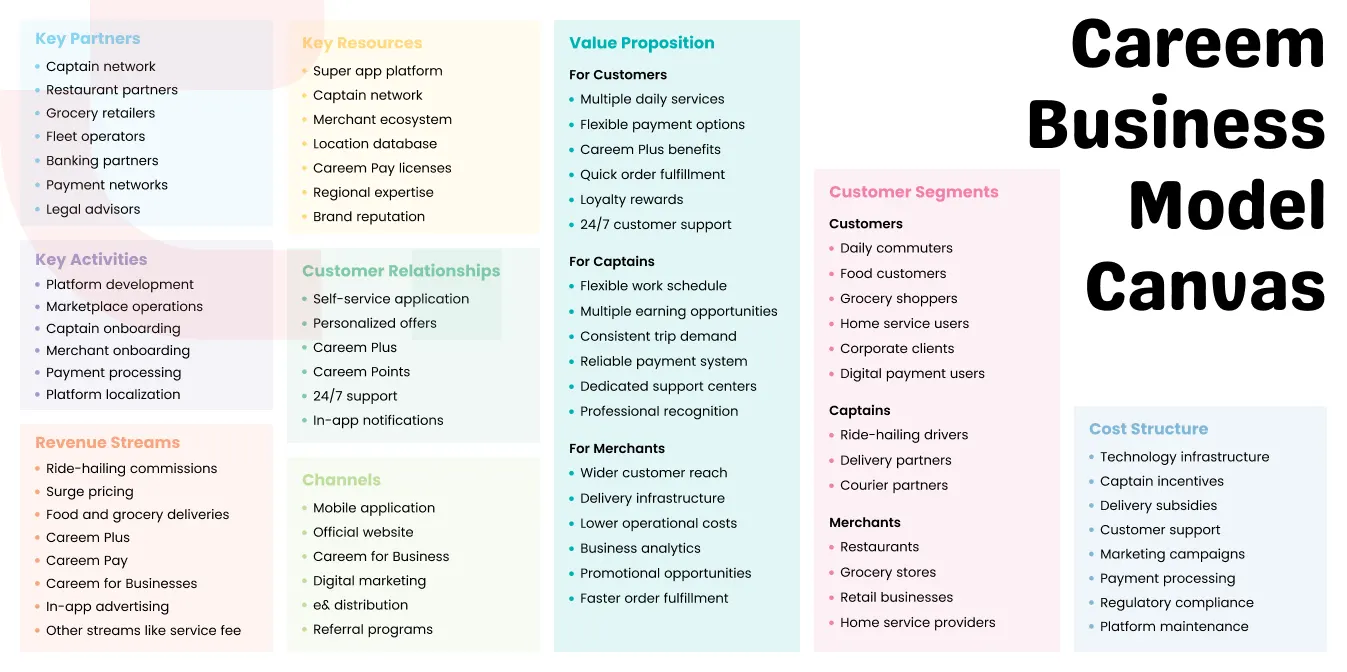
Below is the detailed explanation of each key aspect of the Careem business model.
Key Partners
The platform depends on different partners to run its multi-service operations smoothly in the MENA region.
- Web and mobile applications to provide online delivery services.
- Captains (drivers and delivery partners) for rides and deliveries.
- Restaurants, grocery stores, and retailers to supply meals, groceries, and other essentials for Careem Food and Get.
- Fleet leasing companies are to provide vehicles to the captains who do not own one.
- Banks and payment networks to enable secure transactions in Careem Pay.
- Legal advisors are to comply with government regulations in different MENA regions.
Key Activities
The company focuses on ensuring the smooth functioning of its marketplace in every market it operates in.
- Building and maintaining web and mobile applications.
- Localizing the platform for regional languages, payment preferences, and legal requirements.
- Recruiting captains for rides, deliveries, and courier services.
- Onboarding merchants for Careem Food and Get services
- Handling online transactions and complying with financial regulations in different markets.
Key Resources
The super app requires several resources to conduct efficient ride-hailing and delivery operations.
- A user-intuitive technology platform to provide multiple on-demand services.
- Captains to fulfill ride and delivery requests.
- A strong network of restaurants, grocery stores, and service businesses for deliveries and home services.
- Proprietary location data to help captains navigate the routes more accurately.
- Licenses for Careem Pay to ensure smooth digital payment services.
- Regional expertise to navigate different regulations in various countries of the MENA region.
- Strong brand presence to attract customers.
Value Propositions
The platform creates value for each of its stakeholders, including customers, captains, and merchants.
For Customers:
- They get access to different services like rides, deliveries, payments, and home services from a single platform.
- Multiple payment options like cash and Careem Pay enhance convenience.
- Loyalty programs like Careem Plus enable frequent platform usage while increasing customer retention.
- 24/7 customer support provides prompt solutions to user queries and enhances the experience.
For Merchants:
- Restaurants and retailers can extend their reach and enable online services without having their own delivery platform.
- Saves on operational costs as Careem fulfills delivery orders through its own logistics network.
- In-app advertising and sponsored placements help them improve their business’s visibility.
For Captains (Drivers and Delivery Partners):
- The platform creates an additional income source for captains.
- Flexible earning opportunities are created for multiple services like ride-hailing, food and grocery delivery, and courier services.
- They can operate at their own timings according to their preferences.
- Careem’s wider customer base ensures a consistent flow of ride and delivery requests.
Customer Relationships
Careem has been able to build strong customer relations through its multi-service ecosystem.
- A dedicated customer app lets them book different services and track captains in real time.
- Personalized offers increase customer engagement.
- Careem Plus subscription program builds loyalty by providing exclusive benefits.
- 24/7 customer support helps enhance customer experience.
- Careem Points reward customers for using different services.
Channels
The super app utilizes several channels to reach its different user segments, including customers, captains, and merchant partners.
- Web and mobile applications comprising multiple services.
- Careem for business to onboard corporate clients for employee transportation and meal delivery services.
- Digital marketing campaigns (SEO, paid ads, Social Media Marketing, etc.) to enhance online visibility.
- Careem uses e&’s distribution channels to enhance the adoption of its fintech and digital services.
- Careem Pay referral program, which encourages customers to refer its fintech services to their friends and family in exchange for AED 2000 earnings.
- Partnerships with local businesses to build a strong network of merchants for different delivery and home services.
Customer Segments
The platform serves different user segments through its multi-service marketplace.
Customers:
- People who need cab services for daily travel, airport trips, and office travel.
- Customers who want to order meals, groceries, household essentials, and book home services online.
- Local corporate offices that require a centralized solution to manage the travel needs of their employees and clients.
- Individuals who want to have a digital solution to make bill payments and international transactions.
Merchants:
- Restaurants, grocery stores, retailers, and courier services that want to provide online services without having their own delivery fleet.
- Home service providers who want to extend their reach without investing in building their own technology platform.
Cost Structure
Careem has to go through several costs to run its multi-service operations in different MENA markets.
- Development and maintenance of a technology platform
- Salaries of the customer support team
- Delivery subsidies to have competitive pricing
- Marketing campaigns for user acquisition
- Payment processing fees for online transactions
- Fees for regulatory adherence and licensing in different markets.
Want to Start a Multi-Service Business? Elluminati’s Careem Clone Lets You Launch Quickly Under Your Own Brand
How Does Careem Make Money – Breaking Down Its Monetization Strategies
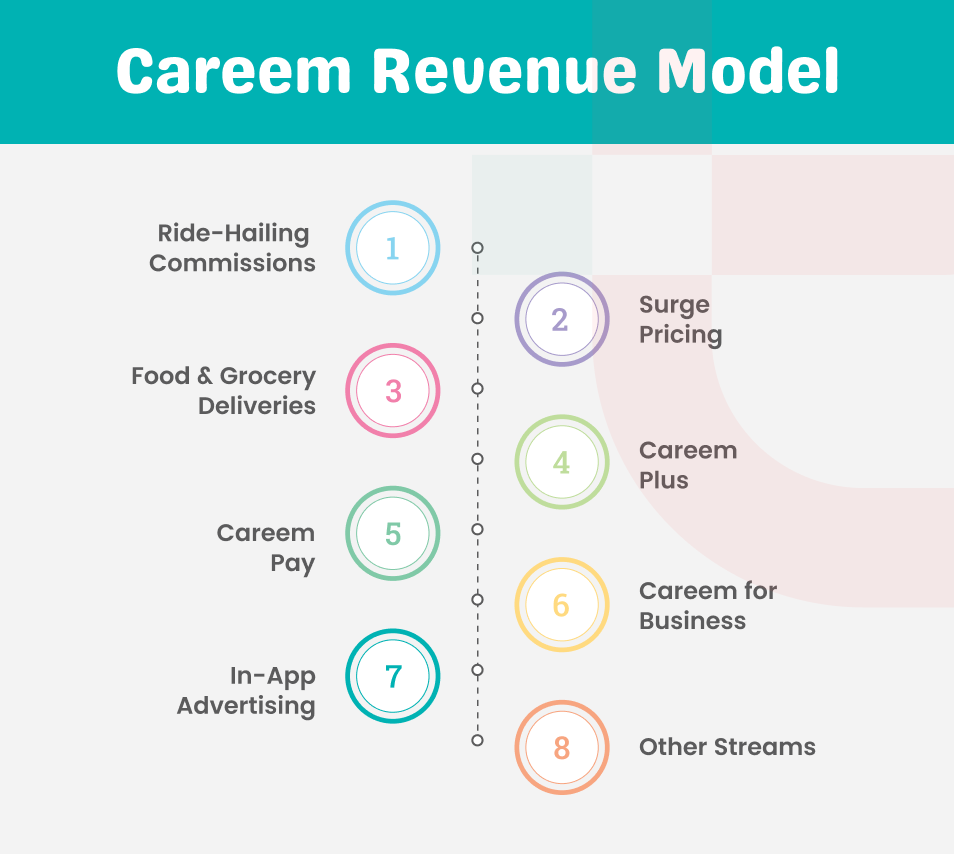
Careem does not depend on a single income source. It earns in multiple ways through transactions of rides and delivery orders, recurring earnings from subscriptions and fintech services, and ecosystem revenue through ads. Here is a detailed understanding of the Careem revenue model.
Ride-Hailing Commissions
The company charges a set percentage of commission for every ride request received through the platform. Commission rates vary depending on the type of ride requested. Economy rides generate lower commissions compared to Business, Max, and intercity trips.
Although Careem has not disclosed commission rates officially, the typical commission is estimated to be 20%-25%. For instance, if a customer books a ride for AED 50 in Dubai, then Careem takes 25% of the total fare, which is AED 12.50, and the captain gets AED 37.50. This income stream tends to grow as the number of bookings increases.
Surge Pricing
Careem’s pricing model uses a surge multiplier that automatically increases the ride fares and delivery charges during high-demand periods like festivals and peak times. This helps the company earn more commission from each trip and order.
Moreover, high pricing also encourages captains to remain available, which ultimately helps the platform maintain a balance between service demand and availability.
Food and Grocery Delivery Commissions
Careem Food and Careem Get charge partnered restaurants, grocery stores, and other merchants a 15% to 30% commission for every delivery and service order received through the platform.
This revenue stream allows the company to earn more as the order volume increases. In addition, since the super app manages its own dark stores in Careem Quik, the quick commerce segment allows it to keep complete margins on every product sold.
Careem Plus
Customers pay a set amount on a monthly or annual basis. In exchange, they receive exclusive benefits like 10% cashback on 10 rides, unlimited free deliveries, buy 1 get 1 deals, 10% off on home services, priority support, and dine-out discounts.
Such benefits encourage repeated usage of the platform, resulting in long-term loyalty among customers.
Careem Pay
Careem Pay is Careem’s own digital wallet that allows customers to make bill payments, do mobile recharges, and send money locally and internationally across 30+ countries.
It becomes valuable for people residing in the UAE and other Gulf nations who need to send large amounts of money regularly to their home countries.
This way, it provides a reason for customers to use the platform on a regular basis, which strengthens retention. The platform generates income by charging a small fee on money transfers, merchant payment processing, and international remittances.
Careem for Business
Corporate organizations can manage employee rides, client transportation, food and grocery deliveries, and couriers through a centralized dashboard.
Companies get complete visibility and full control over travel spend. Revenue comes from service fees along with ride and delivery charges. These contracts create a predictable and higher-value income stream compared to individual customers.
Advertising and Brand Partnerships
Fleet operators, restaurants, grocery stores, and other retailers pay a set amount to appear at the top of search results and promote their services through in-app banner ads. This opens an additional income stream for the company that works independently of daily ride and delivery order volume.
Other Streams
Besides the above-mentioned streams, Careem generates income from several other sources, such as:
- Cancellation fees are charged to customers for canceling booked rides or deliveries at the last moment. Compensating the captain’s wasted time and fuel.
- Bike rental fees are taken as either subscription or pay-per-ride fees for short-distance bike rentals in select regions.
- Service charges are added on top of the ride or delivery order value to cover the cost of platform maintenance.
- Courier delivery fees for sending packages and documents point-to-point. It helps cover operational costs.
- Electronics delivery commissions are charged to electronics retailers for every booking received through the platform.
- Home service commissions from home service providers listed on the platform.
Careem’s Cost Structure and Unit Economics
Here’s a look at the major costs that Careem has to incur to achieve sustainable growth.
Captain Incentives
The platform has to make continuous investments in captains’ payouts and incentive programs. These programs help the company build an adequate network of captains to ensure service availability always.
Delivery Subsidies
Instead of passing the full delivery cost to customers, the platform covers part of it by itself. A few ways that reflect this are discounted or free deliveries and below-cost pricing. This helps the platform attract customers and stay competitive in MENA markets where players like Talabat or Deliveroo are providing heavy discounts.
Call Center Operations
The platform invests in providing dedicated support to captains and customers for instant resolution of their queries and disputes. This helps it enhance user experiences and retention.
Technology Infrastructure
The super app has to invest in building and maintaining the technology platform, cloud infrastructure, and payment systems.
Marketing and Customer Acquisition
Careem spends on acquiring customers, merchants, and captains through digital marketing campaigns, referral programs, and promotional campaigns.
Regulatory Compliance Costs
Business licensing and registration, fintech regulations, and legal requirements vary across different MENA regions, which adds to operational expenses.
Cash Economy and Settlement Challenges
Cash payments increase settlement times and reconciliation efforts to collect commissions when captains get customer payments directly. Careem addressed this by introducing Careem Pay, which reduced cash dependency among customers and created an additional income source for the company.
Regional Price Sensitivity
The company has to charge relatively lower ride fares and delivery charges in many MENA regions due to price sensitivity. In such scenarios, it depends on stronger customer lifetime value for unit economics.
Because of such operational expenses, Careem has to rely on additional streams like Careem Plus, Careem Pay, Careem for Business, and in-app advertising for long-term profitability.
How Careem Stands Out Among Global Giants in the MENA Region with Localization
Careem’s success is the result of its deep understanding of local market needs. It designed every part of its services and technology platform according to regional customer behavior and regulatory framework. Here’s how localization played an integral role in the success of the Careem business model.
- The company understood that most of MENA’s population was underbanked. Due to this, it supported cash along with digital payment modes. It also developed custom reconciliation systems to handle cash collection between customers, captains, and the platform.
- Standard mapping services like Google Maps often struggle to provide accurate routes due to informal addresses and constantly evolving urban infrastructure. As a result, Careem built its own proprietary location database to help captains navigate faster and more efficiently.
- Rather than relying solely on an in-app support system, the company established customer and captain support centers with local language support in every MENA region they operate. This approach helps in resolving user issues faster.
- Features like an Arabic-first platform interface, women-only ride options, Ramadan-adjusted operating hours, and support for local payment preferences helped the company attract customers with ease.
- Referring to drivers as captains and conducting training programs helped the super app strengthen the supply ecosystem.
Careem Vs Its Competitors in the MENA Market
| Platform Name | Its Operating Markets | Services | Subscriptions | Fintech Services | Super App Ecosystem |
|---|---|---|---|---|---|
| Careem | MENAP (Middle East, North Africa, Pakistan) | Ride-hailing, food and grocery delivery, couriers, payments, home services, and quick commerce | Careem Plus | Careem Pay | Yes |
| Uber | Global | Ride-hailing and food delivery | Uber One | No | No |
| Bolt | Europe and Africa | Ride-hailing and food and grocery delivery | Bolt Plus | No | No |
| Yango | Middle East, Africa, and CIS | Rides and delivery services | Limited | Limited | Partial |
| inDrive | Global | Ride-hailing and courier | No | No | No |
| Talabat | Middle East | Food and grocery delivery and retail services | Talabat Pro | No | Partial |
| Deliveroo | Europe, Middle East and Asia Pacific | Food and Grocery delivery | Deliveroo Plus | No | No |
| HungerStation | Saudi Arabia and Bahrain | Food and grocery delivery | No | No | No |
What Lessons Can Entrepreneurs Learn from the Careem Business Model?
Localize More Deeply Than Global Giants Can
Global platforms often overlook local market needs. By adapting your platform to local customer behavior, payment preferences, and regulations, you can gain early traction with ease.
Start with One High-Demand Vertical
Rather than starting multiple services at once, start with one vertical that has the highest demand in the market. Careem began its journey as a corporate car-booking platform and then pivoted to consumer ride-hailing once it found product-market fit. This helps you build a loyal customer base.
Treat Captains Like Your Customers
Just as you treat customers to be valuable for your multi-service business, give the same importance to your drivers, delivery partners, and service providers. Invest in conducting loyalty programs to retain them and build a strong supply network.
Payments Can Turn Marketplace into an Ecosystem
Instead of forcing the adoption of digital payment tools, Careem integrated a cash payment feature in its platform to attract the region’s unbanked population. This can help enhance user convenience, which ultimately results in long-term loyalty.
Subscriptions Stick Multiple Verticals Together
Subscription programs help encourage customers to use multiple services as they are tied to exclusive benefits.
Build for Strategic Acquisitions or Partnerships
Always design your business structure while keeping future partnerships, acquisitions, and investments in mind. This ensures smooth expansion when needed.
How to Build an App Like Careem – A Must-Go Guide
You must consider several factors, like important features, technology stack, and cost to build an app like Careem.
Essential Features for the Careem Like Platform
The platform should consist of dedicated apps and web panels for each stakeholder to provide a smooth experience for each user.
Customer App
It allows customers to access and book multiple services from a single application.
- A structured listing of multiple service categories like rides, food, groceries, courier, and payments, so users can book services with ease.
- Options for instant booking and scheduling to provide flexibility to customers to request services according to their convenience.
- Live tracking shows the real-time location of captains and deliveries, which helps maintain transparency and reduce support overhead.
- Booking history gives information about past trips, including charged fares, for quick access.
- Multiple payment options, including cash, cards, digital wallets, and local payment gateways, to let customers pay according to their needs.
- Multi-language support, including RTL (Arabic/Urdu), removes language barriers and improves adoption rate among the non-English population in the MENA region.
Captain/Driver App
A dedicated application for captains to let them manage their availability, track earnings, and receive service requests.
- Registration process with built-in document verification to help you onboard reliable drivers and delivery partners.
- The online/offline button allows captains to manage their availability and operate on their preferred schedules.
- In-app notifications provide information about the trip and delivery requests, which captains can accept or reject as per their preferences.
- The daily and weekly earnings dashboard provides captains with visibility of trip-by-trip earnings, which helps them maintain transparency.
- Cash settlement and reconciliation system allows you to track collected cash and commissions owed, which simplifies financial management in cash-heavy markets.
- In-app navigation system helps captains provide precise routes to help captains navigate faster and more efficiently, ensuring on-time service deliveries.
Merchant Web Panel
A centralized dashboard allows partnered restaurants, grocery stores, couriers, and other service providers to manage online operations.
- Menu management allows merchants to upload and handle different product or service categories, pricing, and tags in real time.
- A live tracking dashboard lets them identify top-selling products and best-performing captains.
- Online/offline toggle allows merchants to set their availability, giving them the ultimate flexibility to operate on their preferred schedule.
- Push notifications provide order requests that they can either accept or reject based on their preferences.
- They get complete information about scheduled bookings directly from the dashboard to plan operations effectively.
- Merchants can set special offers and promo codes from the web panel to attract more customers.
Admin Web Panel
You can control operations for multiple services and get complete visibility of each task through a single dashboard.
- Set zones for ride and delivery services in different cities and countries directly from the dashboard.
- Manage all users, including customers, captains, merchants, fleet owners, and dispatchers.
- Set commissions and pricing for different services and products without having any technical expertise.
- Generate exportable reports of payment settlements for captains and merchants to maintain transparency.
- The analytics dashboard lets you track bookings and earnings in real time to make better decisions.
- Upload and manage your own products and their categories and sub-categories directly from the dashboard.
Region-Specific Features
Here are some features that you should integrate into your Careem-like app to succeed in the MENA market.
- Cash payment acceptance
- RTL language-supported interface
- Offline-tolerant design for markets with inconsistent network connectivity
- Women-only ride category in the ride-hailing segment
Super App Differentiators
Noteworthy features for your super app ecosystem:
- A microservice architecture to support expansion to different verticals anytime
- A unified wallet system to provide convenience to customers for payments
- A dedicated dashboard for managing corporate clients
- In-app advertising engine for brand promotion
- Ability to set loyalty programs for different verticals from a single dashboard
Technology Stack Recommended for Building the Super App
iOS
- SwiftUI
- Swift
- MVVM
Android
- Jetpack Compose
- Kotlin
- MVVM
Backend
- NodeJS
- Typescript
- NPM
Database
- MongoDB
Frontend
- Angular
Note
Never rely on a single income source. If your only income is commission and you have lower trip volume, your revenue stops entirely. Setting multiple revenue streams, such as cancellation charges, wait periods, and custom prices, ensures consistent income even during low-demand periods.
How Much Does it Cost to Build an App Like Careem?
| Development Stage | Estimated Cost | What It Typically Includes |
|---|---|---|
| Custom Development | $50,000 to $150,000+ | Multi-service ecosystem, fintech, subscriptions, loyalty program, B2B module, AI-powered features, advanced analytics, multi-country support |
| White-Label Careem Clone | $5,000 to $25,000 | Pre-built platform with core super app features, customization, branding, and faster deployment |
Custom Development vs. a Ready-Made Clone Solution – What Should You Choose?
| Factor | Custom Development | Ready-Made Clone Solution |
|---|---|---|
| Initial Investment | High | Lower |
| Time to Launch | 12 to 24 months | Within 5 working days |
| Development Approach | Built entirely from scratch | Pre-built and customized to business needs |
| Core Features | Developed individually | Comes with essential super app features |
| Customization | Unlimited | High, depending on the solution provider |
| Scalability | Depends on the architecture | Designed for multi-city and multi-country growth |
| Testing & Stability | Requires extensive testing | Market-tested with proven workflows |
| Maintenance & Updates | Managed separately after launch | Usually included as part of ongoing support |
| Business Risk | Higher due to longer development cycle | Lower with faster validation and deployment |
| Best For | Enterprises with unique product requirements and larger budgets | Startups and businesses seeking faster market entry with lower investment |
Enter the MENA’s Growing Super App Market Quickly While Localizing Around Regional Needs with Elluminati’s White-Label Careem Clone
How Can Elluminati Help You Build a Careem Like Super App?
Understanding the Careem business model gives entrepreneurs insights about how to build a scalable multi-service business. Its success highlights that you can achieve long-term growth by analyzing local market needs and diversifying revenue streams.
If you are considering launching a similar venture, Elluminati becomes your reliable technology partner with a white-label Careem clone. We hold 14+ years of expertise in building and deploying on-demand solutions for diverse businesses across 100+ countries.
Our market-tested solution comes integrated with a multilingual interface, scalable architecture, an automated dispatch engine, and a regional taxation system, which helps businesses launch and scale multi-service operations in the MENA region quicklyand effectively.
FAQs
The Careem business model operates as a multi-sided marketplace that connects customers, captains (drivers and delivery partners), and merchants through a single digital ecosystem.
The Careem revenue model generates income from multiple sources, including:
- Ride-hailing commissions
- Surge pricing
- Food and grocery delivery commissions
- Careem Plus subscriptions
- Careem Pay digital wallet
- Careem for Business
- In-app advertising
- Other streams
Careem had a split ownership structure until June 2026, in which Uber owned its ride-hailing operations, while e& telecom operator had the 50.3% ownership of its non-mobility services like delivery and courier. Then e& signed an agreement to sell 12.5% of Careem’s stake to Uber, after which Uber will hold a controlling position in the company, with e& holding 37.53% of the stake.
No, Uber operates as a ride-hailing platform while Careem is a multi-service platform that includes ride-hailing, delivery, home services, and quick commerce.
While Careem has not officially disclosed its commission structure, it is estimated to be 20%-25%.
Careem Plus is a subscription program where customers pay a set amount monthly or annually for exclusive benefits like ride discounts, free or discounted deliveries, and priority support.
Careem Pay is a digital financial services platform that allows customers to transfer money, make bill payments, and send international remittances.
The development cost depends on the type of approach you choose. A custom development would cost between $50,000 and $ 150,000+, while a ready-made, white-label clone solution costs from $5,000 to $25,000.
Bolt, Yango, and inDrive serve as competitors in the ride-hailing segment, while Deliveroo, Talabat, and HungerStation are competitors in the delivery segment.