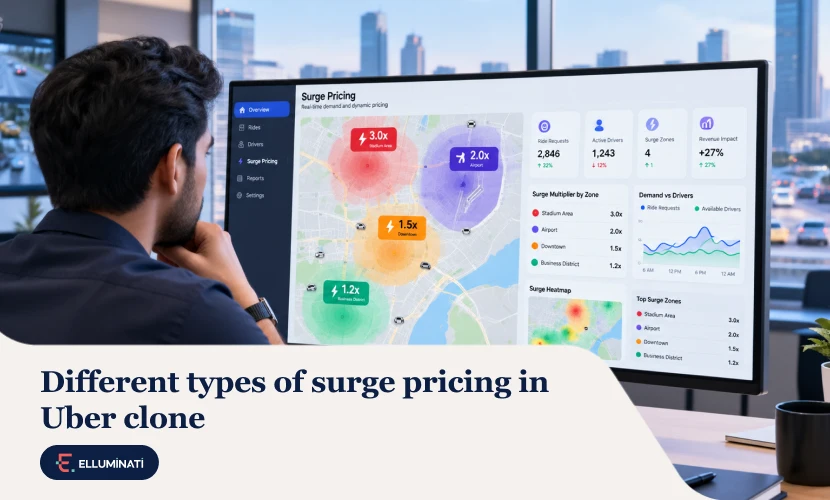
Key Takeaways (or TL;DR)
- Surge pricing is one form of dynamic pricing that increases ride fares when demand surpasses the number of available drivers.
- There are at least six distinct surge mechanisms: demand-ratio, time-based, zone-based, event-based, weather-based, and capped/hybrid.
- Each surge pricing type is designed to handle different ride-hailing scenarios.
- Regulation shapes which types are even usable in a given market; some regions cap multipliers or restrict surges outright during emergencies.
- Showing riders and drivers why a price change matters as much as the underlying mechanism for keeping trust intact.
“Surge pricing” and “dynamic pricing” are used as if they’re the same thing. They’re not, and that mix-up is worth clearing up before anything else, because it changes what a business actually needs to build.
This post breaks down the difference. Besides, we will also understand six distinct types that an Uber-style platform can run. It will also elaborate on what happens when more than one fire occurs at the same time, and where regulations limit which types are usable at all.
Surge Pricing vs Dynamic Pricing – What’s the Difference?
Both surge pricing and dynamic pricing are different types of taxi app revenue models. Understanding this distinction is essential, as both strategies are applicable in different scenarios.
Dynamic Pricing
It is a broader pricing strategy in which fares change (increase or decrease) depending on real-time conditions. It includes discounts, promotional fares, and loyalty-based reductions – none of which are surge. For instance, offering a 20% discount during low-demand periods to attract riders or increasing fares in airport locations to cover operational costs.
Surge Pricing
Surge pricing is a type of dynamic pricing model in which fares automatically increase when ride demand exceeds the number of available drivers. If you have received 300 ride requests simultaneously and you have only 120 drivers available, then the system increases ride prices by 1.5x.
Dynamic pricing is the umbrella term – any fare that moves based on conditions, including discounts, off-peak reductions, and loyalty-based adjustments. Surge pricing is the demand-driven slice of that umbrella: the mechanism that pushes fares up when requests outpace available drivers. Every surge is dynamic pricing. Not every dynamic price is a surge.
The surge multiplier is not fixed. The system keeps a continuous watch on the demand and number of drivers and increases the multiplier as soon as the imbalance occurs.
Treating surge as a single toggle means treating six different triggers, each with its own data source, its own logic, and its own regulatory exposure.
Types of Surge Pricing You Can Implement in an Uber Clone
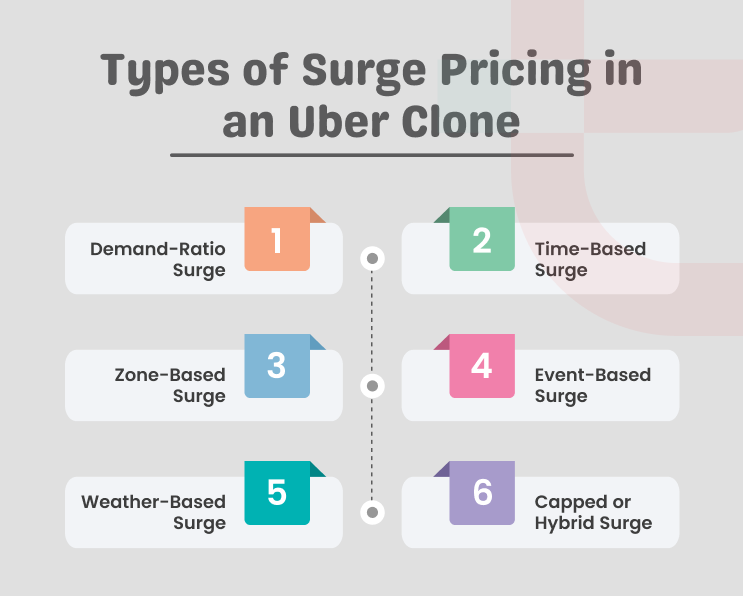
Ride-hailing demand spikes for different reasons. It can be due to rush, busy commute hours, a big event, or bad weather conditions. Each of these scenarios requires different pricing logic.
And that’s why surge pricing involves multiple types to respond to different demand conditions instead of following a single fixed fare logic. Let’s have a look at 6 different types that you can implement in an Uber clone.
Demand-Ratio Surge
It is the most common surge price model.In this type, the system keeps tracking the ratio of ride requests to available drivers in the defined location. Once that ratio exceeds the set threshold, the multiplier starts increasing until the required balance is achieved.
This fare structure benefits you in two ways. It becomes one of the important driver retention strategies to stay available during peak times, which helps you maintain a balance between service availability and increased demand. Second, it also allows you to take advantage of the increased requests and boost your earnings.
Time-Based Surge
Demand for rides predictably increases at certain times. For instance, morning rush hour, evening commute, weekend nightlife, and late-night travel.
Rather than waiting for a spike to occur, you can schedule the fares for such time periods in advance in an Uber clone. This predictability helps you plan driver availability more effectively and capture high-earning windows with ease.
Zone-Based Surge
This type increases fares in specific geographic locations where demand is consistently higher, and driver availability is limited, like airports, business districts, nightlife areas, and neighborhoods where drivers are less willing to operate.
This approach lets you direct more drivers in high-demand locations without affecting pricing in areas where demand is normal.
Event-Based Surge
You can set this fare model in an Uber clone for predictable occasions that are going to generate temporary demand in your operating zone. For instance, concerts, sports events, or festivals, or a group of flights landing at similar times.
This strategy lets you pre-position drivers near the event venue before the surge hits, and not after the demand spikes. However, to run this well, you need to integrate the platform with event calendars.
Weather-Based Surge
In this surge pricing model, you can increase fares during adverse weather conditions like heavy rain, snow, or storms, which push ride demand but make drivers less willing to accept trip requests. The Uber clone tracks live weather data alongside ride-request volume to activate weather-based surge when the conditions you set are met.
Capped or Hybrid Surge
This model combines multiple surge types while capping how high the combined fare increase can go.
For instance, you can apply a demand-based surge during heavy rainstorms but restrict the multiplier to go above 2x in an Uber clone, no matter how high the ride demand gets during that period.
This approach lets you charge riders more but not more than double, which enhances rider trust, and drivers still earn extra for driving in extreme weather conditions. Hybrid surge becomes helpful in regions that impose regulatory caps on surge pricing or for businesses that want to build rider trust through controlled fare increases.
Discover How Elluminati’s Uber Clone Lets You Implement Different Surge Pricing Strategies for Your Ride-Hailing Business
What Happens When Multiple Surge Conditions Occur Simultaneously?
Not all surge types need to trigger one at a time. There can be scenarios when multiple models are applicable at the same time. For instance, ride requests increase when heavy rainfall occurs during evening rush hour near a busy airport. In such cases, multiple surge types get triggered.
- Time-based surge activates when demand spikes at 6 pm
- Zone-based surge, as the pickup location is the airport
- Weather-based surge since ride demand increases due to heavy rainfall
When this happens, the Uber clone’s pricing engine will apply all active surge multipliers together, typically multiplicatively rather than adding them one by one. For instance, a 1.5x time-based surge combined with a 1.3x weather-based surge does not add up to a 2.8x surge. Instead, it multiplies to around 1.95x.
And too-high pricing makes rides costly for riders, which pushes them to affordable competitors. This is why implementing a capped surge rule becomes essential. It prevents the price from getting too high beyond a set limit, no matter how many triggers get active at once.
Here’s how the Uber clone’s price engine works when multiple surge types trigger simultaneously, and you have configured a capped or hybrid surge model in the platform.
- Detects all the active surge pricing triggers for the requested ride.
- Combines the applicable surge multipliers according to the pricing logic configured by you.
- Compares the value of the calculated multiplier with the maximum limit set by you.
- Brings down the total amount to the capped value if it goes past the set limit.
What Appears on the Rider and Driver Side When Surge Pricing Gets Active?
When surge pricing happens, both riders and drivers receive their information based on their role in their dedicated applications. Here’s what each user sees and why the display of those details matters for your ride-hailing business.
What Do Riders See?
Before confirming the booking, riders see complete fare details, which highlight that the surge multiplier is applied along with the reason for its application. For instance, bad weather conditions or any other event.
This helps riders make informed decisions, which prevents fare-related disputes and enhances the overall experience.
What Do Drivers See?
Drivers get map-based visuals of the zones where surge is active in their dedicated mobile app. This allows them to pre-position themselves in high-demand locations where they will receive more ride requests and maximize their earnings.
As more drivers move toward surge regions, the demand-to-supply ratio gradually gets balanced, which ultimately reduces the surge pricing.
Why Does This Transparency Matter?
Surge pricing becomes effective when users know why and how surge pricing is applied.
Riders are generally more accepting of surge pricing when they know why it is being applied compared to an unexplained price increase. Drivers get an idea of locations where they can maximize their earnings. Such transparency helps you build trust among both user groups and retain them for longer.
How Do Legal Regulations Affect Surge Pricing Configuration?
Regulations for surge pricing vary across different countries and sometimes even in states and cities. And this directly affects which surge types you can configure in an Uber clone in a specific market.
For example, Washington state lawmakers proposed a bill, SB 5600, that would cap surge fares to 120% of what the driver earns for a trip during large-scale events organized in the state. It was introduced ahead of Seattle hosting the 2026 FIFA World Cup.
Though it is still pending and has not been enacted into law. If passed, you will need to configure a separate fare limit for event-based surge in Washington. Whereas in the Philippines, the LTFRB (Land Transport Franchising and Regulatory Board) currently caps surge pricing at no more than twice the base fare, under Memorandum Circular (MC 2019-036).
So, you will have to set the multiplier cap to 2x by default. Moreover, you should also be able to change it quickly if LTFRB introduces any other pricing law.
These differences highlight that surge pricing cannot be configured in the same way for every region in an Uber clone. You need to adjust the surge rules according to the local fare regulations of the operating market.
How to Configure Different Surge Pricing Types in an Uber Clone?
Choosing the surge pricing types is just one part of the process. The actual work is configuring them in an Uber clone. Here’s a detailed understanding of how you can configure different surge pricing types.
- Choose the type of surge pricing model that you want to apply based on your business requirements. For example, demand ratio, weather-based, zone-based, or hybrid.
- Set minimum thresholds to activate surge pricing, like demand-to-driver ratio, weather conditions, geofenced service areas, or event schedules, based on the type you want to implement.
- Configure the surge multiplier range to decide how fares will be calculated when demand spikes. You define the multiplier between 1.2x and 3x depending on your pricing strategy and market requirements.
- Set regional pricing rules so your fare structure stays compliant with the regulatory framework.
- Define driver incentives to motivate them to stay available so you can restore the balance between demand and supply.
Explore Elluminati’s Uber Clone to Configure Different Surge Pricing Types and Adapt to Varying Fare Rules in Different Markets
How Does Elluminati’s Uber Clone Help You Set Different Types of Surge Pricing?
There are six different types of surge pricing in an Uber clone, which include demand ratio, time-based, zone-based, event-based, weather-based, and capped. Each type gets activated in different ride-hailing scenarios.
Understanding these fare structures helps you choose the right strategy for your ride-hailing business when demand exceeds the number of available drivers. However, selecting the right approach is not enough to succeed. You need to have a platform that lets you configure different pricing rules according to your target market and operational needs.
Elluminati offers an Uber clone with the flexibility to configure different surge pricing models, multiplier ranges, and region-specific pricing regulations. This allows you to expand to new markets while ensuring regulatory compliance.
FAQs
No, they are different. Dynamic pricing is a broader pricing strategy where fares change (increase or decrease) based on real-time market conditions. And surge pricing, on the contrary, is one type of dynamic pricing in which fares increase automatically when ride requests surpass the number of available drivers.
Surge pricing can be triggered by numerous factors, which include a high demand-to-driver ratio, peak times, busy pickup locations, events or festivals, and adverse weather conditions.
Yes, you can choose surge pricing types for the Uber clone according to your operational needs and target market regulations.
Yes, riders booking rides from the same surge zone at the same time receive the same surge multiplier. However, final fares may still vary, as they depend on several other factors like trip distance, estimated travel time, and additional charges applied by the business.
It depends on the surge pricing regulations of the specific country, state, or city where you want to operate.