Key Takeaways (or TL;DR)
- An Uber clone is fully legal when independently developed using the original source code. What determines legality is how you brand and operate the platform, not its functional similarity to Uber.
- Before purchasing, you should verify source code originality, full IP assignment, compliance with region-specific laws like GDPR, PCI DSS, and complete App Store requirements.
- App Store and Google Play compliance can block your launch entirely if location permissions, wallet disclosures, or privacy policy links are missing.
- Tailor your Terms & Conditions and Privacy Policy in every market you enter, which act as strong legal instruments.
- Try to avoid any elements related to Uber in your platform, such as its name, logo, UI elements, or proprietary design, as they invite trademark claims and serious IP liability.
Most taxi businesses focus heavily on features, scalability, launch timeline, and pricing when choosing a ready-to-launch app like Uber.
However, they forget to consider one critical factor, which is Uber clone legal considerations – a platform-level set of regulatory, licensing, and intellectual property rules that every entrepreneur must follow when launching a ride-hailing business.
Just like it is essential for your business to adhere to all taxi licensing requirements, a ready-made Uber like platform should also ensure regulatory compliance. For instance, regulators in the US and Germany often issue heavy financial penalties, cease-and-desist orders, and even permanently block the platform in case of non-compliance.
This article will give you complete information about all platform-level legal requirements, from GDPR requirements and the Terms and Conditions framework to user data handling and app marketplace policies, so you can enter the market with a legally compliant platform.
Is it Legally Permissible to Launch a Taxi Business with an Uber Clone?
One of the most common concerns for businesses is whether it is legally allowed.
Uber clone is a term used by on-demand app development companies to represent their white-label ride-hailing platform that works like Uber but is built completely from the original source code. The “clone” means a platform that replicates functionality, not one that copies proprietary source code or brand assets.
It is a market positioning term and not the exact copy of Uber. Functional similarity does not create legal risks. Moreover, such features are standard in the ride-hailing industry, and anyone can embed them in their solutions.
So, it is legal to launch your taxi business with a ready-to-launch app like Uber, as long as it does not contain Uber’s brand name, interface design elements, or any such trademarked assets.
Expert Tip
While evaluating software providers, always confirm original source code ownership and that no third-party proprietary components are embedded in the platform. This small step will save you from future IP (Intellectual Property) liability.
What are the Key Uber Clone Legal Considerations?
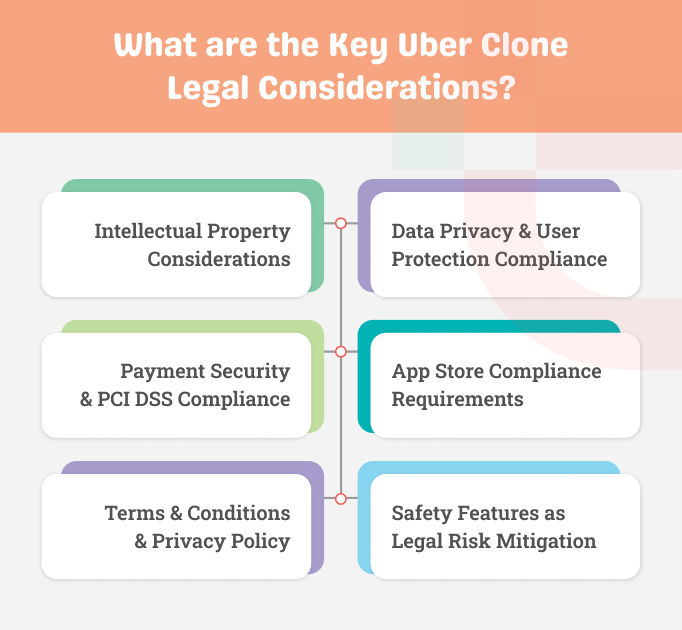
Uber clone legal requirements involve several factors that impact platform ownership, app store approvals, user data protection, and future scalability. Let’s have a detailed understanding of each area.
1) Intellectual Property Considerations
Intellectual Property Rights (IPR) determine who legally owns the ride-hailing platform, branding assets, and source code. Purchasing a solution does not automatically grant full ownership.
Many vendors provide only limited-use licenses. This creates restrictions on platform customization, resale rights, and future fundraising activities. That’s why it is essential to verify platform ownership before choosing the vendor.
If your IP ownership is unclear or disputed, it can halt your operations and even lead to severe financial liabilities if an infringement is claimed.
IP Considerations Include:
- Do not use competitor brand names like Uber or Lyft or any registered ride-hailing trademark in your app, domain, or marketing, as it can trigger serious trademark infringement claims.
- Run a thorough trademark clearance search before finalizing your brand name. This will help you verify whether another company owns similar names or logos in your target market.
- Confirm that the features embedded in the platform are not patented and that they were built without copying Uber’s protected technology.
- Review all the open-source components and third-party libraries used within the platform architecture. Because many components have their own licensing terms, using them incorrectly in the product can pose legal liability.
- Ensure that your chosen vendor provides a full IP assignment and not just a license. A complete IP assignment gives full control over the codebase, which matters for fundraising and expansion.
2) Ensure Data Privacy and User Protection Compliance
The platform will process sensitive information of users like identity documents, payment details, live location, and trip history. That’s why it becomes essential to comply with data privacy standards. Weak privacy controls can result in regulatory penalties, security breaches, and loss of customer trust.
Each country has its own privacy law. For instance, on-demand taxi businesses must comply with the GDPR (General Data Protection Regulation) to operate in Europe. Non-compliance can result in a heavy fine of €20 million or 4% of your annual global turnover.
CCPA (California Consumer Privacy Act) governs platforms operating in California. DPDP Act (Digital Personal Data Protection) in India, the LGPD (Lei Geral de Proteção de Dados Pessoais) in Brazil, and the UAE’s PDPL each impose jurisdiction-specific obligations that differ in scope, consent requirements, and penalty structures.
Data Privacy and User Protection Compliance Include:
- Location data carries the highest risk since it reveals where the users live, work, and travel. So, ensure that it is encrypted during processing to prevent data exposure risks.
- The platform should have workflows related to data deletion and account removal that allow users to request permanent removal of their personal information when needed.
- Maintain audit logs that track administrative activities, data modifications, and internal access for future compliance reviews.
- Inclusion of a consent management system is essential to clearly inform users what information the platform will collect and how it will process that data.
3) Ensure Payment Security and PCI DSS Compliance
PCI DSS (Payment Card Industry Data Security Standard) applies to every platform that processes, stores, or transmits cardholder data. Ride-hailing platforms involve a large number of digital transactions through cards and wallets. As a result, it is necessary for them to comply with PCI DSS.
In case you do not adhere to this regulation and any breaching activity occurs, the platform can be permanently disqualified from processing card transactions. Raw card data must never be stored on your own servers.
Legal Considerations for Payment Security Include:
- Use pre-certified payment gateways like Stripe, PayU, Braintree, and Razorpay instead of building unsecured custom payment processors.
- Implement tokenization technology that replaces sensitive card details with encrypted tokens during transaction processing.
- Enable 3D Secure authentication to reduce fraud liability on the platform.
- Involve KYC verification to validate identity documents, payout eligibility, and banking details during driver onboarding.
- Regions like the UAE, UK, and Singapore mandate integrating AML (Anti-Money Laundering) monitoring systems in the platform to track and detect suspicious financial activities.
Expert Tip
While choosing, confirm that the payment gateways integrated match your target market’s compliant processors because legal requirements for payments vary significantly across different markets. A platform built for the US market may not work properly for Southeast Asia or the Middle East regions.
4) Consider App Store Compliance Requirements
The approval of the platform on app stores depends heavily on how well it complies with their policies and privacy requirements. Both the Google Play Store and the Apple App Store have strict regulations for ride-hailing solutions.
Apple App Store requires
- Justification for background location access and
- In-app payment processes must comply with their own commission structure.
Google Play Store requires
- An accurate declaration of sensitive permissions required by the app for location, camera, and contact access.
- Moreover, if your app involves digital wallets or payment-related policies, then it is necessary for it to fulfill its financial services policies.
App Store and Play Store Compliance Requirements include:
- You will have to submit the rider and driver apps as separate applications in both stores, as they require different permissions.
- Publish a live and accessible privacy Policy URL before submitting the application to either store.
5) Draft Legally Sound Terms & Conditions and Privacy Policy
The Terms and Conditions and Privacy Policy are the legal foundation of the platform. They will define the responsibilities of riders and drivers, surge-pricing disclosures, data-usage terms, and cancellation/refund policies. Without proper legal documentation, the platform gets exposed to liabilities during user disputes and regulatory investigations.
Terms & Conditions and Privacy Policy Include:
- Clearly define whether the platform will operate as an intermediary connecting riders with nearby drivers or a direct service provider, as liability exposure changes accordingly for both.
- Do not copy Terms and Conditions from other platforms, as legal obligations differ across all regions and business structures.
- Make Privacy Policy accessible during the user registration process so they get aware of the data practices before onboarding.
Expert Tip
Partner with local legal counsel to review your T&C and Privacy Policy every time you enter a new market. Get them verified even if you are only changing the language because legal obligations vary by jurisdiction.
6) Platform Safety Features as Legal Risk Mitigation
Safety features in the platform not only protect riders and drivers but also protect your business from legal liabilities. Applications that launch without them risk facing regulatory penalties and carrying full liability for unwanted incidents.
Legal Considerations for Platform Safety Features Include:
- Several markets like the US, UK, and India mandate safety features like the SOS button, real-time GPS tracking, and in-app ride sharing for ride-hailing platforms.
- Authenticate drivers with a photo verification process during login sessions to reduce the risks of account sharing and impersonation.
- The platform must have background verification checks, insurance validation, and vehicle inspection uploads for proper criminal history validation and authentication during driver onboarding.
- Store incident logs, complaint resolution trails, and driver ratings as audit-ready records for future investigations or compliance reviews.
Elluminati’s Ready-made App Like Uber is Built for Compliance-Ready Taxi Businesses
Legal Mistakes You Must Avoid When Launching
Even well-designed taxi platforms can face legal disputes, app store rejections, and operational delays. It’s not because of the faulty technology, but it’s the result of negligence in platform compliance. Here are the critical mistakes that you should avoid when launching an Uber like app.
Using Uber’s Name or Branding in Any Form
Many businesses use the “Uber” word in their domain, app name, and marketing campaigns to improve discoverability. However, directly referencing Uber in branding can put it in trademark conflict. Even repeatedly promoting the platform as an “Uber like app” without a proper disclaimer also poses legal risks.
Treating Compliance as a Post-Launch Task
Many businesses think of platform compliance as a secondary task that can be done after launch. As a result, they have to face legal consequences like app store rejections, GDPR violations, and payment processing issues during the launch phase itself.
Choosing a Software Vendor Without Evaluating IP and Compliance
The vendor choice is where most legal risk originates. Purchasing a ready-made platform without verifying its source code originality and compliance capabilities can create legal risk. Because some vendors provide only limited software licenses instead of complete IP ownership. This would affect future fundraising and scalability.
Launching Without Jurisdiction-Specific Legal Documents
Terms and Conditions and Privacy Policy vary according to the type of operations, regional laws, and data handling practices. For instance, markets like Europe, Brazil, and India have specific data protection policies that a generic policy cannot match. In such scenarios, copying them to other platforms can pose legal concerns.
How to Ensure Uber Clone Compliance from Day One?
If you are considering starting a taxi business, then you should plan for platform-level compliance during the initial stage and not after deployment. Below are the three practices you should follow to ensure Uber clone compliance from day one.
Work with Legal Experts
Legal requirements for an Uber like app vary by countries and sometimes even cities. So, instead of relying solely on the software vendor, partner with expert legal advisors who have familiarity with privacy regulations, digital platform laws, and on-demand transportation technology.
Also, businesses operating in GDPR-regulated markets should consult with data protection professionals before collecting or processing user information.
Choose a Compliance-Ready Solution
Not every pre-built platform is built with compliance in mind. Therefore, look for platforms having PCI DSS-ready payment gateway integrations, built-in privacy workflows, consent management systems, and app store compliance support. Also, verify with your chosen vendor whether the solution has already passed app store approval processes successfully.
Stay Updated with Regulatory Changes
Compliance requirements continue to evolve with time. For instance, India passed the Digital Personal Data Protection (DPDP) rules in November 2025.
Also in late 2025, the EU’s GDPR law saw major updates, which laid emphasis on streamlining enforcement of cross-border cases and faster investigations.
In addition, on April 15 2026, Google Play updated its privacy rules, in which app developers have to request only essential data from users and also use Google’s own privacy-focused tools like contact picker and photo picker wherever possible.
That’s why you should monitor these changes regularly because the platform’s maintenance cycle and technology updates directly impact its compliance readiness.
You can even subscribe to regulatory update services relevant to your target market to keep the platform updated always.
Are You Planning to Launch a Ride-Hailing Platform? Connect with Elluminati for Compliance-Ready Uber Clone Built for Smooth Market Launch
How Elluminati Helps You Build a Compliance-Ready App Like Uber?
Uber clone legal considerations go beyond basic documentation and launch approvals. They include compliance across intellectual property, data privacy laws, payment security, and operational safety. Entrepreneurs who treat platform-level legal compliance as a prerequisite rather than an afterthought launch platforms that scale effectively and build user trust faster.
If you are considering launching your ride-hailing business with a legally compliant app like Uber, the Elluminati becomes an effective partner. With 14+ years of experience in serving 450+ ride-hailing businesses globally, we have built a white-label Uber clone that is designed with GDPR readiness, PCI DSS-compatible payment integrations, and app store compliance requirements in mind from the ground up.
Besides platform development, we also provide a detailed understanding of compliance requirements in specific markets to ensure no platform-related legal issues can pause any business growth.
FAQs
Yes, it is legal to launch an Uber clone if it is built with original source code and branding. The term is usually used by on-demand app development companies to market their white-label solution, which has similar functionality to that of Uber. And functional similarity does not create issues. Legal problems arise when copying trademarks, copyrighted interface designs, brand identities, and source code.
The following are the compliance aspects for an app similar to Uber:
- Intellectual Property Rights (IPR)
- Data privacy and user protection
- Payment security
- App store compliance
- Proper Terms and Conditions and Privacy Policy
- Platform safety features
You should evaluate the country and the city-specific laws for an Uber like ready-made app, to ensure compliance. For this:
- Identify the data privacy regulations by market. Regulations vary by region. For instance, GDPR rules in Europe, CCPA (California Consumer Privacy Act) in the US, and DPDP (Digital Personal Data Protection) Act in India.
- Ensure payment security with PCI DSS gateway compliance
- Create jurisdiction-specific Terms and Conditions
- Partner with an experienced local legal counsel for better knowledge of each law and ensure proper platform compliance.
While it is legal to build a platform with similar functionality like ride bookings, smart dispatch, real-time tracking, and digital payments, you cannot directly copy Uber’s branding elements, interface design, source code, or proprietary assets.