
Key Takeaways (or TL;DR)
- Kenya’s taxi app opportunity is distributed across cars, tuk-tuks, and boda bodas.
- Car-based taxi operators can face strong competition in Nairobi and Mombasa with the presence of several major players like Uber, Bolt, Yego, Farasi Cabs, and Little Ride.
- Kenyan cities and coastal areas like Kisumu, Eldoret, Malindi, Nakuru, and Diani hold opportunities for taxi businesses and remain underserved by established ride-hailing platforms.
- Legal requirements for cars, tuk-tuks, and boda boda taxis differ, and operators must follow them to avoid legal hurdles.
- Operators who ignore regulatory requirements face launch delays, financial penalties, and license suspension.
Taxi app opportunities in Kenya extend beyond conventional car-based ride-hailing. Tuk-tuks and boda bodas have a large share of daily riders but still remain largely undigitized. Most rides are still hailed on the streets, and fares are negotiated on the spot.
That gap is where the opportunity sits. This guide is for fleet owners, tuk-tuk operators, boda boda taxi businesses, and investors evaluating the Kenya market. It highlights the opportunities existing for each vehicle type, legal requirements, and underserved cities.
Kenya’s Ride-Hailing Market: Where do Taxi App Opportunities Stand Today?
Kenya’s ride-hailing market is growing rapidly, and several factors, like increasing urbanization and improved internet connectivity, are contributing to this development. The data below highlights this.
- According to a report by The Star, the number of ride-hailing users is expected to rise to 9.03 million by 2030, with user penetration increasing from 13.9% in 2025 to 14.3% in 2030.
- The same report states that the average revenue per user is forecast at $7.07.
- In 2025, transportation and storage became the second-largest sector in Kenya’s economy after agriculture, generating KSh 2.08 trillion, which is equal to 11.8% of Kenya’s GDP.
- Nairobi accounts for 90% of Kenya’s ride-hailing market share, according to a 2026 TIFA Research study.
- According to the Communications Authority of Kenya, mobile money penetration reached 98% of the population by December 2025. The active subscriptions were 51.36 million, up from 48.6 million three months earlier.
- Bolt Kenya & Ipsos Gig Economy Report found that 53% of the surveyed Kenyan ride-hailing drivers consider the platform their primary source of income.
These figures show that Kenyans are already familiar with the ride-hailing apps and use them regularly. Most Kenyans also use mobile money for everyday transactions. So, new taxi apps entering this market do not have to convince people to adopt them.
Regulatory Requirements in Kenya for Ride-Hailing Businesses
| Requirement | Cars | Tuk-Tuks | Boda Bodas |
|---|---|---|---|
| TNC Licensing |
NTSA-issued TNC license |
Separate the three-wheeled motorcycle rules |
Separate motorcycle rules |
| Vehicle-Specific Requirements |
Insurance, roadworthiness certificate, and a maximum age of 16 years old |
Third-party PSV insurance, covered body, yellow band, seat belts |
Insurance, licensing, PSV badge, protective equipment |
| Company Registration |
✓ |
✓ |
✓ |
| Driver Documents |
PSV badge + valid driving license |
Driving licence |
Driving license |
| Commission |
Negotiation-based, as long as the 18% commission cap is suspended |
Outside TNC rules |
Outside TNC rules |
| Data Protection |
✓ |
✓ |
✓ |
| Driver Operating Hours |
Maximum 8 working hours followed by 4 hours off |
Separate rules |
Separate rules |
Before launching a taxi app in Kenya, you must meet the requirements set by the National Transport and Safety Authority (NTSA) for licensing, driver authorization, vehicle compliance, insurance, and platform obligations.
Licensing
Your company must register as a Transport Network Company (TNC) with NTSA before starting operations. The license is valid for one year and must be renewed annually. The current cost for a license application and renewal is Sh100,000 per company.
Vehicle Compliance
Each vehicle operating in your taxi business must have valid insurance and a certificate of roadworthiness. Also, none of them should be more than 16 years old from their date of manufacture.
Company Requirements
Your company must be legally registered in Kenya, have a registered office in Kenya, and comply with tax regulations. You should also have signed agreements with vehicle owners and drivers. Without these documents, you cannot onboard any driver or fleet owner on the platform.
Driver Documents
Drivers operating in your taxi business must have a Public Service Vehicle (PSV) badge and a valid driving license.
Commission Cap
Kenya’s 2022 regulations set an 18% commission cap per trip, but on September 2, 2026, Kenya’s High Court suspended its enforcement for 12 months. During this time, commissions will be set through negotiations between drivers and the operators.
Commission is one of many ways to generate revenue for taxi apps that is consistent and grows as your booking volume grows. That’s why you should consider the current state of this rule when deciding the commission structures in Kenya.
Data Protection
Since your taxi company will collect and store users’ personal information like name, phone number, and location, you need to register it with the Office of the Data Protection Commissioner as either a data controller or a data processor. NTSA will not provide a license until this requirement is fulfilled.
Driver’s Operating Hours
A driver providing ride-hailing services cannot work for more than eight continuous hours within a 24-hour period. After reaching that limit, the driver must log out of the platform for at least 4 consecutive hours before driving again.
Motorcycle (Boda Boda) Taxi Regulations
Kenya’s TNC regulations do not cover motorcycles. So, boda boda taxi operators fall under separate motorcycle licensing rules, which require operator registration, insurance, licensing, protective equipment, and a PSV badge.
Tuk-Tuk (Three-Wheeled Motorcycle) Taxi Requirements
Tuk-tuks are also excluded from the TNC regulations. They fall under Kenya’s three-wheeled motorcycle regulations, which require seat belts for the rider and the driver, a covered body, a prescribed yellow band, and third-party public service vehicle insurance.
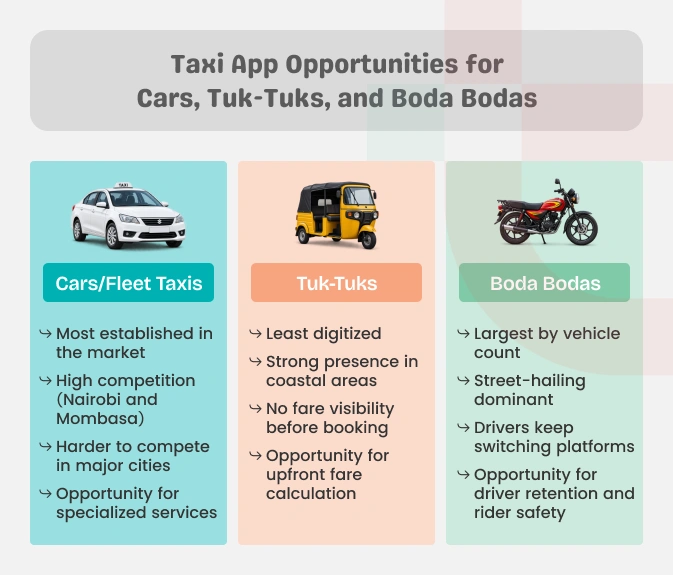
Opportunities for Cars, Tuk-Tuks, and Boda Boda in Kenya
Kenya’s app-based taxi market involves different opportunities for cars, tuk-tuks, and boda bodas. You should choose the vehicle type based on your target market and budget.
Car Taxis
Kenya’s car-based ride-hailing market is the most crowded, with several established players including Uber, Bolt, Yego, Farasi Cabs, and Little Ride. However, opportunities still exist for new operators in this category.
Instead of competing with them on general ride-hailing services, you can focus on a specific service segment or a particular city.
For instance, Hava has been operating since 2022 by focusing its services on Nairobi rather than expanding nationally. Also, An Nisa Taxi offers its taxi services exclusively for women and children and uses only female drivers.
If you are considering this model, starting with an Uber clone can help you launch quickly without building the core infrastructure from the ground up.
Boda Boda Taxis
This is the largest of the three categories by vehicle count and economic footprint, with more than 2 million licensed riders contributing over Sh660 billion annually, which is equal to 4.4% of Kenya’s GDP.
Despite this scale, no single app has been able to dominate this category the way Uber and Bolt do in car-based ride-hailing. This is because most boda boda rides are still hailed on the street. Moreover, drivers often switch to whichever platforms pay better.
You can compete by building a strong driver base with driver retention strategies like lower commissions, faster payouts, and 24/7 support. You can also build rider trust by embedding safety features in taxi apps like SOS buttons and live trip sharing.
Tuk-Tuk Taxis
Tuk-tuks cover most of the local transport on Kenya’s coast, along with cars and boda bodas.
However, it is the least digitized of the three categories. Most tuk-tuk rides in Kenya do not have fixed fares. The driver and rider agree on a price before each trip, and it can be different every time.
This creates an opportunity to launch app-based tuk-tuk booking services, where riders are connected with nearby drivers and fares are calculated upfront based on distance. Transparent pricing is also one of many effective ways to retain riders long-term.
In August 2026, Bolt added a tuk-tuk service category in its Mombasa taxi app.
What Do All Three Taxi App Opportunities in Kenya Require in Common?
Cars, boda bodas, and tuk-tuks serve different transport needs, but they have a few common requirements like payment methods, category-specific regulatory compliance, and multi-vehicle management.
M-Pesa Payment Integration
On-demand taxi apps depend on mobile money besides cash payments. In Kenya, M-Pesa is the dominant mobile money processor and the default payment option for most riders and drivers. It runs through Safaricom’s Daraja API, which lets your app accept payments online, send payouts to drivers, and track transactions in real time.
This integration supports payments across multiple vehicle categories, which eliminates the need to build separate processors for each one.
Single Platform for Multiple Vehicle Categories
Modern taxi platforms support multiple vehicle types, including cars, boda bodas, and tuk-tuks, through the same rider app, driver pool, admin panel, and dispatch system. So, you can start with one category first and later expand to others without rebuilding the technology from scratch.
A white-label taxi platform provides this technology foundation. It lets you configure fare rules, document requirements, and vehicle capacity limits for each vehicle type from a single admin panel.
Regulatory Compliance
Legal requirements for cars, tuk-tuks, and boda bodas differ in Kenya. Cars operate under NTSA regulations, while motorcycles and three-wheeled vehicles have different needs. In such scenarios, a platform built to support regulations for multiple vehicle categories lets you handle different legal requirements from one system.
Underserved Regions in Kenya Beyond Nairobi and Mombasa
Nairobi and Mombasa have strong opportunities for taxi apps in Kenya. Beyond these two, many mid-sized cities and coastal towns also offer good opportunities for businesses.
Kisumu
It is Kenya’s third-largest city, sitting on Lake Victoria, with its own international airport and steady business travel. Several major ride-hailing platforms like Little, Bolt, and Uber already operate here, but the city is still less contested compared to Nairobi, creating room for new businesses.
Eldoret
Eldoret received city status on August 15, 2024. It serves as an important commercial and agricultural center in western Kenya. Uber and Wasili are already operating in the city, which confirms demand for app-based transport. New operators can differentiate with specialized services like corporate transport and premium rides.
Malindi and Diani
These coastal towns of Kenya have well-established tuk-tuk activities. Moreover, one of the country’s first electric tuk-tuk pilots, the Atmosfair-backed Sunny Tuk-Tuk fleet, was launched in Diani. That makes these regions a strong fit for businesses considering launching app-based tuk-tuk taxi services.
Nakuru
It is one of Kenya’s fastest-growing urban centers in the Rift Valley and became Kenya’s fourth city in December 2021.
Wasili, a ride-hailing platform, built its business in Nakuru and other Rift Valley cities, and since then, it has been operating successfully in the region. A locally focused taxi app can establish a strong position by serving transport needs that national platforms overlook.
How Elluminati Can Help To Launch Your Own Ride-Hailing App
Kenya offers taxi app opportunities for different vehicle types, including cars, tuk-tuks, and boda bodas. But you do not have to build a technology platform for each vertical. A single taxi platform can support different service types, payment processors, and country-specific regulations.
If you are planning to launch taxi operations in Kenya, Elluminati becomes your reliable technology partner. With 14+ years of experience, our taxi app development company has helped 450+ mobility businesses across different countries.
Our solution supports multi-vehicle categories, smart dispatch, multiple payment options, and taxation for different countries, so you can launch faster without building from scratch.
FAQs
Kenya’s car-based taxi category is well established in Nairobi and Mombasa, with several major players in the market like Uber, Bolt, and other local players. But digital booking for tuk-tuks and boda bodas is in the development stage. Also, secondary cities like Kisumu, Eldoret, and Nakuru are less saturated regions.
Yes, you need to acquire an NTSA license to operate your own Transport Network Company (TNC) in Kenya.
Kenya’s 2022 TNC regulations apply a commission cap of 18% of the fare per trip for ride-hailing platforms. But Kenya’s High Court suspended its enforcement in September 2026 for 12 months. During this time, commissions are decided through negotiations between drivers and the platform operators.
No, although Mombasa is a major tuk-tuk market, several other Kenyan cities and coastal regions like Kisumu, Nakuru, Malindi, and Diani have app opportunities for three-wheeled taxis.
You can integrate M-Pesa into the taxi platform through Safaricom’s Daraja API directly or via a licensed payment aggregator. This integration allows riders to make online payments and also lets you process driver payouts and commission deductions directly in the app.
Boda-bodas and tuk-tuks have comparatively lower costs than cars. However, the right vehicle category depends on local demand, driver availability, and operating costs.